New Zealand Appliances Market Growth Rate Analysis (2025 - 2031)
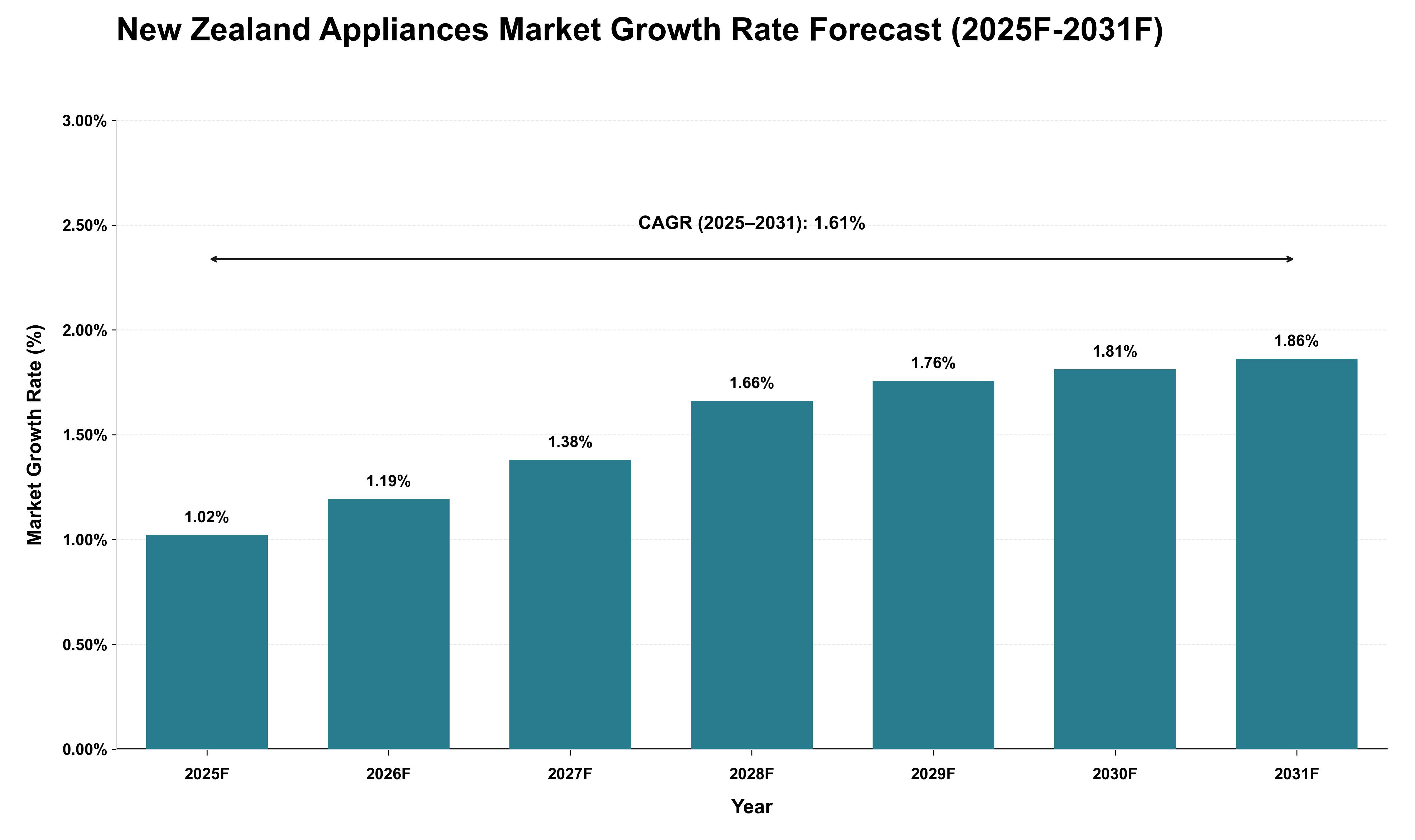
The projected growth trajectory for the New Zealand appliances market will exhibit a gradual acceleration, as indicated by the increasing annual growth rates from 1.02% in 2025 to 1.86% by 2031. This trend suggests a strengthening demand driven by evolving consumer preferences and potential enhancements in product innovation. Supply chain dynamics will play a critical role, particularly as global input costs fluctuate due to geopolitical tensions and trade policies affecting import dependencies. As manufacturers adapt to these challenges, they may implement cost-effective sourcing strategies and invest in local production capabilities, which could further influence pricing structures and availability of appliances. Additionally, cyclical trends in consumer spending are expected to align with broader economic recovery patterns, supporting sustained growth within this sector despite external pressures. The overall CAGR of 1.61% reflects these complex interactions between supply chain resilience and market demand evolution over the forecast period.
Key Highlights of the Report:
- New Zealand Appliances Market Outlook
- Market Size of New Zealand Appliances Market, 2025
- Forecast of New Zealand Appliances Market, 2032
- Historical Data and Forecast of New Zealand Appliances Revenues & Volume for the Period 2022 - 2032
- New Zealand Appliances Market Trend Evolution
- New Zealand Appliances Market Drivers and Challenges
- New Zealand Appliances Price Trends
- New Zealand Appliances Porter's Five Forces
- New Zealand Appliances Industry Life Cycle
- Historical Data and Forecast of New Zealand Appliances Market Revenues & Volume By Product for the Period 2022 - 2032
- Historical Data and Forecast of New Zealand Appliances Market Revenues & Volume By Home Appliances for the Period 2022 - 2032
- Historical Data and Forecast of New Zealand Appliances Market Revenues & Volume By Personal Care Appliances for the Period 2022 - 2032
- Historical Data and Forecast of New Zealand Appliances Market Revenues & Volume By Smartphones for the Period 2022 - 2032
- Historical Data and Forecast of New Zealand Appliances Market Revenues & Volume By Others for the Period 2022 - 2032
- New Zealand Appliances Import Export Trade Statistics
- Market Opportunity Assessment By Product
- New Zealand Appliances Top Companies Market Share
- New Zealand Appliances Competitive Benchmarking By Technical and Operational Parameters
- New Zealand Appliances Company Profiles
- New Zealand Appliances Key Strategic Recommendations






































