New Zealand Construction Plastics Market Top 5 Importing Countries and Market Competition (HHI) Analysis
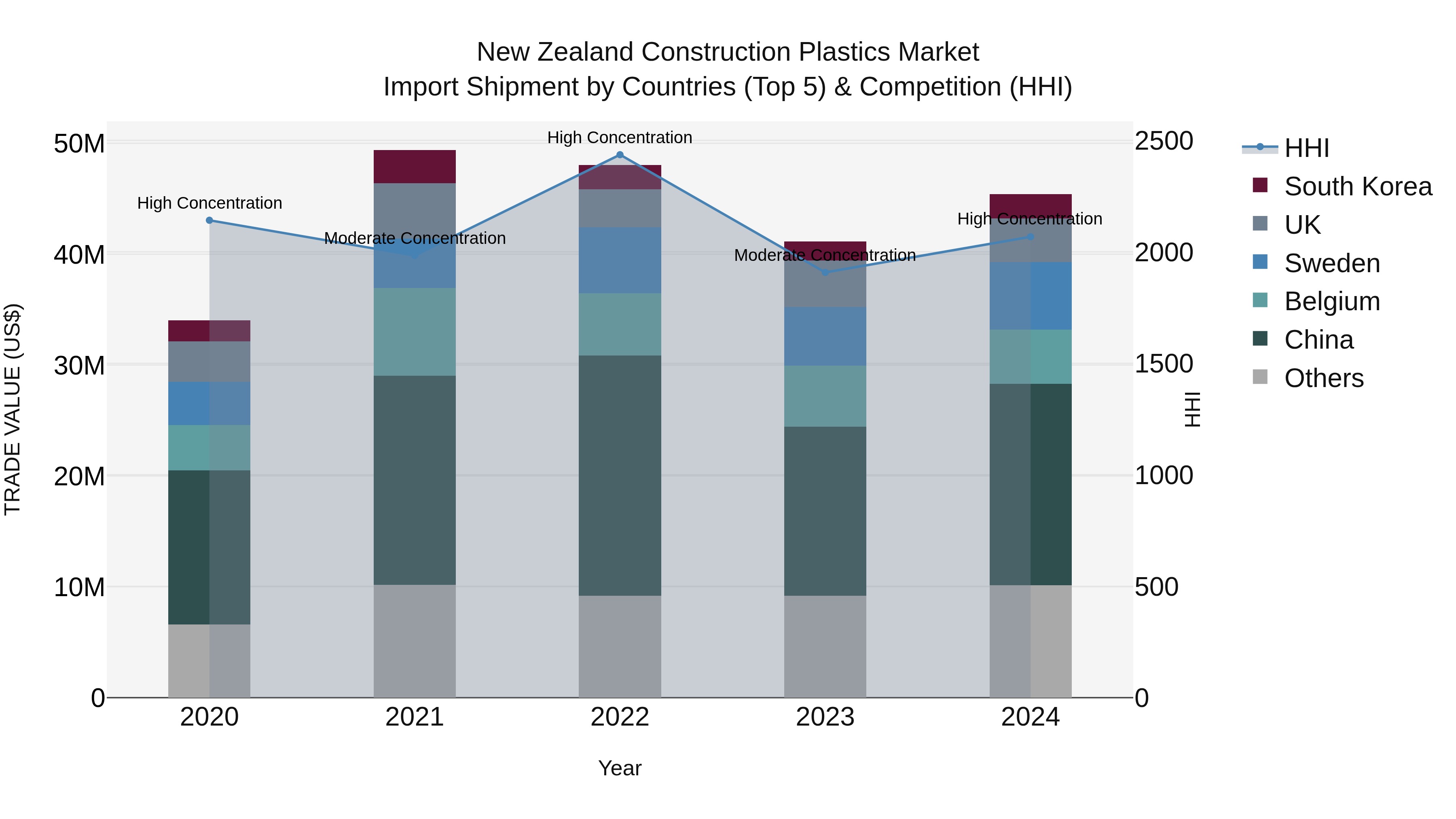
The New Zealand construction plastics import market saw a significant increase in concentration in 2024, with top exporters being China, Sweden, Belgium, UK, and Luxembourg. This shift towards high concentration signals a potential shift in market dynamics. The compound annual growth rate (CAGR) of 7.48% from 2020 to 2024 highlights steady growth in the market, with a notable growth rate of 10.33% from 2023 to 2024. These trends indicate a competitive landscape with opportunities for both local and international players to capitalize on the growing demand for construction plastics in New Zealand.
New Zealand Construction Plastics Market Overview
Plastics play a versatile role in the construction industry, offering lightweight, durable, and cost-effective solutions for various applications. In New Zealand, the construction plastics market is witnessing growth driven by trends such as modular construction, plastic piping systems, and insulation materials.
Drivers of the market
The construction plastics market in New Zealand is driven by the advantages plastics offer over traditional materials, such as durability, lightweight, and ease of installation. The growing preference for energy-efficient buildings boosts the use of plastics for insulation and fenestration applications. Moreover, innovations in plastic composites and the rising trend of modular construction contribute to market growth, providing versatile and cost-effective solutions for various construction needs.
Challenges of the market
In the New Zealand Construction Plastics Market, challenges stem from sustainability and waste management issues. Mitigating plastic pollution and promoting circular economy principles require innovative solutions and industry-wide collaboration. Moreover, ensuring plastics` structural integrity and longevity in construction applications while minimizing environmental impact presents ongoing challenges.
Government Policy of the market
Regulations in New Zealand address the construction plastics market to ensure the safety, performance, and environmental sustainability of plastic products used in construction. Policies may include requirements for recyclability, fire resistance, and chemical composition of construction plastics. Compliance with building regulations and environmental standards is necessary for plastic manufacturers and suppliers.
Key Highlights of the Report:
- New Zealand Construction Plastics Market Outlook
- Market Size of New Zealand Construction Plastics Market, 2024
- Forecast of New Zealand Construction Plastics Market, 2031
- Historical Data and Forecast of New Zealand Construction Plastics Revenues & Volume for the Period 2021-2031
- New Zealand Construction Plastics Market Trend Evolution
- New Zealand Construction Plastics Market Drivers and Challenges
- New Zealand Construction Plastics Price Trends
- New Zealand Construction Plastics Porter`s Five Forces
- New Zealand Construction Plastics Industry Life Cycle
- Historical Data and Forecast of New Zealand Construction Plastics Market Revenues & Volume By Type for the Period 2021-2031
- Historical Data and Forecast of New Zealand Construction Plastics Market Revenues & Volume By Pvc for the Period 2021-2031
- Historical Data and Forecast of New Zealand Construction Plastics Market Revenues & Volume By Polyurethane for the Period 2021-2031
- Historical Data and Forecast of New Zealand Construction Plastics Market Revenues & Volume By Polypropylene for the Period 2021-2031
- Historical Data and Forecast of New Zealand Construction Plastics Market Revenues & Volume By Polyethylene for the Period 2021-2031
- Historical Data and Forecast of New Zealand Construction Plastics Market Revenues & Volume By Application for the Period 2021-2031
- Historical Data and Forecast of New Zealand Construction Plastics Market Revenues & Volume By Window for the Period 2021-2031
- Historical Data and Forecast of New Zealand Construction Plastics Market Revenues & Volume By Roofing for the Period 2021-2031
- Historical Data and Forecast of New Zealand Construction Plastics Market Revenues & Volume By Flooring for the Period 2021-2031
- Historical Data and Forecast of New Zealand Construction Plastics Market Revenues & Volume By Insulation for the Period 2021-2031
- Historical Data and Forecast of New Zealand Construction Plastics Market Revenues & Volume By Piping for the Period 2021-2031
- New Zealand Construction Plastics Import Export Trade Statistics
- Market Opportunity Assessment By Type
- Market Opportunity Assessment By Application
- New Zealand Construction Plastics Top Companies Market Share
- New Zealand Construction Plastics Competitive Benchmarking By Technical and Operational Parameters
- New Zealand Construction Plastics Company Profiles
- New Zealand Construction Plastics Key Strategic Recommendations






































