New Zealand Electric Motor Market Year-wise Growth Rate (2021-2031F)
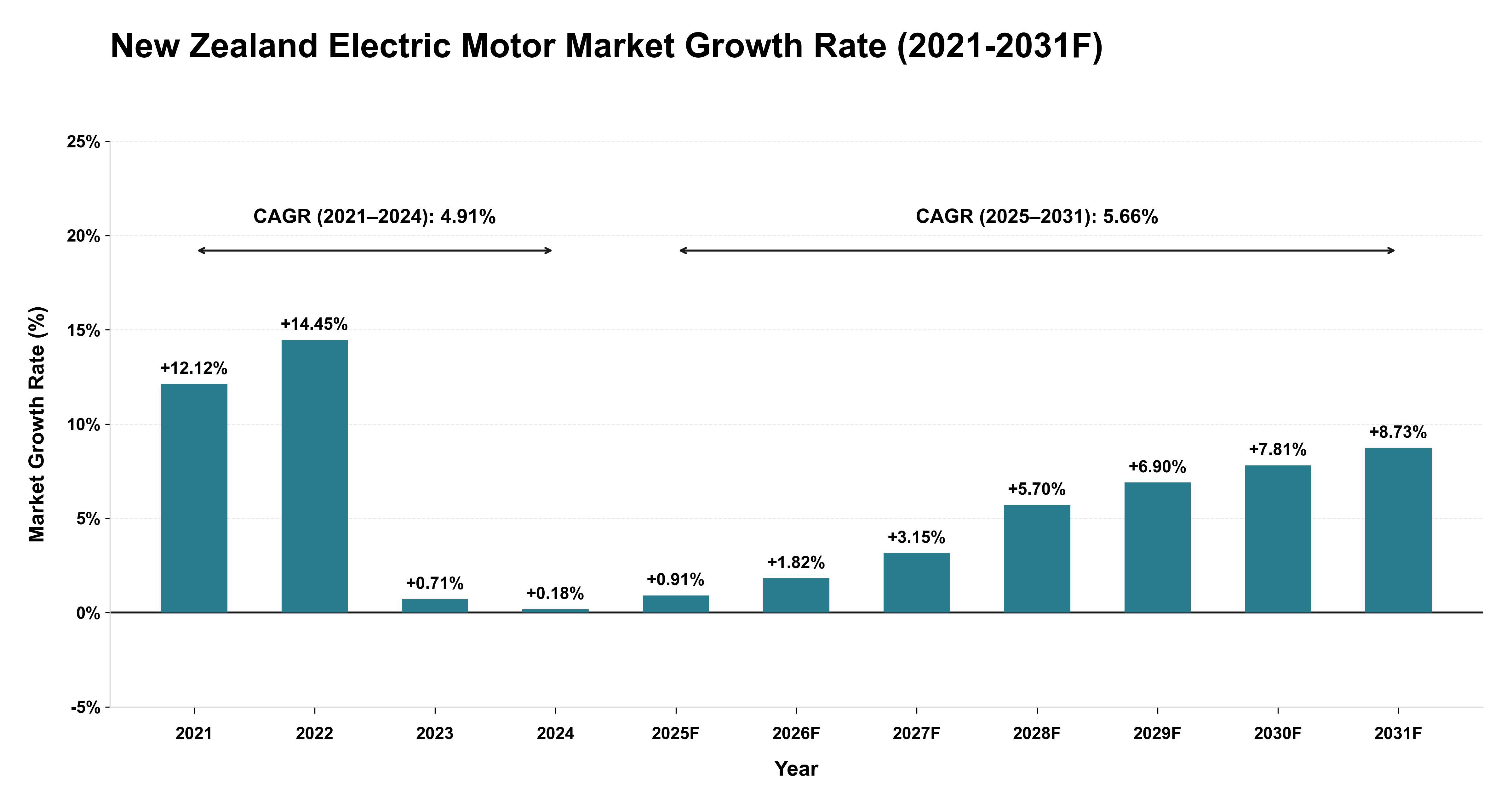
In the New Zealand Electric Motor Market, the period from 2021 to 2024 witnessed fluctuating growth rates, starting strong at 12.12% in 2021 and then experiencing a slowdown in 2023 and 2024 at 0.71% and 0.18%, respectively. These fluctuations could be attributed to initial market penetration, regulatory adjustments, and technological transitions impacting demand. Looking ahead to 2025-2031, an upward trend is forecasted with growth rates steadily increasing from 0.91% in 2025 to a robust 8.73% in 2031. This acceleration is likely driven by increased adoption of electric vehicles, renewable energy projects, and industrial automation initiatives that boost demand for electric motors across various sectors, indicating a positive outlook for the market's expansion fueled by sustainable energy transitions and technological advancements.
Key Highlights of the Report:
- New Zealand Electric Motor Market Outlook
- Market Size of New Zealand Electric Motor Market, 2024
- Forecast of New Zealand Electric Motor Market, 2031
- Historical Data and Forecast of New Zealand Electric Motor Revenues & Volume for the Period 2021-2031
- New Zealand Electric Motor Market Trend Evolution
- New Zealand Electric Motor Market Drivers and Challenges
- New Zealand Electric Motor Price Trends
- New Zealand Electric Motor Porter`s Five Forces
- New Zealand Electric Motor Industry Life Cycle
- Historical Data and Forecast of New Zealand Electric Motor Market Revenues & Volume By Motor Type for the Period 2021-2031
- Historical Data and Forecast of New Zealand Electric Motor Market Revenues & Volume By Alternate Current (AC) Motor for the Period 2021-2031
- Historical Data and Forecast of New Zealand Electric Motor Market Revenues & Volume By Direct Current (DC) Motor for the Period 2021-2031
- Historical Data and Forecast of New Zealand Electric Motor Market Revenues & Volume By Hermetic Motor for the Period 2021-2031
- Historical Data and Forecast of New Zealand Electric Motor Market Revenues & Volume By Output Power for the Period 2021-2031
- Historical Data and Forecast of New Zealand Electric Motor Market Revenues & Volume By Voltage Range for the Period 2021-2031
- Historical Data and Forecast of New Zealand Electric Motor Market Revenues & Volume By 9 V & Below for the Period 2021-2031
- Historical Data and Forecast of New Zealand Electric Motor Market Revenues & Volume By 10-20 V for the Period 2021-2031
- Historical Data and Forecast of New Zealand Electric Motor Market Revenues & Volume By 21-60 V for the Period 2021-2031
- Historical Data and Forecast of New Zealand Electric Motor Market Revenues & Volume By 60 V & Above for the Period 2021-2031
- Historical Data and Forecast of New Zealand Electric Motor Market Revenues & Volume By Application for the Period 2021-2031
- Historical Data and Forecast of New Zealand Electric Motor Market Revenues & Volume By Industrial machinery for the Period 2021-2031
- Historical Data and Forecast of New Zealand Electric Motor Market Revenues & Volume By Motor vehicles for the Period 2021-2031
- Historical Data and Forecast of New Zealand Electric Motor Market Revenues & Volume By Heating, ventilating, and cooling (HVAC) equipment for the Period 2021-2031
- Historical Data and Forecast of New Zealand Electric Motor Market Revenues & Volume By Aerospace & transportation for the Period 2021-2031
- Historical Data and Forecast of New Zealand Electric Motor Market Revenues & Volume By Household appliances for the Period 2021-2031
- Historical Data and Forecast of New Zealand Electric Motor Market Revenues & Volume By Other for the Period 2021-2031
- Historical Data and Forecast of New Zealand Electric Motor Market Revenues & Volume By Speed (RPM) for the Period 2021-2031
- Historical Data and Forecast of New Zealand Electric Motor Market Revenues & Volume By Low-Speed Electric Motors (Less Than 1,000 RPM) for the Period 2021-2031
- Historical Data and Forecast of New Zealand Electric Motor Market Revenues & Volume By Medium-Speed Electric Motors (1,001-25,000 RPM) for the Period 2021-2031
- Historical Data and Forecast of New Zealand Electric Motor Market Revenues & Volume By High-Speed Electric Motors (25,001-75,000 RPM) for the Period 2021-2031
- Historical Data and Forecast of New Zealand Electric Motor Market Revenues & Volume By Ultrahigh-Speed Electric Motors (Greater Than 75,001 RPM) for the Period 2021-2031
- New Zealand Electric Motor Import Export Trade Statistics
- Market Opportunity Assessment By Motor Type
- Market Opportunity Assessment By Output Power
- Market Opportunity Assessment By Voltage Range
- Market Opportunity Assessment By Application
- Market Opportunity Assessment By Speed (RPM)
- New Zealand Electric Motor Top Companies Market Share
- New Zealand Electric Motor Competitive Benchmarking By Technical and Operational Parameters
- New Zealand Electric Motor Company Profiles
- New Zealand Electric Motor Key Strategic Recommendations






































