New Zealand Fruit Market Year-wise Growth Rate (2021-2031F)
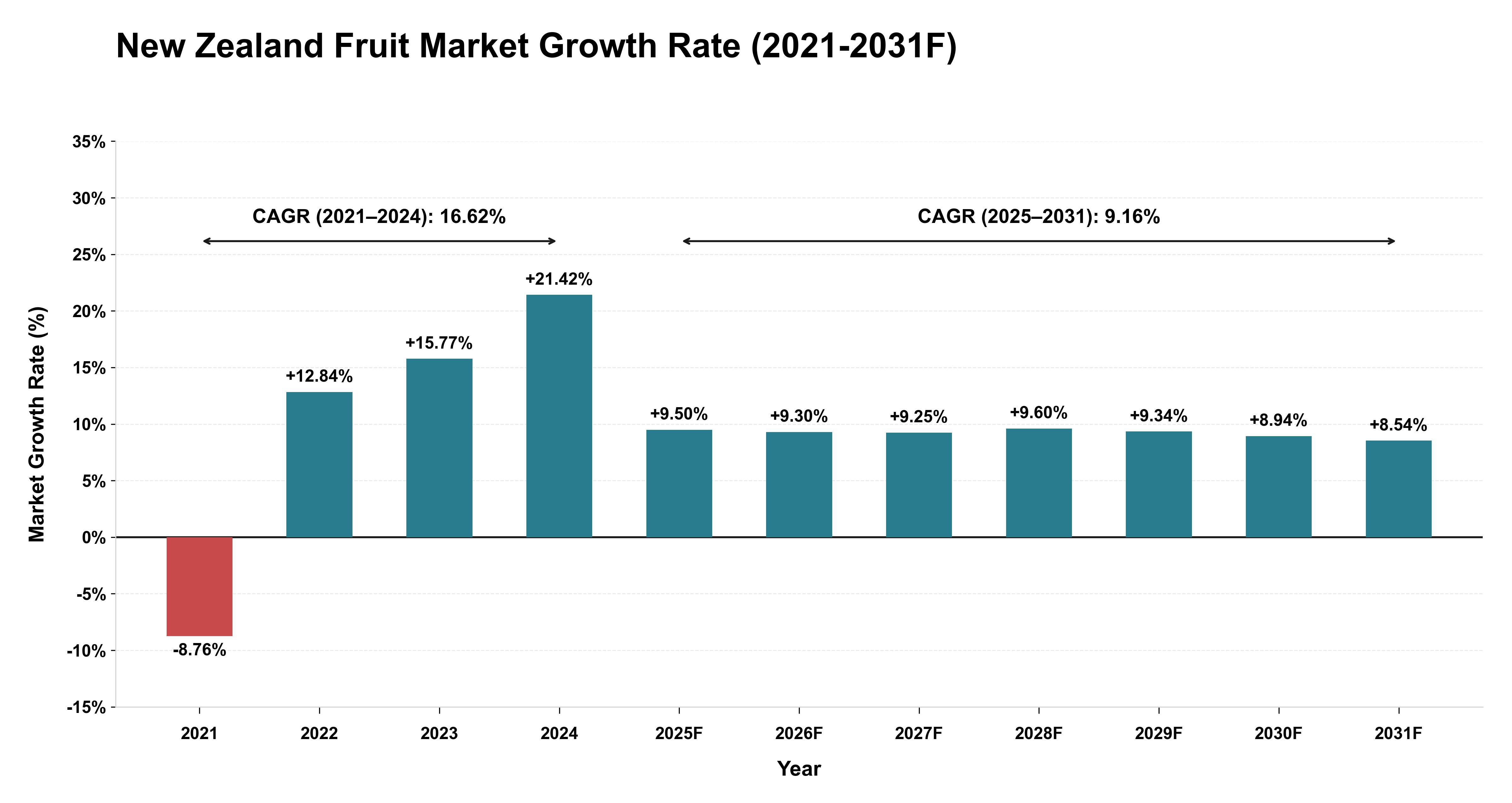
The New Zealand Fruit Market witnessed a turbulent period from 2021 to 2024, marked by a sharp decline in growth of -8.76% in 2021, followed by a significant recovery with growth rates of 12.84%, 15.77%, and 21.42% in the subsequent years. This erratic trajectory can be attributed to supply chain disruptions, weather fluctuations affecting harvests, and shifting consumer preferences towards healthier eating habits. Looking ahead to the forecast period of 2025-2031, the market is expected to stabilize with a more moderate CAGR of 9.16%. This deceleration reflects a maturing industry, where demand for New Zealand fruits remains steady but at a more sustainable pace as the market adjusts to the post-pandemic landscape and focuses on enhancing product quality and sustainability practices to meet evolving consumer expectations.
Key Highlights of the Report:
- New Zealand Fruit Market Outlook
- Market Size of New Zealand Fruit Market, 2025
- Forecast of New Zealand Fruit Market, 2032
- Historical Data and Forecast of New Zealand Fruit Revenues & Volume for the Period 2022 - 2032F
- New Zealand Fruit Market Trend Evolution
- New Zealand Fruit Market Drivers and Challenges
- New Zealand Fruit Price Trends
- New Zealand Fruit Porter`s Five Forces
- New Zealand Fruit Industry Life Cycle
- Historical Data and Forecast of New Zealand Fruit Market Revenues & Volume By Applications for the Period 2022 - 2032F
- Historical Data and Forecast of New Zealand Fruit Market Revenues & Volume By Supermarkets and Hypermarkets for the Period 2022 - 2032F
- Historical Data and Forecast of New Zealand Fruit Market Revenues & Volume By Specialty Stores for the Period 2022 - 2032F
- Historical Data and Forecast of New Zealand Fruit Market Revenues & Volume By Online for the Period 2022 - 2032F
- Historical Data and Forecast of New Zealand Fruit Market Revenues & Volume By Type for the Period 2022 - 2032F
- Historical Data and Forecast of New Zealand Fruit Market Revenues & Volume By Fresh for the Period 2022 - 2032F
- Historical Data and Forecast of New Zealand Fruit Market Revenues & Volume By Dried for the Period 2022 - 2032F
- Historical Data and Forecast of New Zealand Fruit Market Revenues & Volume By Frozen for the Period 2022 - 2032F
- Historical Data and Forecast of New Zealand Fruit Market Revenues & Volume By Others for the Period 2022 - 2032F
- New Zealand Fruit Import Export Trade Statistics
- Market Opportunity Assessment By Applications
- Market Opportunity Assessment By Type
- New Zealand Fruit Top Companies Market Share
- New Zealand Fruit Competitive Benchmarking By Technical and Operational Parameters
- New Zealand Fruit Company Profiles
- New Zealand Fruit Key Strategic Recommendations






































