New Zealand Kefir Market Top 5 Importing Countries and Market Competition (HHI) Analysis
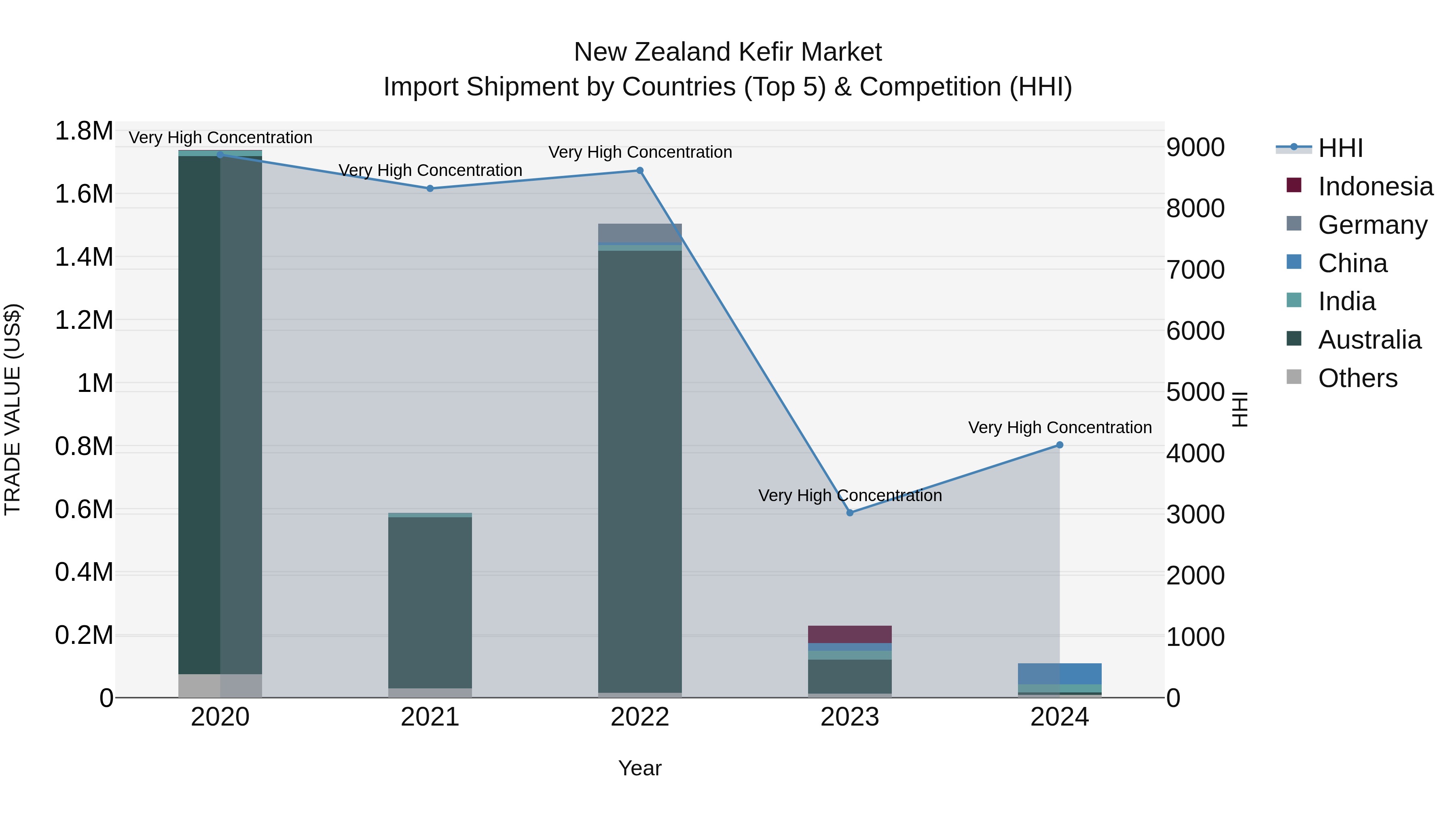
Despite a significant decrease in the Compound Annual Growth Rate (CAGR) from 2020 to 2024, New Zealand continues to import kefir primarily from China, India, Netherlands, Australia, and Iran. The High Herfindahl-Hirschman Index (HHI) indicates a highly concentrated market in 2024. The negative growth rate in 2023-24 suggests a challenging market environment for kefir imports, which could be influenced by various factors such as changing consumer preferences or supply chain disruptions. Monitoring these trends and understanding the dynamics of the market will be crucial for stakeholders in the kefir import industry in New Zealand.
New Zealand Kefir Market Overview
The kefir market in New Zealand is expanding as more consumers discover its health benefits, including probiotic properties. This fermented milk drink is gaining popularity in health food stores and supermarkets.
Drivers of the market
The demand for kefir in New Zealand is driven by the growing consumer interest in probiotic and functional foods. Kefir, a fermented dairy product, is known for its health benefits, including improved digestion and immune system support. The increasing awareness of gut health and the trend towards natural and healthy beverages propel the market. Additionally, the availability of flavored and plant-based kefir products caters to a wider consumer base, further driving demand.
Challenges of the market
Despite the growing consumer interest in probiotic-rich foods, the Kefir market in New Zealand confronts challenges related to limited awareness and distribution. Educating consumers about the health benefits of Kefir and expanding its availability beyond niche health stores could be pivotal for market expansion. Additionally, ensuring product quality and freshness poses ongoing challenges for manufacturers and retailers.
Government Policy of the market
Regulations ensuring food safety and quality standards impact the kefir market. Government support for the dairy industry and health-promoting food products fosters market expansion.
Key Highlights of the Report:
- New Zealand Kefir Market Outlook
- Market Size of New Zealand Kefir Market, 2024
- Forecast of New Zealand Kefir Market, 2031
- Historical Data and Forecast of New Zealand Kefir Revenues & Volume for the Period 2021-2031
- New Zealand Kefir Market Trend Evolution
- New Zealand Kefir Market Drivers and Challenges
- New Zealand Kefir Price Trends
- New Zealand Kefir Porter`s Five Forces
- New Zealand Kefir Industry Life Cycle
- Historical Data and Forecast of New Zealand Kefir Market Revenues & Volume By Nature for the Period 2021-2031
- Historical Data and Forecast of New Zealand Kefir Market Revenues & Volume By Organicfor the Period 2021-2031
- Historical Data and Forecast of New Zealand Kefir Market Revenues & Volume By Conventional for the Period 2021-2031
- Historical Data and Forecast of New Zealand Kefir Market Revenues & Volume By Product Types for the Period 2021-2031
- Historical Data and Forecast of New Zealand Kefir Market Revenues & Volume By Flavoredfor the Period 2021-2031
- Historical Data and Forecast of New Zealand Kefir Market Revenues & Volume By Unflavoredfor the Period 2021-2031
- Historical Data and Forecast of New Zealand Kefir Market Revenues & Volume By Applications for the Period 2021-2031
- Historical Data and Forecast of New Zealand Kefir Market Revenues & Volume By Foods and beverages for the Period 2021-2031
- Historical Data and Forecast of New Zealand Kefir Market Revenues & Volume By Pharmaceutical for the Period 2021-2031
- Historical Data and Forecast of New Zealand Kefir Market Revenues & Volume By Source for the Period 2021-2031
- Historical Data and Forecast of New Zealand Kefir Market Revenues & Volume By Animal milkfor the Period 2021-2031
- Historical Data and Forecast of New Zealand Kefir Market Revenues & Volume By Soy milkfor the Period 2021-2031
- Historical Data and Forecast of New Zealand Kefir Market Revenues & Volume By Coconut milk for the Period 2021-2031
- Historical Data and Forecast of New Zealand Kefir Market Revenues & Volume By Others for the Period 2021-2031
- New Zealand Kefir Import Export Trade Statistics
- Market Opportunity Assessment By Nature
- Market Opportunity Assessment By Product Types
- Market Opportunity Assessment By Applications
- Market Opportunity Assessment By Source
- New Zealand Kefir Top Companies Market Share
- New Zealand Kefir Competitive Benchmarking By Technical and Operational Parameters
- New Zealand Kefir Company Profiles
- New Zealand Kefir Key Strategic Recommendations






































