New Zealand Wax Market Top 5 Importing Countries and Market Competition (HHI) Analysis
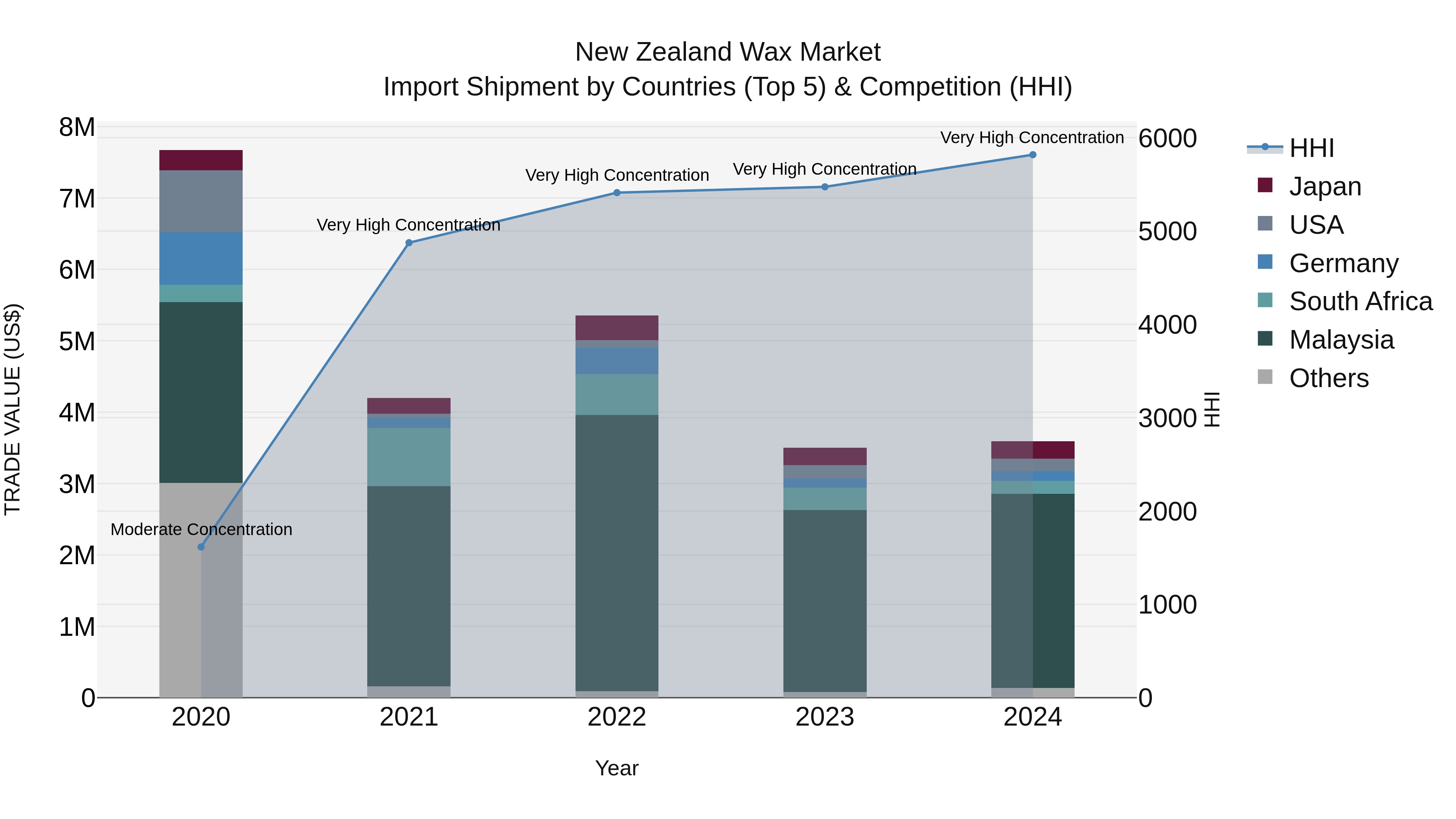
New Zealand`s wax import market in 2024 continued to showcase a high level of concentration, with top exporting countries being Malaysia, Japan, South Africa, USA, and Germany. Despite a negative compound annual growth rate (CAGR) of -17.26% from 2020 to 2024, there was a slight improvement in the growth rate from 2023 to 2024 at 2.65%. This data indicates a potential shift in the market dynamics and highlights the importance of monitoring trends and opportunities for the wax import industry in New Zealand.
New Zealand Wax Market Overview
The wax market in New Zealand encompasses various types of waxes, including natural waxes like beeswax and petroleum-derived waxes like paraffin wax. Waxes find applications in industries such as cosmetics, pharmaceuticals, and food packaging, driving demand in the market.
Drivers of the market
The wax market in New Zealand is driven by diverse applications across industries such as packaging, cosmetics, and pharmaceuticals. Increasing demand for natural waxes in cosmetic products and industrial applications fuels market growth. Moreover, the growing preference for sustainable and bio-based raw materials contributes to the expansion of the wax market.
Challenges of the market
Ensuring consistent quality and supply of waxes for various industrial applications presents a challenge in the New Zealand wax market. Addressing concerns related to raw material availability, processing efficiency, and environmental sustainability is essential for market competitiveness.
Government Policy of the market
Government policies in the wax market may focus on regulating wax production processes, ensuring product quality and safety, and promoting sustainable sourcing practices. This could include standards for wax purity, guidelines for waste management in wax manufacturing, and support for research on bio-based waxes.
Key Highlights of the Report:
- New Zealand Wax Market Outlook
- Market Size of New Zealand Wax Market, 2024
- Forecast of New Zealand Wax Market, 2031
- Historical Data and Forecast of New Zealand Wax Revenues & Volume for the Period 2021-2031
- New Zealand Wax Market Trend Evolution
- New Zealand Wax Market Drivers and Challenges
- New Zealand Wax Price Trends
- New Zealand Wax Porter`s Five Forces
- New Zealand Wax Industry Life Cycle
- Historical Data and Forecast of New Zealand Wax Market Revenues & Volume By Product for the Period 2021-2031
- Historical Data and Forecast of New Zealand Wax Market Revenues & Volume By Mineral for the Period 2021-2031
- Historical Data and Forecast of New Zealand Wax Market Revenues & Volume By Synthetic for the Period 2021-2031
- Historical Data and Forecast of New Zealand Wax Market Revenues & Volume By Natural for the Period 2021-2031
- Historical Data and Forecast of New Zealand Wax Market Revenues & Volume By Applications for the Period 2021-2031
- Historical Data and Forecast of New Zealand Wax Market Revenues & Volume By Candles for the Period 2021-2031
- Historical Data and Forecast of New Zealand Wax Market Revenues & Volume By Packaging for the Period 2021-2031
- Historical Data and Forecast of New Zealand Wax Market Revenues & Volume By Plastic & Rubber for the Period 2021-2031
- Historical Data and Forecast of New Zealand Wax Market Revenues & Volume By Cosmetics & Toiletries for the Period 2021-2031
- Historical Data and Forecast of New Zealand Wax Market Revenues & Volume By Fire Logs for the Period 2021-2031
- Historical Data and Forecast of New Zealand Wax Market Revenues & Volume By Adhesives for the Period 2021-2031
- Historical Data and Forecast of New Zealand Wax Market Revenues & Volume By Others for the Period 2021-2031
- New Zealand Wax Import Export Trade Statistics
- Market Opportunity Assessment By Product
- Market Opportunity Assessment By Applications
- New Zealand Wax Top Companies Market Share
- New Zealand Wax Competitive Benchmarking By Technical and Operational Parameters
- New Zealand Wax Company Profiles
- New Zealand Wax Key Strategic Recommendations






































