Nigeria Ascorbic Acid Market Size, Share & Growth Rate
The Nigeria Ascorbic Acid Market was estimated at USD 267 Million in 2025 and is projected to reach USD 374 Million by 2032, growing at a CAGR of 4.9% from 2026 to 2032. This growth is primarily fueled by rising health consciousness among consumers, particularly in the wake of the COVID-19 pandemic. The demand for vitamin C fortified products across food, beverage, and pharmaceutical sectors is expected to enhance market opportunities significantly.
Nigeria Ascorbic Acid Market Year-wise Growth Rate and Key Drivers
This graph highlights how the Nigeria Ascorbic Acid Market has steadily grown over the years, supported by major growth factors.
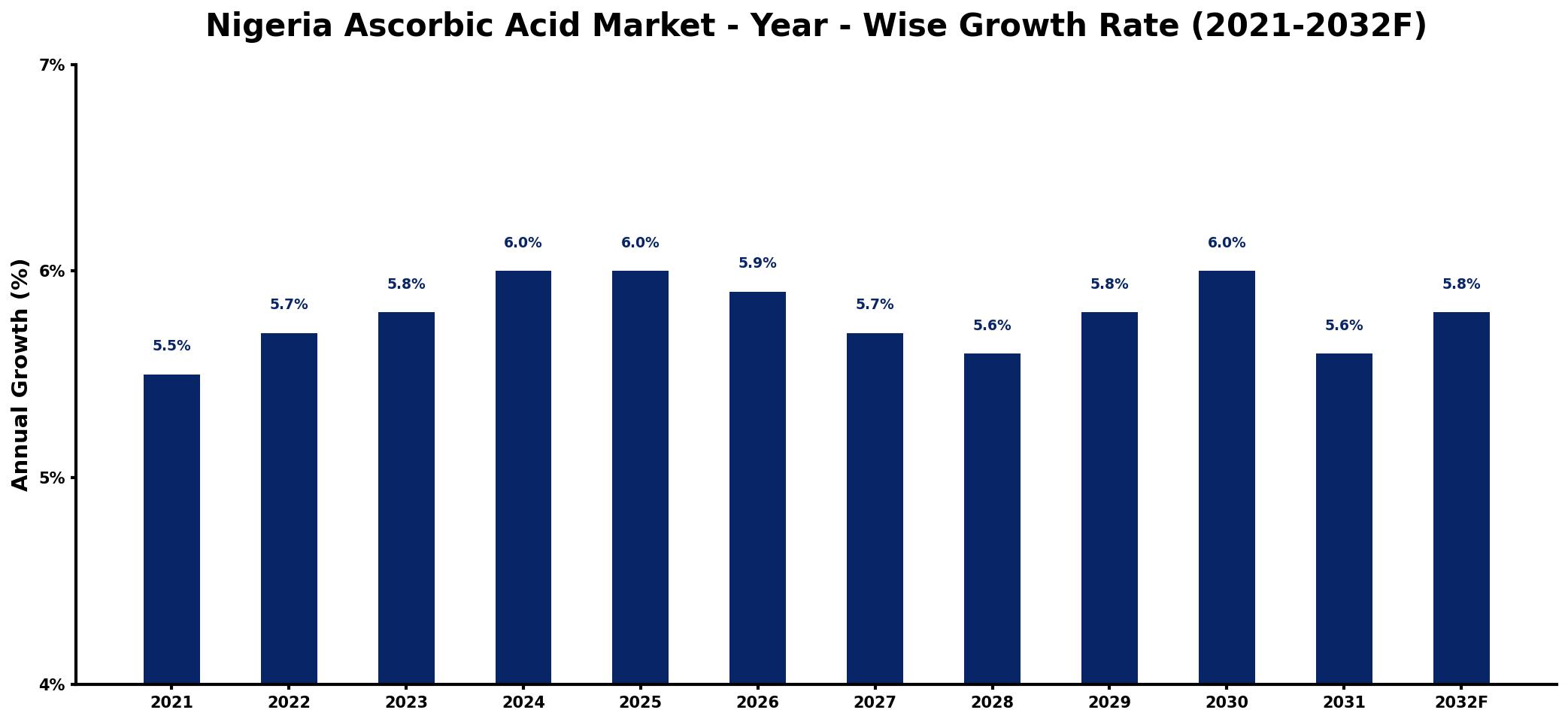
The table below presents the year‑wise growth rates along with the key drivers influencing the market
| Year | Growth Rate | Major Drivers |
| 2021 | 5.5% | Rising health awareness among consumers |
| 2022 | 5.7% | Growing demand for dietary supplements |
| 2023 | 5.8% | Increased investment in nutraceuticals |
| 2024 | 6.0% | Expansion of health food stores |
| 2025 | 6.0% | Higher consumer spending on wellness |
| 2026 | 5.9% | Emergence of online retail platforms |
| 2027 | 5.7% | Surge in functional food offerings |
| 2028 | 5.6% | Strengthening of distribution networks |
| 2029 | 5.8% | Development of innovative product formulations |
| 2030 | 6.0% | Growing popularity of natural ingredients |
| 2031 | 5.6% | Increase in health-focused marketing campaigns |
| 2032 | 5.8% | Rising demand for organic products |
Note: Market size estimations and growth projections presented in this report are based on 6Wresearch's proprietary forecasting methodology, utilizing the latest available industry data, government publications, and primary research inputs.
Nigeria Ascorbic Acid Market Synopsis
The increasing awareness of the health benefits associated with ascorbic acid is the most significant driving force currently shaping the Nigeria Ascorbic Acid Market. As consumers become more health-conscious, the demand for products enriched with vitamin C continues to escalate, particularly within the food and beverage sector.
Moreover, the pharmaceutical industry is increasingly leveraging ascorbic acid in various medicinal formulations, which is further propelling market growth. This evolving landscape presents opportunities for manufacturers and suppliers to innovate and expand their product offerings in line with consumer demands.
Nigeria Ascorbic Acid Market Key Takeaways
- The Nigeria Ascorbic Acid market is characterized by increasing consumer awareness of health benefits.
- The food and beverage sector is a major contributor to the rising demand for ascorbic acid.
- Local production initiatives are being encouraged to reduce dependence on imports.
- Challenges remain due to inconsistent product quality and counterfeit goods.
- Investment opportunities abound in manufacturing and product innovation.
Evaluation of Restraints in Nigeria Ascorbic Acid Market
While the Nigeria Ascorbic Acid Market holds significant promise, it faces several challenges that could impede its growth trajectory. Chief among these is the inconsistent quality of products, which is compounded by a lack of rigorous quality control measures. This not only affects consumer trust but also creates an environment ripe for counterfeit goods. Moreover, fluctuating raw material prices and a reliance on imports can destabilize market conditions, making it imperative for stakeholders to develop strategies that enhance local production capabilities and ensure quality assurance.
Nigeria Ascorbic Acid Market Trends
The demand for ascorbic acid is currently driven by health trends, with consumers increasingly opting for fortified food and beverages. Innovations in product development are being seen, particularly in health supplements and functional foods. Additionally, as awareness around immunity-boosting ingredients grows, ascorbic acid's role in the wellness sector continues to expand. Digital marketing and e-commerce platforms are also increasingly being utilized to reach a broader audience, further enhancing market dynamics.
Nigeria Ascorbic Acid Market Opportunities
The Nigeria Ascorbic Acid market is ripe with investment opportunities. The expanding pharmaceutical sector and the growing food and beverage industries are significant avenues for investors. Focused investments in manufacturing could cater to rising demand, while research and development can lead to innovative products tailored for specific markets. Furthermore, enhancing consumer awareness about the benefits of ascorbic acid could open new channels for market expansion.
Government Initiatives in the Nigeria Ascorbic Acid Market
The Nigerian government has implemented regulatory policies aimed at enhancing the quality and safety of ascorbic acid products. The National Agency for Food and Drug Administration and Control (NAFDAC) plays a crucial role in overseeing the registration and quality control processes. In addition, the Standards Organization of Nigeria (SON) enforces quality standards to protect consumers and encourage fair trade practices. To bolster domestic production, the government is promoting initiatives that support local manufacturers, ultimately aiming to reduce reliance on imports.
Future Insights of the Nigeria Ascorbic Acid Market
Looking ahead to 2026-2032, the Nigeria Ascorbic Acid market is expected to witness sustained growth driven by ongoing health trends and a robust food and beverage sector. Government initiatives aimed at fostering local production are likely to further support market expansion. Additionally, as consumers continue to prioritize health and wellness, the demand for high-quality ascorbic acid products is projected to increase. This period could also see an upsurge in innovative applications for ascorbic acid across various industries.
Nigeria Ascorbic Acid Market Latest Developments (2025 - 2026)
In recent months, the Nigeria Ascorbic Acid market has observed an increasing number of manufacturers focusing on quality improvement and compliance with regulatory standards. Efforts are being made to enhance consumer awareness of vitamin C benefits through strategic marketing campaigns. Additionally, partnerships between local producers and international suppliers are being explored to improve supply chain efficiencies and product offerings, setting the stage for a more robust market.
Nigeria Ascorbic Acid Market - Key Attractiveness of the Report
- 10 Years of Market Numbers
- Historical Data Starting from 2022 to 2025
- Base Year: 2025
- Forecast Data until 2032
- Key Performance Indicators Impacting the Market
- Major Upcoming Developments and Projects
Key Highlights of the Report:
- Nigeria Ascorbic Acid Market Outlook
- Market Size of Nigeria Ascorbic Acid Market, 2025
- Forecast of Nigeria Ascorbic Acid Market, 2032
- Historical Data and Forecast of Nigeria Ascorbic Acid Revenues & Volume for the Period 2022-2032F
- Nigeria Ascorbic Acid Market Trend Evolution
- Nigeria Ascorbic Acid Market Drivers and Challenges
- Nigeria Ascorbic Acid Price Trends
- Nigeria Ascorbic Acid Porter's Five Forces
- Nigeria Ascorbic Acid Industry Life Cycle
- Historical Data and Forecast of Nigeria Ascorbic Acid Market Revenues & Volume By Grade for the Period 2022-2032F
- Historical Data and Forecast of Nigeria Ascorbic Acid Market Revenues & Volume By Food & Pharmaceutical for the Period 2022-2032F
- Historical Data and Forecast of Nigeria Ascorbic Acid Market Revenues & Volume By Industrial for the Period 2022-2032F
- Historical Data and Forecast of Nigeria Ascorbic Acid Market Revenues & Volume By Application for the Period 2022-2032F
- Historical Data and Forecast of Nigeria Ascorbic Acid Market Revenues & Volume By Food & Beverages for the Period 2022-2032F
- Historical Data and Forecast of Nigeria Ascorbic Acid Market Revenues & Volume By Pharmaceutical for the Period 2022-2032F
- Historical Data and Forecast of Nigeria Ascorbic Acid Market Revenues & Volume By Cosmetics for the Period 2022-2032F
- Historical Data and Forecast of Nigeria Ascorbic Acid Market Revenues & Volume By Chemicals for the Period 2022-2032F
- Historical Data and Forecast of Nigeria Ascorbic Acid Market Revenues & Volume By Agriculture for the Period 2022-2032F
- Historical Data and Forecast of Nigeria Ascorbic Acid Market Revenues & Volume By Others for the Period 2022-2032F
- Nigeria Ascorbic Acid Import Export Trade Statistics
- Market Opportunity Assessment By Grade
- Market Opportunity Assessment By Application
- Nigeria Ascorbic Acid Top Companies Market Share
- Nigeria Ascorbic Acid Competitive Benchmarking By Technical and Operational Parameters
- Nigeria Ascorbic Acid Company Profiles
- Nigeria Ascorbic Acid Key Strategic Recommendations






































