Nigeria Automotive Lighting Market Top 5 Importing Countries and Market Competition (HHI) Analysis
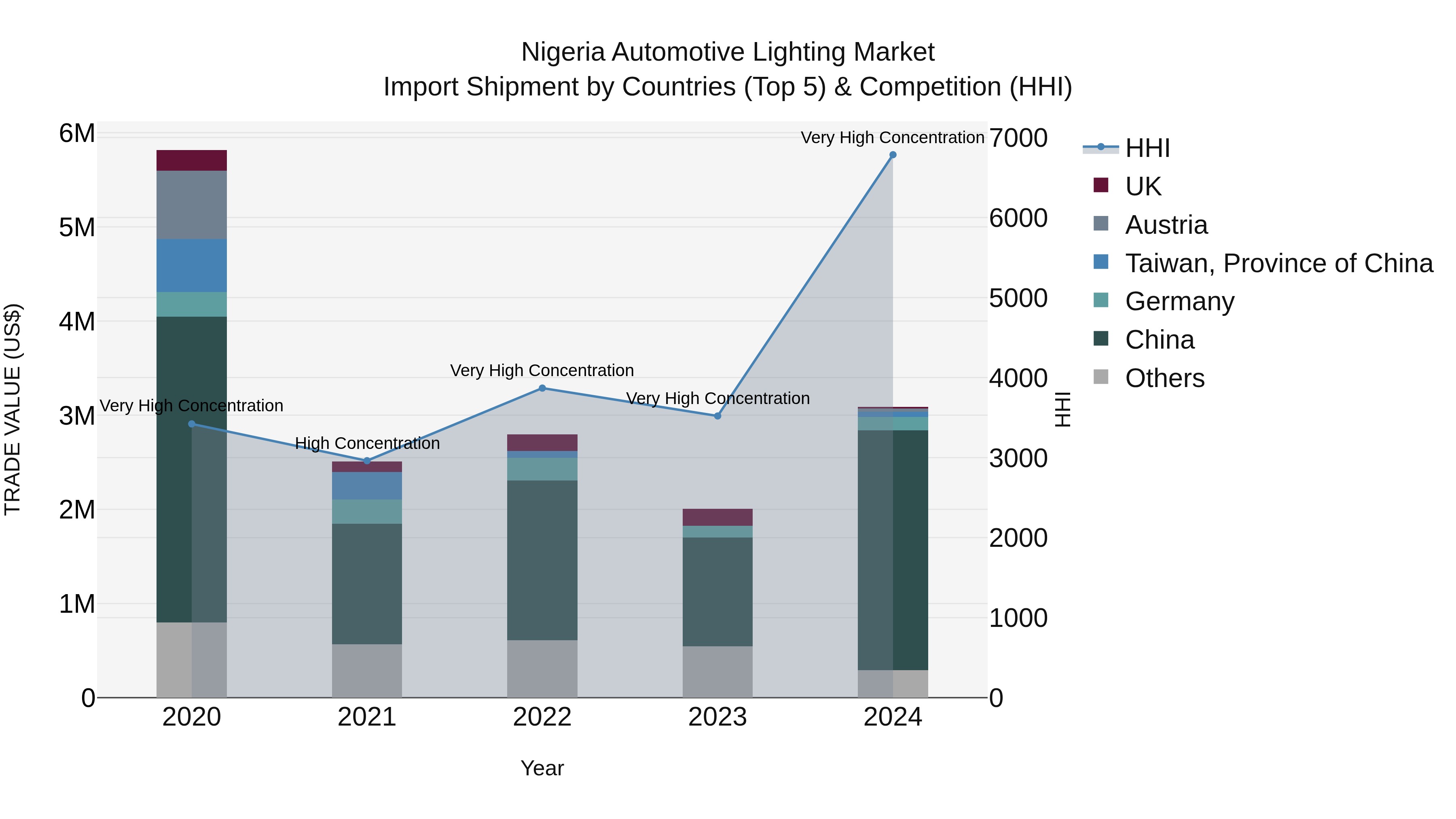
In 2024, Nigeria continued to rely on imports for automotive lighting, with top exporters being China, Germany, Egypt, Taiwan, and the USA. The high Herfindahl-Hirschman Index (HHI) indicates a market dominated by a few key players. Despite a negative compound annual growth rate (CAGR) from 2020-2024, the industry saw a significant upturn in 2024 with a growth rate of 54.13% over the previous year. This suggests a potential shift or surge in demand for automotive lighting products in Nigeria, presenting opportunities for both domestic and international suppliers to capitalize on this momentum.
Nigeria Automotive Lighting Market Overview
The Nigeria Automotive Lighting Market is experiencing steady growth driven by factors such as the increasing demand for vehicles, infrastructure development, and rising safety awareness. The market is primarily dominated by traditional lighting technologies like halogen and incandescent bulbs, but there is a growing shift towards LED lighting due to its energy efficiency and longer lifespan. The demand for advanced lighting features such as adaptive headlights, daytime running lights, and fog lights is also on the rise, particularly in premium vehicle segments. Government regulations mandating the use of certain lighting technologies for safety reasons are also influencing market growth. Key players in the Nigeria Automotive Lighting Market include Osram, Philips, Hella, and Valeo, among others, who are focusing on product innovation and strategic partnerships to gain a competitive edge in the market.
Nigeria Automotive Lighting Market Trends
The Nigeria Automotive Lighting Market is witnessing a shift towards energy-efficient and eco-friendly LED lighting solutions, driven by the government`s initiatives to promote sustainability and reduce carbon emissions. LED technology is gaining popularity due to its longer lifespan, better visibility, and lower energy consumption compared to traditional lighting options. Additionally, there is a growing demand for advanced lighting features such as adaptive headlights and ambient lighting in luxury vehicles. The market is also seeing increasing adoption of smart lighting systems that can adjust brightness and color temperature based on driving conditions. With a focus on safety, aesthetics, and sustainability, the Nigeria Automotive Lighting Market is expected to continue its growth trajectory in the coming years.
Nigeria Automotive Lighting Market Challenges
The Nigeria Automotive Lighting Market faces several challenges, including the presence of counterfeit products, inadequate enforcement of regulations, and the high cost of genuine lighting products. Counterfeit products not only affect the revenues of legitimate manufacturers but also pose safety risks to consumers due to their substandard quality. The lack of strict enforcement of regulations allows these counterfeit products to thrive in the market, further exacerbating the problem. Additionally, the high cost of genuine lighting products can deter price-sensitive consumers from purchasing them, leading to a preference for cheaper, counterfeit alternatives. Addressing these challenges will require a concerted effort from industry stakeholders, regulatory bodies, and the government to ensure the availability of safe and affordable automotive lighting products in Nigeria.
Nigeria Automotive Lighting Market Investment Opportunities
The Nigeria Automotive Lighting Market presents several investment opportunities due to the increasing demand for automotive vehicles in the country. With a growing middle-class population and improving economic conditions, there is a rising need for high-quality automotive lighting products to enhance safety and aesthetics. Investing in the manufacturing or distribution of LED headlights, taillights, fog lights, and interior lighting systems can be lucrative. Additionally, there is a growing trend towards energy-efficient lighting solutions in the automotive sector, creating opportunities for investors to introduce innovative and sustainable lighting products. Collaborating with local automotive manufacturers or aftermarket retailers can also provide avenues for market entry and expansion in the Nigeria Automotive Lighting Market.
Nigeria Automotive Lighting Market Government Policy
The Nigerian government has implemented policies aimed at promoting local production and assembly of automotive lighting products to boost the domestic automotive industry. These policies include import tariffs and restrictions on fully assembled vehicles to incentivize local manufacturing and assembly. Additionally, the National Automotive Industry Development Plan (NAIDP) provides incentives such as tax breaks, reduced import duties on completely knocked down (CKD) kits, and support for local content development. The Automotive Industry Policy Bill seeks to further enhance the local automotive sector by promoting investments, technology transfer, and innovation. Overall, these government policies are geared towards developing a sustainable automotive lighting market in Nigeria and fostering economic growth in the sector.
Nigeria Automotive Lighting Market Future Outlook
The Nigeria Automotive Lighting Market is expected to witness significant growth in the coming years, driven by factors such as increasing vehicle production, rising demand for advanced lighting technologies, and the growing focus on vehicle safety and aesthetics. With the country`s expanding middle-class population and improving economic conditions, there is a growing preference for newer vehicles equipped with advanced lighting systems. Additionally, government regulations mandating the use of energy-efficient lighting solutions in vehicles are expected to further boost market growth. As automotive manufacturers increasingly prioritize the integration of advanced lighting technologies to enhance vehicle performance and safety, the Nigeria Automotive Lighting Market is likely to experience steady growth and innovation in the foreseeable future.
Key Highlights of the Report:
- Nigeria Automotive Lighting Market Outlook
- Market Size of Nigeria Automotive Lighting Market, 2021
- Forecast of Nigeria Automotive Lighting Market, 2031
- Historical Data and Forecast of Nigeria Automotive Lighting Revenues & Volume for the Period 2021 - 2031
- Nigeria Automotive Lighting Market Trend Evolution
- Nigeria Automotive Lighting Market Drivers and Challenges
- Nigeria Automotive Lighting Price Trends
- Nigeria Automotive Lighting Porter's Five Forces
- Nigeria Automotive Lighting Industry Life Cycle
- Historical Data and Forecast of Nigeria Automotive Lighting Market Revenues & Volume By Vehicle Type for the Period 2021 - 2031
- Historical Data and Forecast of Nigeria Automotive Lighting Market Revenues & Volume By Passenger Vehicle for the Period 2021 - 2031
- Historical Data and Forecast of Nigeria Automotive Lighting Market Revenues & Volume By Commercial Vehicle for the Period 2021 - 2031
- Historical Data and Forecast of Nigeria Automotive Lighting Market Revenues & Volume By Technology for the Period 2021 - 2031
- Historical Data and Forecast of Nigeria Automotive Lighting Market Revenues & Volume By Halogen for the Period 2021 - 2031
- Historical Data and Forecast of Nigeria Automotive Lighting Market Revenues & Volume By Xenon/HID (High-intensity Discharge Lamp) for the Period 2021 - 2031
- Historical Data and Forecast of Nigeria Automotive Lighting Market Revenues & Volume By LED (Light Emitting Diode) for the Period 2021 - 2031
- Historical Data and Forecast of Nigeria Automotive Lighting Market Revenues & Volume By Application for the Period 2021 - 2031
- Historical Data and Forecast of Nigeria Automotive Lighting Market Revenues & Volume By Front/Headlamps for the Period 2021 - 2031
- Historical Data and Forecast of Nigeria Automotive Lighting Market Revenues & Volume By Rear Lighting for the Period 2021 - 2031
- Historical Data and Forecast of Nigeria Automotive Lighting Market Revenues & Volume By Side for the Period 2021 - 2031
- Historical Data and Forecast of Nigeria Automotive Lighting Market Revenues & Volume By Interior Lighting for the Period 2021 - 2031
- Nigeria Automotive Lighting Import Export Trade Statistics
- Market Opportunity Assessment By Vehicle Type
- Market Opportunity Assessment By Technology
- Market Opportunity Assessment By Application
- Nigeria Automotive Lighting Top Companies Market Share
- Nigeria Automotive Lighting Competitive Benchmarking By Technical and Operational Parameters
- Nigeria Automotive Lighting Company Profiles
- Nigeria Automotive Lighting Key Strategic Recommendations






































