Nigeria Aviation Market Size, Share & Growth Rate
The Nigeria Aviation Market was estimated at USD 1479 Million in 2025 and is projected to reach USD 2131 Million by 2032, growing at a CAGR of 5.4% from 2026 to 2032. This growth trajectory is largely fueled by the nations expanding economy and increasing urbanization, which collectively elevate demand for air travel. The rising middle class is also playing a pivotal role, contributing to higher disposable incomes that enable more Nigerians to opt for air travel as a preferred mode of transportation.
Nigeria Aviation Market Year-wise Growth Rate and Key Drivers
This graph highlights how the Nigeria Aviation Market has steadily grown over the years, supported by major growth factors.
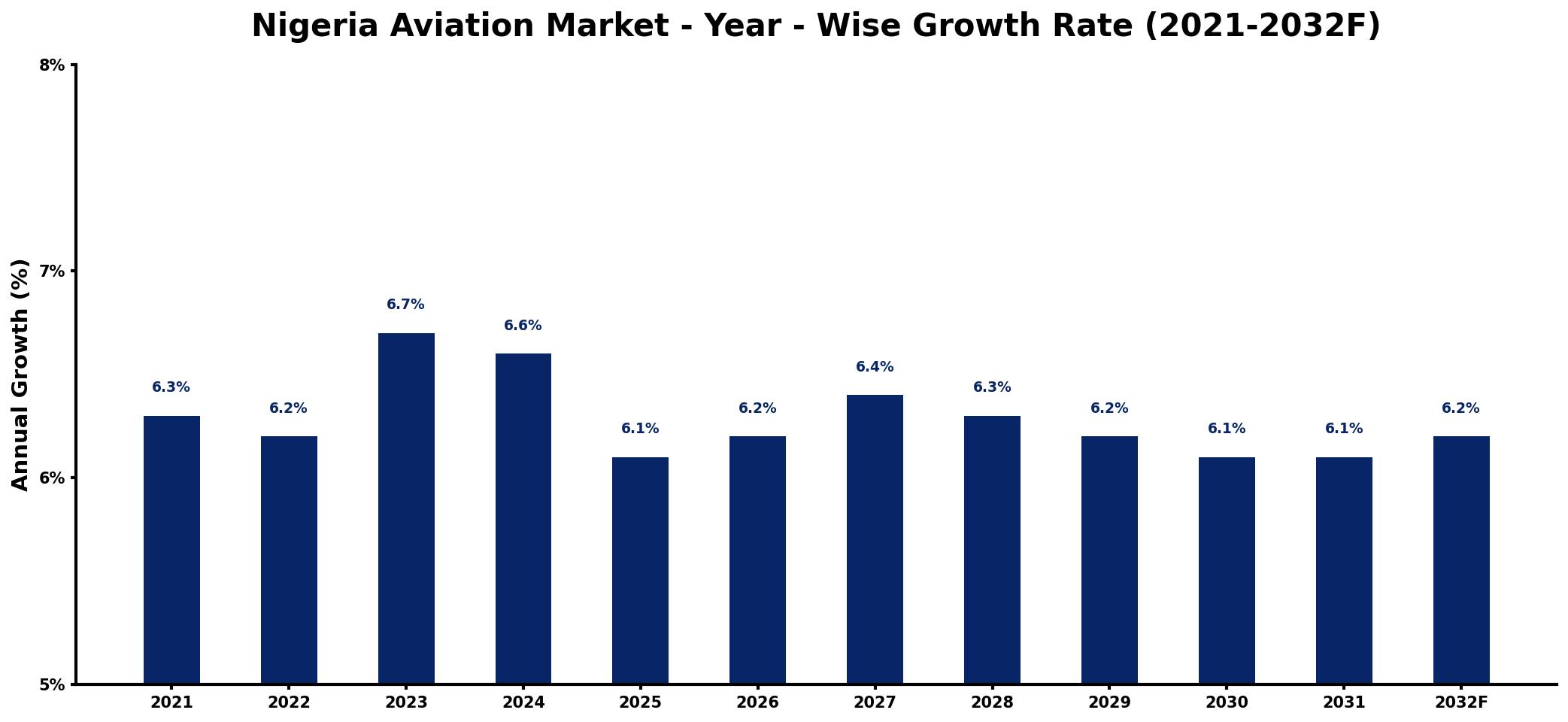
The table below presents the year‑wise growth rates along with the key drivers influencing the market
| Year | Growth Rate | Major Drivers |
| 2021 | 6.3% | Rising consumer travel demand |
| 2022 | 6.2% | Increased foreign investment influx |
| 2023 | 6.7% | Expansion of regional connectivity |
| 2024 | 6.6% | Growing tourism industry potential |
| 2025 | 6.1% | Enhanced infrastructure development projects |
| 2026 | 6.2% | Strengthening cargo transportation networks |
| 2027 | 6.4% | Emergence of low-cost carriers |
| 2028 | 6.3% | Technological advancements in logistics |
| 2029 | 6.2% | Boost in private sector partnerships |
| 2030 | 6.1% | Increasing corporate travel requirements |
| 2031 | 6.1% | Diversification of service offerings |
| 2032 | 6.2% | increased production capacity utilization |
Note: Market size estimations and growth projections presented in this report are based on 6Wresearch's proprietary forecasting methodology, utilizing the latest available industry data, government publications, and primary research inputs.
Nigeria Aviation Market Synopsis
The key force currently shaping the Nigeria Aviation Market is the substantial increase in passenger demand. This surge is not only driven by domestic travel but also international routes as Nigerias position within the African continent becomes increasingly prominent.
In addition to demand, infrastructure modernization is making significant strides. Government initiatives focused on improving airport facilities and aviation safety are integral to enhancing the travel experience, thus attracting more travelers and boosting the sector's overall growth.
Nigeria Aviation Market Key Takeaways
- The market is expected to witness a substantial increase in passenger numbers due to growing urbanization and income levels.
- Investment in airport infrastructure is critical to accommodating the anticipated rise in air traffic.
- Government policies are progressively aimed at enhancing safety and operational efficiency within the aviation sector.
- Airlines are increasingly adopting advanced technologies to improve the customer travel experience.
- Sustainability practices are gaining traction as the industry seeks to mitigate its environmental impact.
Evaluation of Restraints in Nigeria Aviation Market
Despite the promising growth trajectory, the Nigeria Aviation Market is hindered by several restraints. Inadequate infrastructure, such as outdated airports and insufficient services, leads to congestion and flight delays, which can deter travelers. High operating costs driven by fluctuating fuel prices and maintenance expenses further limit the potential for growth. Additionally, safety concerns stemming from past incidents have raised questions about industry standards, which need to be addressed to build consumer confidence. Regulatory hurdles and inconsistent policies present further challenges that stakeholders must navigate in order to capitalize on the burgeoning opportunities within the market.
Nigeria Aviation Market Trends
The Nigeria Aviation Market is currently witnessing noteworthy trends that are shaping its future. Domestic airlines are expanding their routes to meet the rising demand for regional travel, enhancing connectivity within the country. In tandem, airport facilities are undergoing modernization to handle larger aircraft and accommodate increased passenger volumes. The adoption of innovative technologies, such as biometric screening and mobile check-in, is being embraced to streamline operations and improve the passenger experience. Moreover, a growing emphasis on sustainability is prompting airlines to explore fuel-efficient aircraft and practices to reduce their carbon footprint.
Nigeria Aviation Market Opportunities
Investment opportunities abound in the Nigeria Aviation Market, particularly in the realm of airport infrastructure expansion and modernization. With air travel demand on the rise, opportunities for constructing new terminals and upgrading existing facilities are significant. Additionally, the launch of new airline routes and partnerships with international carriers present avenues for enhanced connectivity and market penetration. Another promising area lies in the maintenance, repair, and overhaul (MRO) services sector, which is expected to expand as the number of aircraft increases. Overall, the combination of rising passenger traffic and government support makes this market an attractive prospect for potential investors.
Government Initiatives in the Nigeria Aviation Market
The Nigerian government plays a crucial role in shaping the aviation landscape through various initiatives and regulatory frameworks. The Nigerian Civil Aviation Authority (NCAA) is at the forefront, implementing regulations to enhance safety and security standards. Additionally, the government is focused on investing in airport infrastructure through construction and renovation projects aimed at modernizing facilities nationwide. Efforts to attract foreign investment and improve market competitiveness, including the establishment of a national carrier, Nigeria Air, are also key components of current policies.
Future Insights of the Nigeria Aviation Market
Looking ahead, the Nigeria Aviation Market is well-positioned for continued growth through 2032 and beyond. The convergence of a growing middle class, urbanization, and enhanced government investment in infrastructure are set to transform the market. The implementation of the Single African Air Transport Market (SAATM) is anticipated to facilitate better regional connectivity and increased international collaboration. However, for the market to reach its full potential, it must tackle existing challenges such as infrastructure limitations and regulatory inefficiencies head-on. By addressing these critical areas, the market can unlock significant opportunities for airlines and service providers alike.
Nigeria Aviation Market Latest Developments (2025 - 2026)
In recent months, the Nigeria Aviation Market has seen a number of positive developments, signaling a commitment to growth and modernization. There has been increased public spending on airport renovations and upgrades, aimed at accommodating the rising number of passengers and improving service quality. Additionally, airlines are beginning to announce new routes in response to growing demand, reinforcing the industrys optimistic outlook. Government initiatives focused on safety and efficiency are also becoming more pronounced, reflecting a strong commitment to enhance the overall aviation experience.
Nigeria Aviation Market - Key Attractiveness of the Report
- 10 Years of Market Numbers
- Historical Data Starting from 2022 to 2025
- Base Year: 2025
- Forecast Data until 2032
- Key Performance Indicators Impacting the Market
- Major Upcoming Developments and Projects
Key Highlights of the Report:
- Nigeria Aviation Market Outlook
- Market Size of Nigeria Aviation Market, 2025
- Forecast of Nigeria Aviation Market, 2032
- Historical Data and Forecast of Nigeria Aviation Revenues & Volume for the Period 2022-2032F
- Nigeria Aviation Market Trend Evolution
- Nigeria Aviation Market Drivers and Challenges
- Nigeria Aviation Price Trends
- Nigeria Aviation Porter's Five Forces
- Nigeria Aviation Industry Life Cycle
- Historical Data and Forecast of Nigeria Aviation Market Revenues & Volume By Type for the Period 2022-2032F
- Historical Data and Forecast of Nigeria Aviation Market Revenues & Volume By Commercial Aviation for the Period 2022-2032F
- Historical Data and Forecast of Nigeria Aviation Market Revenues & Volume By Military Aviation for the Period 2022-2032F
- Historical Data and Forecast of Nigeria Aviation Market Revenues & Volume By General Aviation for the Period 2022-2032F
- Nigeria Aviation Import Export Trade Statistics
- Market Opportunity Assessment By Type
- Nigeria Aviation Top Companies Market Share
- Nigeria Aviation Competitive Benchmarking By Technical and Operational Parameters
- Nigeria Aviation Company Profiles
- Nigeria Aviation Key Strategic Recommendations






































