Nigeria Borosilicate Glass Market Size, Share & Growth Rate
The Nigeria Borosilicate Glass Market was estimated at USD 312 Million in 2025 and is projected to reach USD 410 Million by 2032, growing at a CAGR of 4.0% from 2026 to 2032. This growth trajectory is primarily fueled by the escalating demand from the pharmaceutical, chemical, and electronics sectors. As healthcare infrastructure advances and laboratory research gains momentum, the utility of borosilicate glass in diverse applications becomes increasingly evident.
Nigeria Borosilicate Glass Market Year-wise Growth Rate and Key Drivers
This graph highlights how the Nigeria Borosilicate Glass Market has steadily grown over the years, supported by major growth factors.
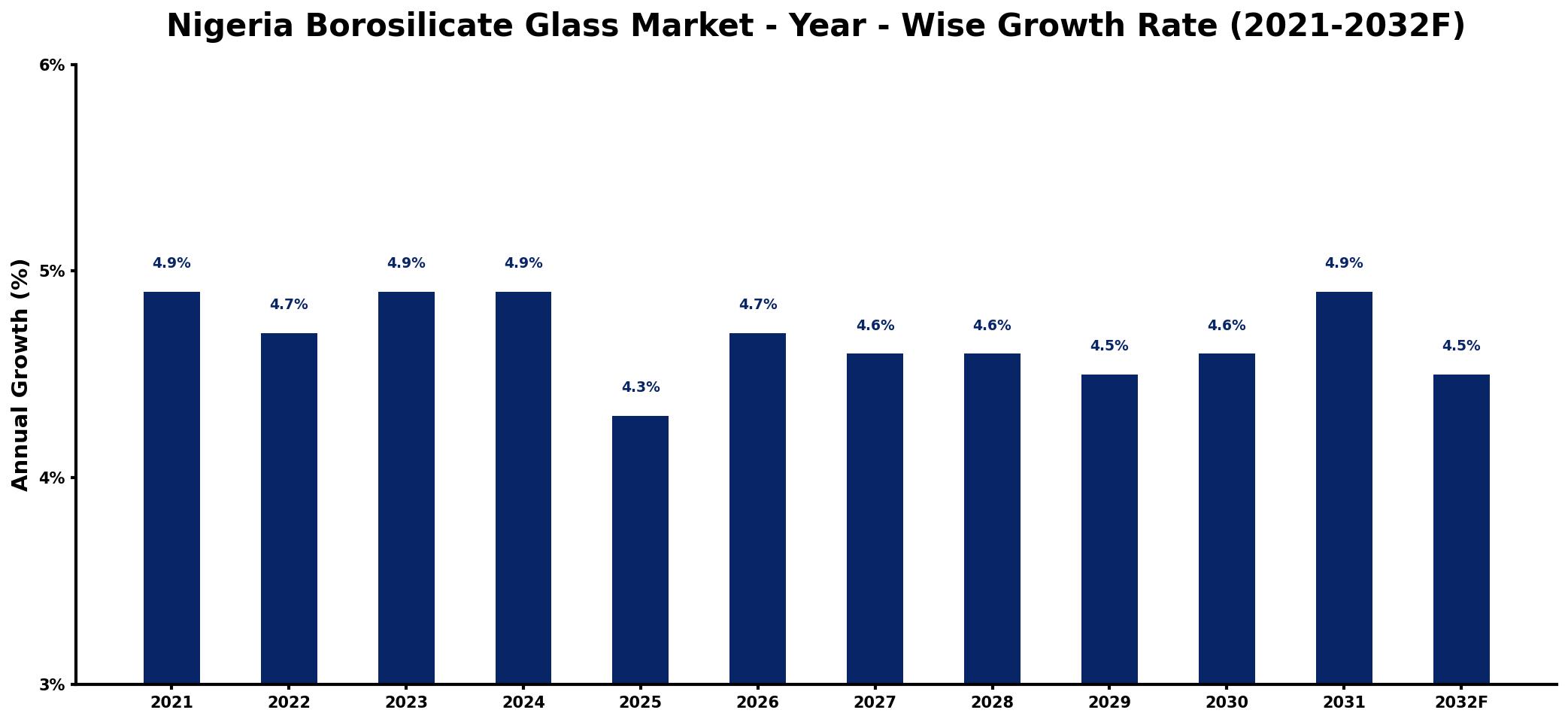
The table below presents the year‑wise growth rates along with the key drivers influencing the market
| Year | Growth Rate | Major Drivers |
| 2021 | 4.9% | Rising demand from laboratory equipment |
| 2022 | 4.7% | Growth in pharmaceutical manufacturing sector |
| 2023 | 4.9% | Increasing investments in research facilities |
| 2024 | 4.9% | Expansion of educational institutions |
| 2025 | 4.3% | Growing popularity in consumer products |
| 2026 | 4.7% | Surge in chemical processing applications |
| 2027 | 4.6% | Advancements in scientific research technologies |
| 2028 | 4.6% | Enhanced focus on sustainable materials |
| 2029 | 4.5% | Increasing export opportunities for manufacturers |
| 2030 | 4.6% | Development of innovative packaging solutions |
| 2031 | 4.9% | Strengthened regulations boosting quality standards |
| 2032 | 4.5% | Growing integration in electronics industry |
Note: Market size estimations and growth projections presented in this report are based on 6Wresearch's proprietary forecasting methodology, utilizing the latest available industry data, government publications, and primary research inputs.
Nigeria Borosilicate Glass Market Synopsis
In recent years, the Nigeria Borosilicate Glass Market has witnessed a significant uptick in demand, driven by the distinct properties of borosilicate glass, particularly its thermal and chemical resistance. These attributes make it an ideal choice for laboratory equipment, glass piping systems, and various lighting applications, aligning perfectly with the needs of modern industries.
Furthermore, the burgeoning pharmaceutical sector is driving the demand for borosilicate glass packaging, presenting opportunities for local manufacturers. As the market evolves, it is becoming increasingly vital for stakeholders to adapt and innovate in response to the shifting landscape of consumer needs and regulatory frameworks.
Nigeria Borosilicate Glass Market Key Takeaways
- The market is driven by increasing applications in pharmaceuticals, chemicals, and electronics.
- Borosilicate glass's inherent properties make it increasingly preferred over traditional glass materials.
- Investment in research and development is crucial for maintaining competitiveness and meeting growing demands.
- Government initiatives are creating a conducive environment for local manufacturers through incentives and support.
- Consumer awareness about the advantages of borosilicate glass is critical for driving market growth.
Evaluation of Restraints in Nigeria Borosilicate Glass Market
Despite its robust growth, the Nigeria Borosilicate Glass Market faces several constraints. One significant issue is the limited understanding among consumers and manufacturers regarding the benefits of borosilicate glass, which can hinder demand compared to conventional glass options. Furthermore, the high production costs associated with specialized manufacturing processes and skilled labor present challenges for local producers. In addition, inconsistent quality standards in the market can erode consumer trust and impact growth potential. Addressing these challenges will require enhanced educational efforts and a focus on quality assurance to establish borosilicate glass as a preferred material.
Nigeria Borosilicate Glass Market Trends
Current trends indicate a rising adoption of borosilicate glass across various industries, particularly in laboratory equipment manufacturing where its superior properties are highly valued. Sustainability is also influencing market dynamics; as businesses seek eco-friendly packaging solutions, borosilicate glass has gained traction in food and beverage applications. Moreover, advancements in manufacturing technologies are improving the durability and strength of borosilicate products, which is expected to further stimulate demand in the coming years.
Nigeria Borosilicate Glass Market Opportunities
The Nigeria Borosilicate Glass Market is ripe with investment opportunities, especially with the ongoing growth of the pharmaceutical and solar energy sectors. Companies looking to invest in borosilicate glass production can capitalize on Nigeria's expanding healthcare and manufacturing landscapes. Additionally, the government's emphasis on renewable energy solutions enhances the prospects for borosilicate glass applications in solar technology, presenting an avenue for innovative partnerships and business ventures.
Government Initiatives in the Nigeria Borosilicate Glass Market
The Nigerian government has implemented several initiatives to bolster the borosilicate glass market, including protective import tariffs aimed at supporting local manufacturers. Furthermore, financial incentives such as tax breaks and subsidies for production processes encourage domestic investment. Regulatory frameworks have also been established to ensure quality standards and promote environmentally sustainable practices in manufacturing, fostering a more competitive market environment.
Future Insights of the Nigeria Borosilicate Glass Market
Looking ahead to the period between 2026 and 2032, the Nigeria Borosilicate Glass Market is projected to continue its steady expansion. As industries increasingly adopt borosilicate glass for its superior performance characteristics, the synergy between technological advancements and market demand will drive growth. However, ongoing attention to raw material costs and competition from alternative materials will be essential to navigate the evolving landscape successfully.
Nigeria Borosilicate Glass Market Latest Developments (2025 - 2026)
Recent developments in the Nigeria Borosilicate Glass Market indicate a shift towards enhanced manufacturing technologies, enabling the production of higher-quality products. Additionally, collaborations between local manufacturers and international firms are emerging, focusing on innovation and capacity expansion. The increasing emphasis on sustainability is prompting businesses to explore eco-friendly practices, aligning with global trends and consumer expectations.
Nigeria Borosilicate Glass Market - Key Attractiveness of the Report
- 10 Years of Market Numbers
- Historical Data Starting from 2022 to 2025
- Base Year: 2025
- Forecast Data until 2032
- Key Performance Indicators Impacting the Market
- Major Upcoming Developments and Projects
Key Highlights of the Report:
- Nigeria Borosilicate Glass Market Outlook
- Market Size of Nigeria Borosilicate Glass Market, 2025
- Forecast of Nigeria Borosilicate Glass Market, 2032
- Historical Data and Forecast of Nigeria Borosilicate Glass Revenues & Volume for the Period 2022-2032F
- Nigeria Borosilicate Glass Market Trend Evolution
- Nigeria Borosilicate Glass Market Drivers and Challenges
- Nigeria Borosilicate Glass Price Trends
- Nigeria Borosilicate Glass Porter's Five Forces
- Nigeria Borosilicate Glass Industry Life Cycle
- Historical Data and Forecast of Nigeria Borosilicate Glass Market Revenues & Volume By Type for the Period 2022-2032F
- Historical Data and Forecast of Nigeria Borosilicate Glass Market Revenues & Volume By High Borosilicate Glass for the Period 2022-2032F
- Historical Data and Forecast of Nigeria Borosilicate Glass Market Revenues & Volume By Medium Borosilicate Glass for the Period 2022-2032F
- Historical Data and Forecast of Nigeria Borosilicate Glass Market Revenues & Volume By Application for the Period 2022-2032F
- Historical Data and Forecast of Nigeria Borosilicate Glass Market Revenues & Volume By Solar Energy Tubes for the Period 2022-2032F
- Historical Data and Forecast of Nigeria Borosilicate Glass Market Revenues & Volume By Heat Glassware for the Period 2022-2032F
- Historical Data and Forecast of Nigeria Borosilicate Glass Market Revenues & Volume By Laboratory Glassware for the Period 2022-2032F
- Historical Data and Forecast of Nigeria Borosilicate Glass Market Revenues & Volume By Pharmaceutical Packaging for the Period 2022-2032F
- Historical Data and Forecast of Nigeria Borosilicate Glass Market Revenues & Volume By Chemical Tubes for the Period 2022-2032F
- Historical Data and Forecast of Nigeria Borosilicate Glass Market Revenues & Volume By Others for the Period 2022-2032F
- Nigeria Borosilicate Glass Import Export Trade Statistics
- Market Opportunity Assessment By Type
- Market Opportunity Assessment By Application
- Nigeria Borosilicate Glass Top Companies Market Share
- Nigeria Borosilicate Glass Competitive Benchmarking By Technical and Operational Parameters
- Nigeria Borosilicate Glass Company Profiles
- Nigeria Borosilicate Glass Key Strategic Recommendations






































