Nigeria Building Thermal Insulation Market Top 5 Importing Countries and Market Competition (HHI) Analysis
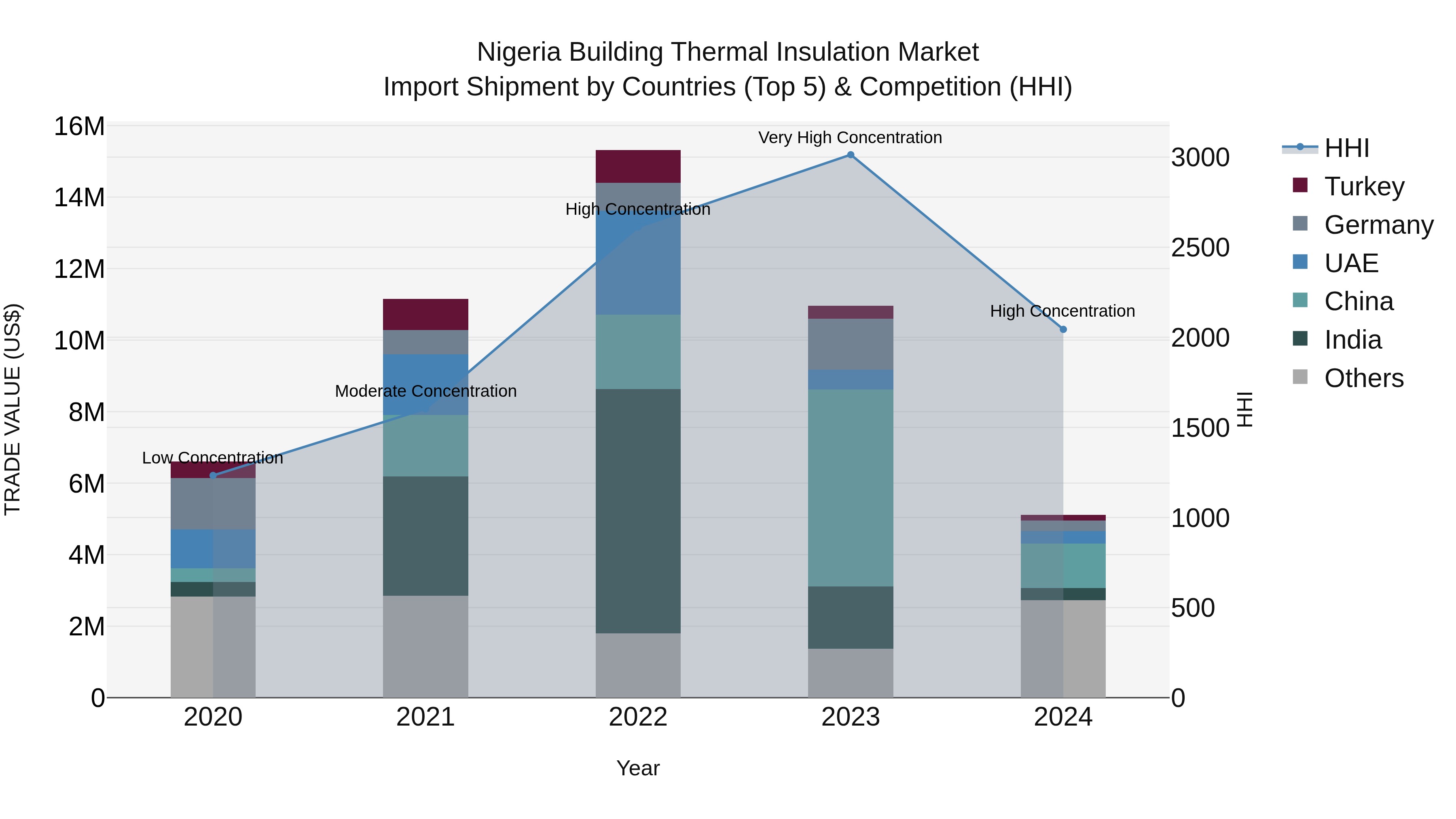
The thermal insulation import shipments in Nigeria saw a significant shift in 2024, with top exporting countries being Indonesia, China, UAE, India, and Germany. The market concentration, as measured by the HHI, remained high in 2024 after reaching very high levels in 2023. The industry experienced a negative compound annual growth rate (CAGR) of -6.18% from 2020 to 2024, with a steep decline in growth rate of -53.34% from 2023 to 2024. These trends indicate a challenging market environment for thermal insulation importers in Nigeria, necessitating strategic adjustments to navigate the changing landscape.
Topics Covered in the Nigeria Building Thermal Insulation Market Report
Nigeria Building Thermal Insulation Market report thoroughly covers the market By Materials, By wool insulation, By Application, and By Building Types. The market report provides an unbiased and detailed analysis of the ongoing market trends, opportunities/high growth areas, and market drivers which would help the stakeholders to devise and align their market strategies according to the current and future market dynamics.
Nigeria Building Thermal Insulation Market Synopsis
The Nigeria building thermal insulation market has experienced significant growth in recent years, driven by the government’s increasing focus on sustainability and energy efficiency in construction. The market includes a range of materials such as fiberglass, polystyrene, and polyurethane foam, used to enhance a building's energy performance by reducing heat transfer. With ambitious national programs, the push for greener, more energy-efficient practices continue to reshape the built environment in Nigeria.
According to 6Wresearch, the Nigeria Building Thermal Insulation Market is anticipated to grow at a CAGR of 5.2% during the forecast period 2025-2031. The Nigeria building thermal insulation market is primarily driven by increasing government initiatives promoting energy efficiency and sustainable construction. Regulations mandating the use of thermal insulation in buildings, such as the Building Code, encourage the adoption of advanced insulation materials. Additionally, rising energy costs have heightened the demand for energy-saving solutions, with thermal insulation playing a pivotal role in reducing cooling loads in the region's hot climate. Rapid urbanization, coupled with a growing construction sector, further bolsters the market as developers seek to meet energy efficiency standards. Moreover, increased awareness of environmental benefits and advancements in eco-friendly insulation materials also contribute to the Nigeria Building Thermal Insulation Market growth.
Despite the promising growth potential, the Nigeria building thermal insulation market faces several challenges. One significant obstacle is the high cost of importing key raw materials, which leads to increased production expenses and limits the affordability of insulation solutions for end-users. Additionally, the lack of widespread awareness about the long-term benefits of building insulation contributes to slow adoption rates, particularly in rural areas where traditional construction methods are still predominant.
Nigeria Building Thermal Insulation Market Trends
The market is witnessing a growing shift towards eco-friendly and sustainable insulation materials, such as mineral wool, cellulose, and recycled fibers, driven by rising environmental awareness. Technological advancements in insulation products, including lightweight and high-performance materials, are also shaping the market landscape. Moreover, an increasing focus on green building certifications like LEED is encouraging the adoption of advanced thermal insulation solutions. The integration of thermal insulation into smart building technologies is an emerging trend, enhancing energy monitoring and optimization capabilities.
Investment Opportunities in the Nigeria Building Thermal Insulation Market
The market offers promising investment opportunities, particularly in the development and manufacturing of innovative, energy-efficient insulation materials. Rising construction activities in residential, commercial, and industrial sectors create a robust demand for thermal insulation products. Investments in local production facilities can capitalize on the growing preference for domestically manufactured materials to reduce costs and ensure regulatory compliance. Opportunities also exist in R&D for eco-friendly solutions and expanding distribution networks to reach untapped regions.
Leading Players in the Nigeria Building Thermal Insulation Market
The building thermal insulation market in Nigeria is characterized by the presence of both local and international players who drive innovation and competition. Key companies operating in this space include manufacturers, suppliers, and distributors specializing in a range of insulation materials such as fiberglass, polystyrene, and polyurethane foam. Prominent international companies like Rockwool Group and Owens Corning contribute to the market with high-quality, energy-efficient insulation products, supported by their extensive global expertise.
Government Regulations of the Nigeria Building Thermal Insulation Market
The Nigeria building thermal insulation market is influenced by various government regulations that aim to promote energy efficiency and environmental sustainability. Policies such as the Nigerian Energy Efficiency Code (NEEC) and other building standards encourage the adoption of insulation materials to reduce energy consumption in residential, commercial, and industrial structures. Additionally, the government's commitment to meeting international climate change agreements has spurred initiatives to enhance energy performance in the construction industry. Compliance with these regulations has become essential for manufacturers and builders operating within the market.
Future Insights of the Nigeria Building Thermal Insulation Market
The future of the Nigeria building thermal insulation market is promising, driven by the increasing emphasis on green building practices and energy conservation. Rising urbanization and population growth are expected to boost construction activities, creating a higher demand for insulation solutions. Innovations in eco-friendly materials and the integration of advanced technologies are projected to shape the market's evolution. Furthermore, government support through incentives and awareness campaigns on energy efficiency will likely play a pivotal role in fostering market expansion over the next decade.
Market Segmentation Analysis
The report offers a comprehensive study of the subsequent market segments and their leading categories.
Expanded Polystyrene Foam to Dominate the Market- By Materials
According to Ashutosh, Senior Research Analyst, 6Wresearch, Expanded Polystyrene Foam (EPS) is leading the market within the Plastic Foam category due to its versatility, affordability, and wide range of applications. Renowned for its lightweight and high compressive strength, EPS is extensively used in the construction industry for insulation and as a structural material. Its excellent thermal insulation properties make it a preferred choice for maintaining energy efficiency in buildings.
Glass Wool to Dominate the Market- By wool insulation
Glass Wool is widely used due to its lightweight structure, cost-effectiveness, and excellent thermal and sound insulation capabilities. Its versatility makes it ideal for both residential and commercial buildings.
Roof Insulation to Dominate the Market- By application
Roof Insulation This application dominates the insulation market, driven by the need to reduce heat loss and improve energy efficiency in buildings. Roof insulation plays a critical role in maintaining indoor temperature stability, significantly cutting heating and cooling costs. It is widely adopted in both residential and commercial constructions, especially in regions with extreme climatic conditions.
Residential Buildings to Dominate the Market- By Building Types
Residential Buildings - The residential segment leads the insulation market, driven by the rising demand for energy-efficient homes and increasing awareness of sustainable construction practices. Insulation in residential buildings reduces energy consumption, enhances thermal comfort, and contributes to lower utility bills. Growing urbanization and government incentives for green buildings further fuel its adoption in this segment.
Key Attractiveness of the Report
- 10 Years of Market Numbers.
- Historical Data Starting from 2021 to 2024
- Base Year: 2024
- Forecast Data until 2031
- Key Performance Indicators Impacting the Market
- Major Upcoming Developments and Projects
Key Highlights of the Report:
- NigeriaBuilding Thermal Insulation Market Overview
- NigeriaBuilding Thermal Insulation Market Outlook
- NigeriaBuilding Thermal Insulation Market Forecast
- Historical Data and Forecast NigeriaBuilding Thermal Insulation MarketRevenues for the Period 2021-2031
- Historical Data and Forecast of NigeriaBuilding Thermal Insulation MarketRevenues, By Materials, for the Period 2021-2031
- Historical Data and Forecast of NigeriaBuilding Thermal Insulation MarketRevenues, By Applications, for the Period 2021-2031
- Historical Data and Forecast of NigeriaBuilding Thermal Insulation MarketRevenues, By Building Types, for the Period 2021-2031
- Market Drivers and Restraints
- Industry Life Cycle
- Porter’s Five Force Analysis
- Impact Analysis of COVID-19
- Market Trends
- NigeriaBuilding Thermal InsulationMarketRevenue Ranking, By Companies
- Competitive Benchmarking
- Company Profiles
- Key Strategic Recommendations
Markets Covered
The report provides a detailed analysis of the following market segments
Plastic Foam
- Expanded Polystyrene Foam
- Extruded Polystyrene Foam (EPS)
- Polyurethane (PUR) & Polyisocyanurate (PIR) Foam
- Others
Wool Insulation
- Glass Wool
- Stone Wool
- Others
By Applications
- Roof insulation
- Wall Insulation
- Floor Insulation
By Building Types
- Residential
- Commercial
- Industrial






































