Nigeria Commercial Vehicles Market Top 5 Importing Countries and Market Competition (HHI) Analysis
The commercial vehicles import market in Nigeria continues to thrive, with significant contributions from top exporters such as China, USA, UAE, Japan, and Italy. The market witnessed a shift towards higher concentration in 2024, indicating increased dominance of key players. The impressive Compound Annual Growth Rate (CAGR) of 24.62% from 2020 to 2024 highlights the sector`s strong performance. Moreover, the notable growth rate of 21.16% from 2023 to 2024 suggests sustained momentum in the market, attracting lucrative opportunities for businesses operating in the commercial vehicles segment.
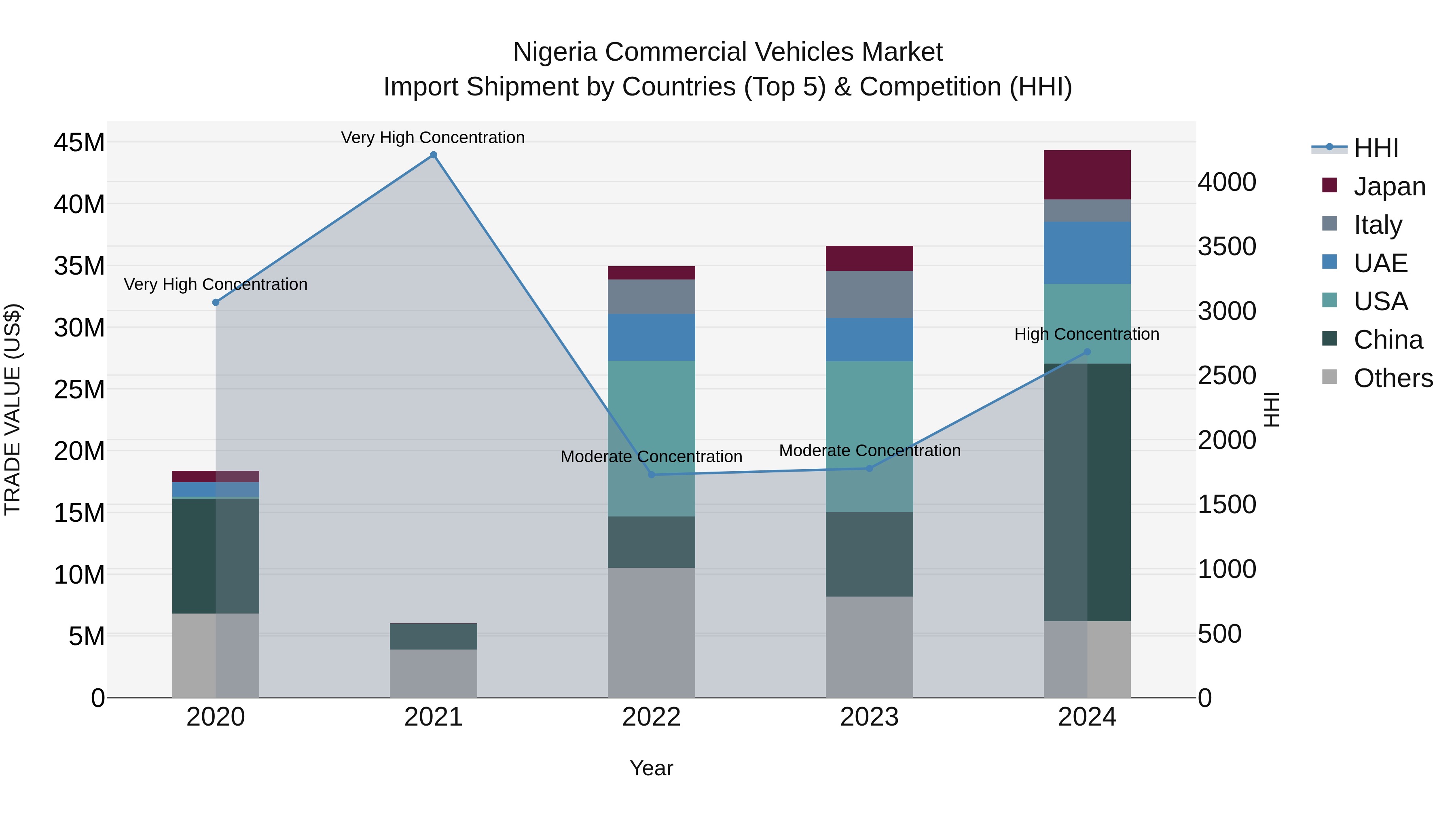
Nigeria Commercial Vehicles Market Synopsis
The Nigeria commercial vehicles market is projected to grow at a CAGR of 8.1% during the forecast period (20202026). The growth in this market can be attributed to rising demand for light and medium-duty commercial vehicles due to increasing urbanization and improving road infrastructure, along with government initiatives such as tax incentives on commercial vehicle purchases. Moreover, the increasing purchasing power of people has led to an increase in sales of private cars across Nigeria which has further boosted the demand for light and medium-duty commercial vehicles such as pick-up trucks, vans, SUVs etc. Furthermore, technological advancements such as electric mobility solutions are expected to drive the growth of the Nigeria commercial vehicles market over the forecast period
Key Highlights of the Report:
- Nigeria Commercial vehicles Market Outlook
- Market Size of Nigeria Commercial vehicles Market, 2019
- Forecast of Nigeria Commercial vehicles Market, 2026
- Historical Data and Forecast of Nigeria Commercial vehicles Revenues & Volume for the Period 2016 - 2026
- Nigeria Commercial vehicles Market Trend Evolution
- Nigeria Commercial vehicles Market Drivers and Challenges
- Nigeria Commercial vehicles Price Trends
- Nigeria Commercial vehicles Porter's Five Forces
- Nigeria Commercial vehicles Industry Life Cycle
- Historical Data and Forecast of Nigeria Commercial vehicles Market Revenues & Volume By Product for the Period 2016 - 2026
- Historical Data and Forecast of Nigeria Commercial vehicles Market Revenues & Volume By Light Commercial Vehicles (LCVs) for the Period 2016 - 2026
- Historical Data and Forecast of Nigeria Commercial vehicles Market Revenues & Volume By Heavy Trucks for the Period 2016 - 2026
- Historical Data and Forecast of Nigeria Commercial vehicles Market Revenues & Volume By Buses & Coaches for the Period 2016 - 2026
- Historical Data and Forecast of Nigeria Commercial vehicles Market Revenues & Volume By End-Users for the Period 2016 - 2026
- Historical Data and Forecast of Nigeria Commercial vehicles Market Revenues & Volume By Industrial for the Period 2016 - 2026
- Historical Data and Forecast of Nigeria Commercial vehicles Market Revenues & Volume By Mining & Construction for the Period 2016 - 2026
- Historical Data and Forecast of Nigeria Commercial vehicles Market Revenues & Volume By Logistics for the Period 2016 - 2026
- Historical Data and Forecast of Nigeria Commercial vehicles Market Revenues & Volume By Passenger Transportation for the Period 2016 - 2026
- Historical Data and Forecast of Nigeria Commercial vehicles Market Revenues & Volume By Others for the Period 2016 - 2026
- Nigeria Commercial vehicles Import Export Trade Statistics
- Market Opportunity Assessment By Product
- Market Opportunity Assessment By End-Users
- Nigeria Commercial vehicles Top Companies Market Share
- Nigeria Commercial vehicles Competitive Benchmarking By Technical and Operational Parameters
- Nigeria Commercial vehicles Company Profiles
- Nigeria Commercial vehicles Key Strategic Recommendations






































