Global Commercial Vehicles Market Highlights
| Market Size (2025) | USD 1312.5 Billion |
| Forecast Size (2032) | USD 1724.6 Billion |
| CAGR | 5.31% |
| Base Year | 2025 |
| Forecast Period | 2026-2032 |
| Largest Region | North America |
| Fastest Growing Region | Asia |
| Largest Segment | Trucks |
| Fastest Growing Segment | Electric Vehicles |
| Leading Companies | Daimler, Volvo, Tata Motors, Scania, MAN |
Global Commercial Vehicles Market Size & Growth Rate (2026-2032)
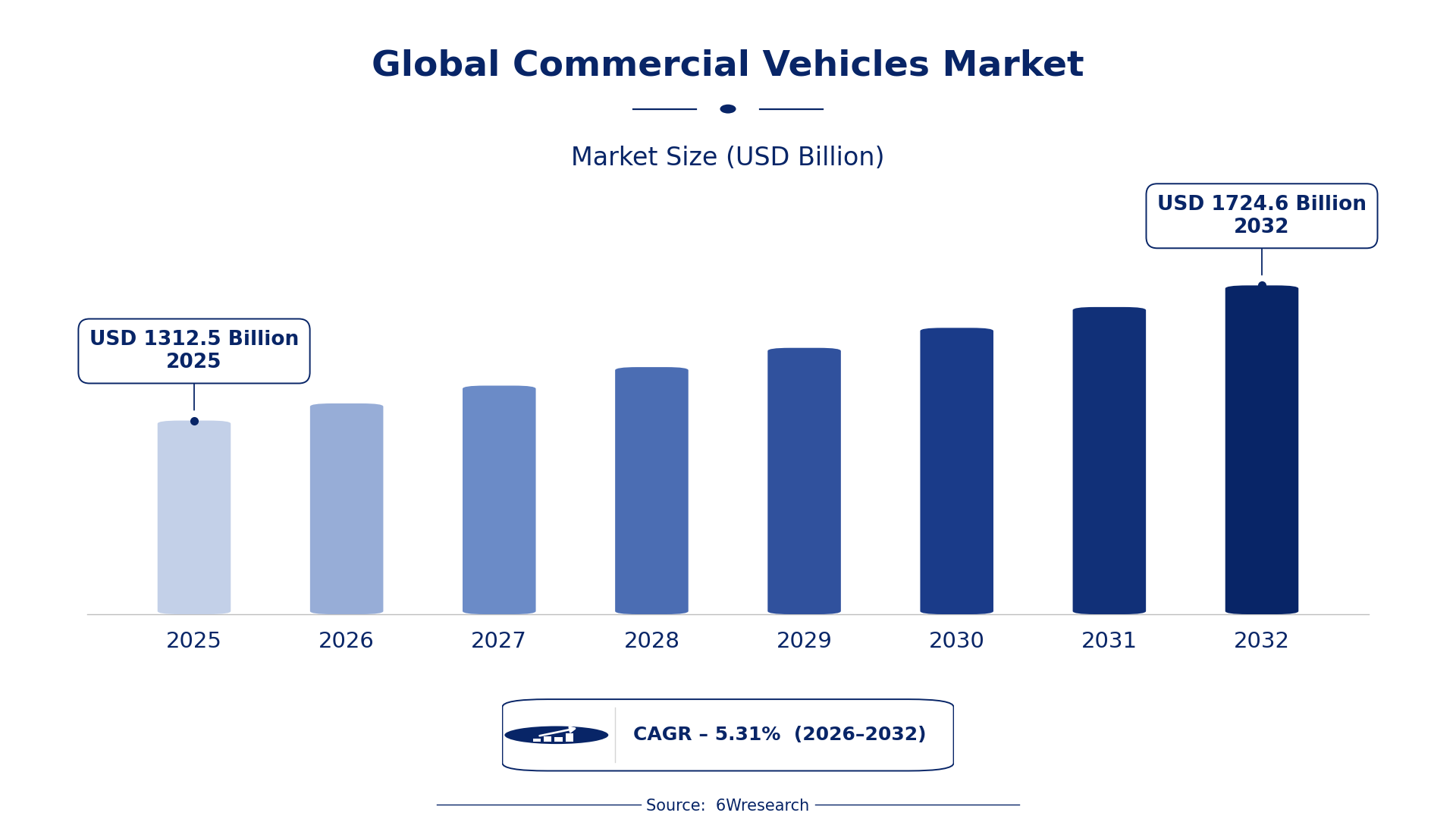
The Global Commercial Vehicles Market was estimated at USD 1312.5 Billion in 2025 and is projected to reach USD 1724.6 Billion by 2032, growing at a CAGR of 5.31% from 2026 to 2032.
Global Commercial Vehicles Market Synopsis
The Global Commercial Vehicles Market is undergoing transformative shifts characterized by increasing demand for sustainability and efficiency in transportation. Innovations in electric and autonomous vehicles are at the forefront of this dynamic environment, reshaping how businesses operate in logistics and fleet management. These advancements not only facilitate compliance with stringent emissions regulations but also enhance operational efficiencies for various sectors.
As the need for efficient last-mile delivery solutions grows, driven significantly by the e-commerce boom, commercial vehicle manufacturers are focused on developing specialized vehicles equipped with advanced technologies. The focus on connectivity, telematics, and fleet management solutions is redefining industry standards, enabling logistics companies to harness real-time data for better decision-making and operational optimization.
Global Commercial Vehicles Market Year-wise Growth Rate and Key Drivers
This graph illustrates the annual growth rates of the Global Commercial Vehicles Market from 2022 to 2032, highlighting a steady upward trajectory and projected expansion over the forecast period.
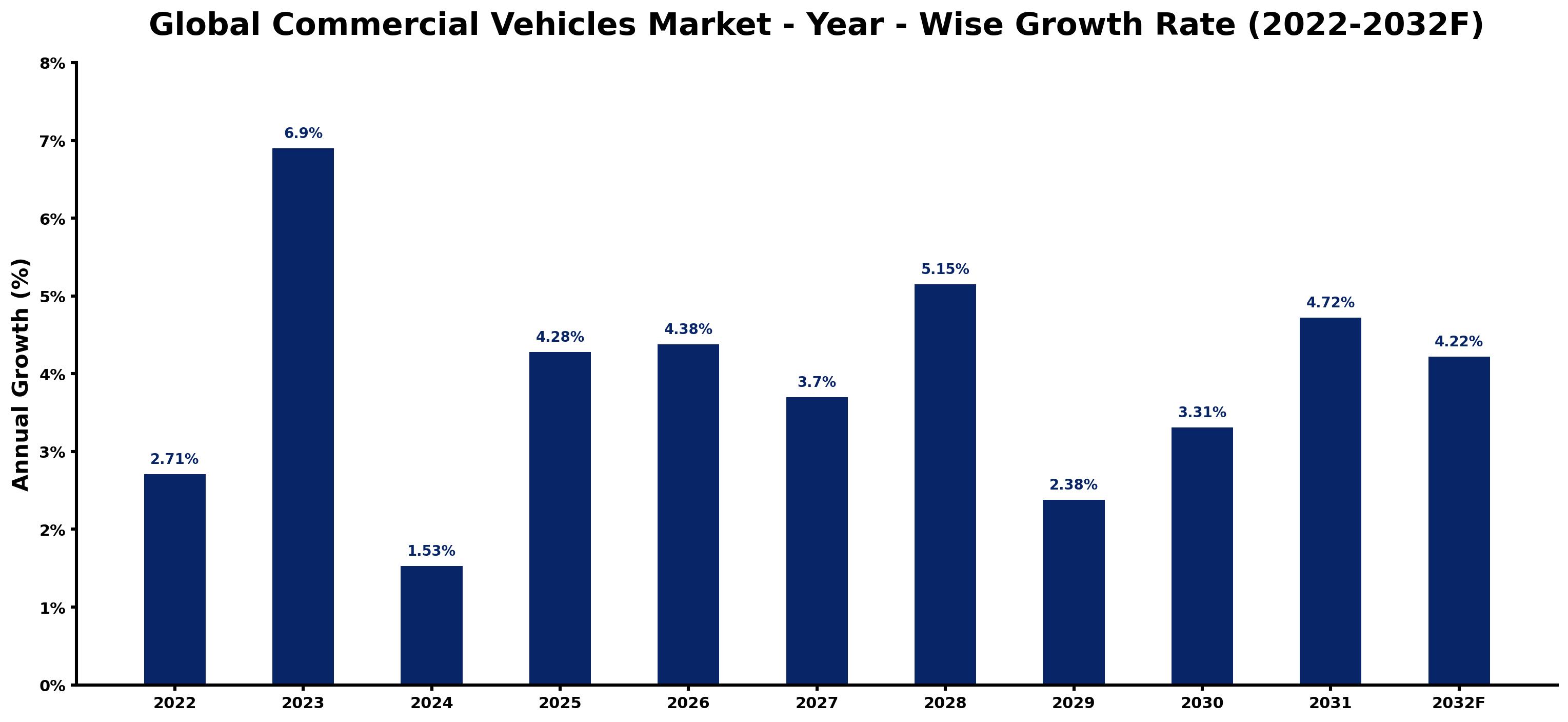
The table below presents the year‑wise growth rates along with the key drivers influencing the market
| Year | Growth Rate (%) | Major Drivers |
| 2022 | 2.71 | Expanding commercial vehicle fleets in emerging markets drives regional sales growth. |
| 2023 | 6.9 | Manufacturers increasingly prioritize sustainability initiatives to align with global emissions regulations. |
| 2024 | 1.53 | EV battery technology advancements help mitigate supply chain disruptions in commercial vehicles. |
| 2025 | 4.28 | Recent emissions regulations increase the need for cleaner commercial vehicle powertrains. |
| 2026 | 4.38 | In North America, powertrain electrification technologies enhance commercial vehicle performance standards. |
| 2027 | 3.7 | Increasing raw material costs prompt commercial vehicle manufacturers to optimize production strategies. |
| 2028 | 5.15 | While urban consumers adopt electric commercial vehicles, fleet operators seek lower operational costs. |
| 2029 | 2.38 | Shifting preferences for electrified commercial vehicles drive new OEM production schedules. |
| 2030 | 3.31 | Established OEMs are increasingly acquiring technology firms to enhance their commercial vehicle portfolios. |
| 2031 | 4.72 | A shift toward skilled labor development evolves the training requirements for commercial vehicle technicians. |
| 2032 | 4.22 | Fleet operators are demanding smarter commercial vehicles, fostering advancements in autonomous driving software. |
Note - Market size estimations and growth projections presented in this report are based on 6Wresearch's proprietary research methodology, combining internal industry data, secondary research, and primary validation, updated periodically to reflect current market conditions. As markets evolve rapidly, figures for certain industries may vary slightly and are intended as informed estimates rather than absolute figures. For the most current market sizing, we recommend validating figures with a 6Wresearch analyst.
Global Commercial Vehicles Market Key Takeaways
Below are some of the specific key takeaways from the market, including:
- Commercial trucks hold the largest segment of the market, accounting for approximately 60% share in 2025.
- Electric vehicles are expected to be the fastest-growing segment with a projected CAGR of 12.5% from 2026 to 2032.
- Daimler AG announced a significant investment of USD 2 billion towards the development of electric truck models in 2022.
- As of 2025, North America is projected to represent over 40% of the Global Commercial Vehicles Market.
- The growing trend of e-commerce has led to an increase in demand for last-mile delivery vehicles, propelling product innovation.
Evaluation of Restraints in Global Commercial Vehicles Market
The Global Commercial Vehicles Market faces substantial challenges, particularly related to regulatory pressures surrounding emissions and safety standards. For instance, the European Union has set ambitious regulations mandating a reduction in CO2 emissions by 30% by 2030, which has compelled manufacturers to accelerate the transition to electric and hybrid vehicles. These regulations often lead to increased production costs as companies invest in R&D to meet compliance, presenting a competitive threat to lower-budget entities. Additionally, fluctuating fuel prices, which can rise above $3 per gallon, further strain operational budgets for fleet owners reliant on internal combustion engines.
Global Commercial Vehicles Market Trends
A significant trend reshaping the Global Commercial Vehicles Market is the surge in electric vehicle adoption, driven by consumer preference for sustainable transport solutions. For example, by 2025, Volvo aims to boost its electric vehicle portfolio with a commitment to launch at least 40 electrified models, signifying a robust industry shift towards electrification. Furthermore, the integration of automation technologies—such as advanced driver assistance systems (ADAS)—is revolutionizing vehicle safety and performance metrics. A compelling instance of this is Fuso’s introduction of a vehicle equipped with Level 4 autonomous capabilities in Japan, expected to redefine logistics operations. These evolving technologies not only enhance operational efficiency but also align with safety standards imposed by government regulations.
Global Commercial Vehicles Market Opportunities
Future revenue opportunities in the Global Commercial Vehicles Market are primarily anchored in sectors such as hydrogen fuel cells and connected vehicle technologies. Companies like Toyota are investing in hydrogen-powered systems, with plans to launch fuel-cell heavy-duty trucks by 2025, reflecting a strategy that responds to both environmental sustainability and operational efficiency needs. Furthermore, advancements in data analytics and telematics are emerging as game-changers. Utilizing these systems can enhance route optimization for logistics providers, driving down operational costs and improving delivery speeds. As urbanization continues, the demand for advanced last-mile delivery solutions could create revenue-generating partnerships between logistics and technology firms.
Global Commercial Vehicles Market by Vehicle Type
In the Global Commercial Vehicles Market, trucks dominate the vehicle type segment, holding approximately ~60% share in 2025. This commanding presence is largely due to their critical role in freight transportation across various industries. The electric vehicle segment is anticipated to grow the fastest, showcasing a CAGR of 12.5% from 2026 to 2032. As regulations tighten around emissions, logistics companies are increasingly turning to electric fleets to comply with sustainability mandates while enjoying lower fuel costs and operational efficiencies.
Global Commercial Vehicles Market by Propulsion Type
In terms of propulsion type, Internal Combustion Engine (ICE) vehicles are projected to lead the Global Commercial Vehicles Market with roughly 70% share in 2025, as they continue to account for the majority of commercial transport operations. Nevertheless, the Hybrid and Electric Vehicles segment is expected to demonstrate remarkable growth with a CAGR of 15% from 2026 to 2032, as manufacturers adapt to evolving consumer preferences and stringent regulatory demands. This expansion is fueled by government incentives and advancements in battery technologies, positioning hybrid and electric vehicles as essential components in future fleets.
Global Commercial Vehicles Market by Region
North America is the largest region in the Global Commercial Vehicles Market, capturing about ~40% share in 2025, primarily due to established manufacturing hubs and strong demand in the logistics sector. Conversely, Asia is anticipated to be the fastest-growing market, expected to register a CAGR of 8.5% from 2026 to 2032. Factors such as rapid urbanization, growing e-commerce activities, and government support for electric vehicles are driving this growth, leading to an increased focus on enhancing local manufacturing capabilities and supply chain efficiency.
Government Initiatives in the Global Commercial Vehicles Market
The regulatory landscape surrounding the Global Commercial Vehicles Market is characterized by significant government initiatives aimed at promoting sustainability, safety, and efficiency within the sector. Various federal and state policies are emerging to transform commercial transport and support the transition towards greener technologies.
- U.S. Department of Transportation (DOT), "Federal Motor Vehicle Safety Standards," implemented in 2021, aims to enhance safety regulations for commercial vehicles, particularly for large trucks and buses.
- European Commission, "Green Deal," initiated in 2020, allocates €1 trillion towards making Europe climate-neutral by 2050, impacting commercial vehicle emissions and encouraging electric vehicle adoption.
- California Air Resources Board (CARB), "Advanced Clean Trucks Regulation," adopted in 2020, mandates that a certain percentage of all trucks sold in California must be zero-emission, thereby stimulating growth for electric commercial vehicles.
- Government of China, "New Energy Vehicle (NEV) Mandate," launched in 2019, provides incentives for electric and hybrid commercial vehicles, promoting substantial investments in locally manufactured products.
Future Insights of the Global Commercial Vehicles Market
By 2032, the Global Commercial Vehicles Market is expected to witness transformative shifts in technology infusion and supply chain dynamics. As manufacturers increasingly focus on electric and hydrogen fuel cell technologies, companies like Toyota are leading initiatives in sustainable heavy-duty transport solutions. Transitioning to connected vehicle technologies will enhance fleet management efficiencies, allowing real-time data utilization for route optimization and cost savings. These trends indicate not only a move towards environmentally friendly operations but also a strategic repositioning for competitive advantage in a rapidly evolving market.
Global Commercial Vehicles Market Latest Developments
Recent advancements in the Global Commercial Vehicles Market showcase remarkable efforts by key players to adapt to changing market needs and regulatory pressures. The following developments underscore this trend:
- Daimler AG recently completed the rollout of its electric truck line which emphasizes sustainability while targeting operational efficiencies aligned with tightening emissions regulations.
- Volvo is actively expanding its electric vehicles portfolio, with plans to introduce several new electric models by late 2023, aiming for significant market penetration and technological leadership.
- Tata Motors is currently ramping up production capabilities in India for electric commercial vehicles, with expectations of completed facilities by 2024 to meet rising local and international demand.
- Scania is developing autonomous vehicle technologies, with pilot testing programs expected to be underway throughout 2023 to enhance safety and efficiency in fleet operations.
Global Commercial Vehicles Market Key Players and Industry Positioning
The competitive landscape of the Global Commercial Vehicles Market remains dominated by a few key players, characterized by both regional and technological strengths. While some companies focus on electric and hybrid innovations, others leverage robust manufacturing capabilities for traditional vehicles. This blend of focus areas contributes to a mixed competitive environment, ensuring distinct positioning based on product offerings and regional market strategies.
| Leading Company | Core Strength | Strategic Focus |
|---|---|---|
| Daimler | Strong R&D in electric vehicle technologies | Focus on sustainable transport solutions |
| Volvo | Leadership in safety and electric vehicle segments | Expanding electrified vehicle offerings |
| Tata Motors | Robust manufacturing capabilities | Investment in local adaptations for EV markets |
| Scania | Expertise in heavy-duty vehicles and sustainability | Development of autonomous driving technology |
| MAN | Diverse product portfolio catering to various sectors | Enhancing supply chain efficiencies through innovation |
Overall, the interplay between traditional manufacturing and new technology adoption will shape strategies among these leading companies, offering various opportunities to address changing market dynamics.
Key Attractiveness of the Report
- 10 Years of Market Numbers
- Historical Data Starting from 2022 to 2025
- Base Year: 2025
- Forecast Data until 2032
- Key Performance Indicators Impacting the Market
- Major Upcoming Developments and Projects
Key Highlights of the Report:
- Global Commercial Vehicles Market Outlook
- Market Size of Global Commercial Vehicles Market, 2025
- Forecast of Global Commercial Vehicles Market, 2032
- Historical Data and Forecast of Global Commercial Vehicles Revenues & Volume for the Period 2022-2032
- Global Commercial Vehicles Market Trend Evolution
- Global Commercial Vehicles Market Drivers and Challenges
- Global Commercial Vehicles Price Trends
- Global Commercial Vehicles Porter's Five Forces
- Global Commercial Vehicles Industry Life Cycle
- Historical Data and Forecast of Global Commercial Vehicles Market Revenues & Volume
- Historical Data and Forecast of Global Commercial Vehicles Market Revenues & Volume By Vehicle Type for the Period 2022-2032
- Historical Data and Forecast of Global Commercial Vehicles Market Revenues & Volume By Commercial Vehicles for the Period 2022-2032
- Historical Data and Forecast of Global Commercial Vehicles Market Revenues & Volume By Propulsion Type for the Period 2022-2032
- Historical Data and Forecast of Global Commercial Vehicles Market Revenues & Volume By Hybrid and Electric Vehicles for the Period 2022-2032
- Historical Data and Forecast of Global Commercial Vehicles Market Revenues & Volume By ICE for the Period 2022-2032
- Historical Data and Forecast of North America Commercial Vehicles Market Revenues & Volume By Vehicle Type for the Period 2022-2032
- Historical Data and Forecast of North America Commercial Vehicles Market Revenues & Volume By Commercial Vehicles for the Period 2022-2032
- Historical Data and Forecast of North America Commercial Vehicles Market Revenues & Volume By Propulsion Type for the Period 2022-2032
- Historical Data and Forecast of North America Commercial Vehicles Market Revenues & Volume By Hybrid and Electric Vehicles for the Period 2022-2032
- Historical Data and Forecast of North America Commercial Vehicles Market Revenues & Volume By ICE for the Period 2022-2032
- Historical Data and Forecast of United States of America Commercial Vehicles Market Revenues & Volume for the Period 2022-2032
- Historical Data and Forecast of Canada Commercial Vehicles Market Revenues & Volume for the Period 2022-2032
- Historical Data and Forecast of Rest of North America Commercial Vehicles Market Revenues & Volume for the Period 2022-2032
- Historical Data and Forecast of Latin America (LATAM) Commercial Vehicles Market Revenues & Volume By Vehicle Type for the Period 2022-2032
- Historical Data and Forecast of Latin America (LATAM) Commercial Vehicles Market Revenues & Volume By Commercial Vehicles for the Period 2022-2032
- Historical Data and Forecast of Latin America (LATAM) Commercial Vehicles Market Revenues & Volume By Propulsion Type for the Period 2022-2032
- Historical Data and Forecast of Latin America (LATAM) Commercial Vehicles Market Revenues & Volume By Hybrid and Electric Vehicles for the Period 2022-2032
- Historical Data and Forecast of Latin America (LATAM) Commercial Vehicles Market Revenues & Volume By ICE for the Period 2022-2032
- Historical Data and Forecast of Brazil Commercial Vehicles Market Revenues & Volume for the Period 2022-2032
- Historical Data and Forecast of Mexico Commercial Vehicles Market Revenues & Volume for the Period 2022-2032
- Historical Data and Forecast of Argentina Commercial Vehicles Market Revenues & Volume for the Period 2022-2032
- Historical Data and Forecast of Rest of LATAM Commercial Vehicles Market Revenues & Volume for the Period 2022-2032
- Historical Data and Forecast of Asia Commercial Vehicles Market Revenues & Volume By Vehicle Type for the Period 2022-2032
- Historical Data and Forecast of Asia Commercial Vehicles Market Revenues & Volume By Commercial Vehicles for the Period 2022-2032
- Historical Data and Forecast of Asia Commercial Vehicles Market Revenues & Volume By Propulsion Type for the Period 2022-2032
- Historical Data and Forecast of Asia Commercial Vehicles Market Revenues & Volume By Hybrid and Electric Vehicles for the Period 2022-2032
- Historical Data and Forecast of Asia Commercial Vehicles Market Revenues & Volume By ICE for the Period 2022-2032
- Historical Data and Forecast of China Commercial Vehicles Market Revenues & Volume for the Period 2022-2032
- Historical Data and Forecast of India Commercial Vehicles Market Revenues & Volume for the Period 2022-2032
- Historical Data and Forecast of Japan Commercial Vehicles Market Revenues & Volume for the Period 2022-2032
- Historical Data and Forecast of Rest of Asia Commercial Vehicles Market Revenues & Volume for the Period 2022-2032
- Historical Data and Forecast of Africa Commercial Vehicles Market Revenues & Volume By Vehicle Type for the Period 2022-2032
- Historical Data and Forecast of Africa Commercial Vehicles Market Revenues & Volume By Commercial Vehicles for the Period 2022-2032
- Historical Data and Forecast of Africa Commercial Vehicles Market Revenues & Volume By Propulsion Type for the Period 2022-2032
- Historical Data and Forecast of Africa Commercial Vehicles Market Revenues & Volume By Hybrid and Electric Vehicles for the Period 2022-2032
- Historical Data and Forecast of Africa Commercial Vehicles Market Revenues & Volume By ICE for the Period 2022-2032
- Historical Data and Forecast of South Africa Commercial Vehicles Market Revenues & Volume for the Period 2022-2032
- Historical Data and Forecast of Nigeria Commercial Vehicles Market Revenues & Volume for the Period 2022-2032
- Historical Data and Forecast of Egypt Commercial Vehicles Market Revenues & Volume for the Period 2022-2032
- Historical Data and Forecast of Rest of Africa Commercial Vehicles Market Revenues & Volume for the Period 2022-2032
- Historical Data and Forecast of Europe Commercial Vehicles Market Revenues & Volume By Vehicle Type for the Period 2022-2032
- Historical Data and Forecast of Europe Commercial Vehicles Market Revenues & Volume By Commercial Vehicles for the Period 2022-2032
- Historical Data and Forecast of Europe Commercial Vehicles Market Revenues & Volume By Propulsion Type for the Period 2022-2032
- Historical Data and Forecast of Europe Commercial Vehicles Market Revenues & Volume By Hybrid and Electric Vehicles for the Period 2022-2032
- Historical Data and Forecast of Europe Commercial Vehicles Market Revenues & Volume By ICE for the Period 2022-2032
- Historical Data and Forecast of United Kingdom Commercial Vehicles Market Revenues & Volume for the Period 2022-2032
- Historical Data and Forecast of France Commercial Vehicles Market Revenues & Volume for the Period 2022-2032
- Historical Data and Forecast of Germany Commercial Vehicles Market Revenues & Volume for the Period 2022-2032
- Historical Data and Forecast of Rest of Europe Commercial Vehicles Market Revenues & Volume for the Period 2022-2032
- Historical Data and Forecast of Middle East Commercial Vehicles Market Revenues & Volume By Vehicle Type for the Period 2022-2032
- Historical Data and Forecast of Middle East Commercial Vehicles Market Revenues & Volume By Commercial Vehicles for the Period 2022-2032
- Historical Data and Forecast of Middle East Commercial Vehicles Market Revenues & Volume By Propulsion Type for the Period 2022-2032
- Historical Data and Forecast of Middle East Commercial Vehicles Market Revenues & Volume By Hybrid and Electric Vehicles for the Period 2022-2032
- Historical Data and Forecast of Middle East Commercial Vehicles Market Revenues & Volume By ICE for the Period 2022-2032
- Historical Data and Forecast of Saudi Arabia Commercial Vehicles Market Revenues & Volume for the Period 2022-2032
- Historical Data and Forecast of UAE Commercial Vehicles Market Revenues & Volume for the Period 2022-2032
- Historical Data and Forecast of Turkey Commercial Vehicles Market Revenues & Volume for the Period 2022-2032
- Historical Data and Forecast of Rest of Middle East Commercial Vehicles Market Revenues & Volume for the Period 2022-2032
- Global Commercial Vehicles Market - Key Performance Indicators
- Global Commercial Vehicles Market - Import Export Trade Statistics
- Global Commercial Vehicles Market - Opportunity Assessment By Countries
- Global Commercial Vehicles Market - Opportunity Assessment By Vehicle Type
- Global Commercial Vehicles Market - Opportunity Assessment By Propulsion Type
- Global Commercial Vehicles Market - Top Companies Market Share
- Global Commercial Vehicles Market - Top Companies Profiles
- Global Commercial Vehicles Market - Comparison of Players in Technical and Operating Parameters
- Global Commercial Vehicles Market - Strategic Recommendations
Markets Covered
The Global Commercial Vehicles Market report provides a detailed analysis of the following market segments:
By Regions and Countries:
- North America
- Europe
- LATAM
- Middle East
- Asia
- Africa
By Vehicle Type:
- Commercial Vehicles
By Propulsion Type:
- Hybrid
- Electric Vehicles
- ICE






































