Germany Commercial vehicles Market Summary
The germany commercial vehicles market was estimated at USD 159 Million in 2025 and is projected to reach USD 171 Million by 2032, growing at a CAGR of 0.6% from 2026 to 2032.
Germany Commercial vehicles Market Year-wise Growth Rate and Key Drivers
This graph highlights how the Germany Commercial vehicles Market has steadily grown over the past five years, supported by major growth factors.
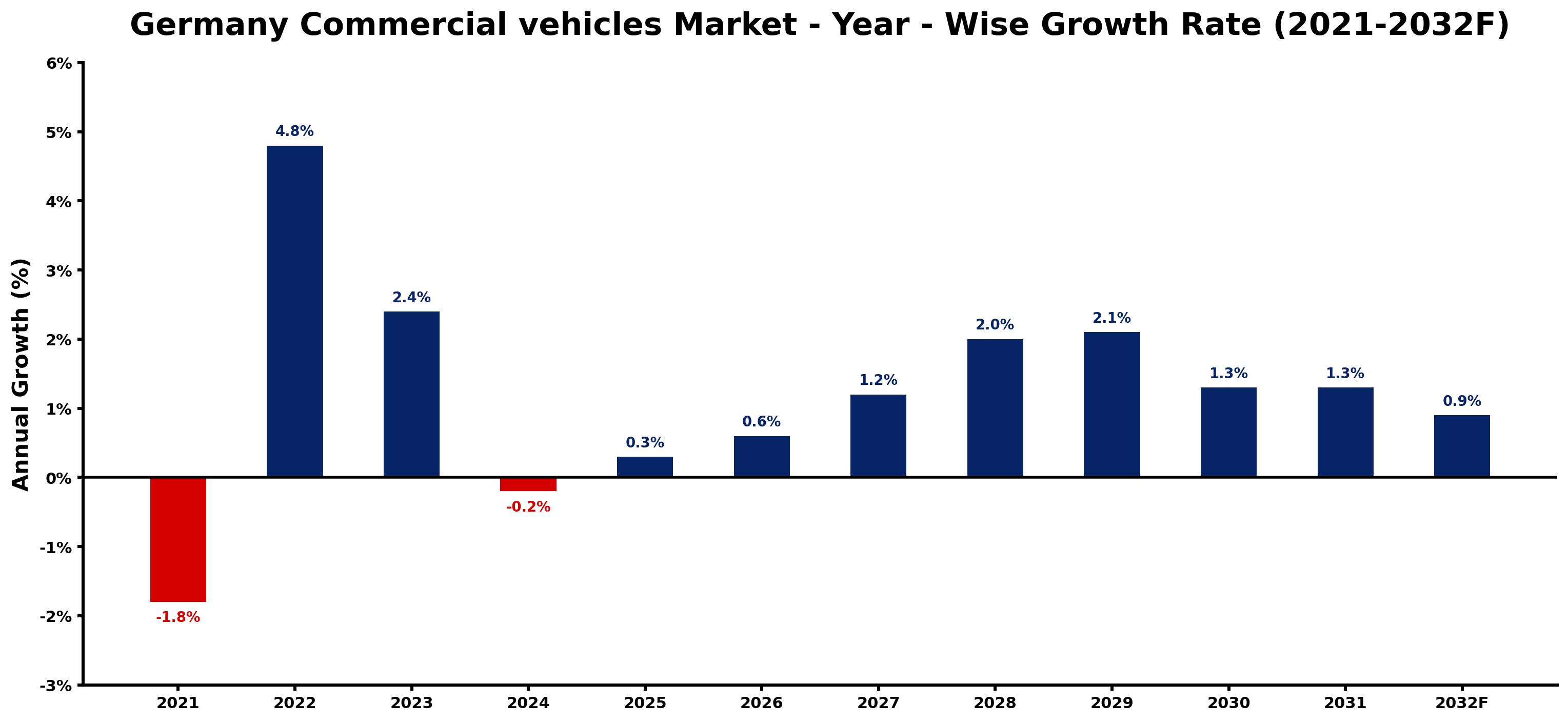
The table below presents the year wise growth rates along with the key drivers influencing the market
| Year | Growth Rate | Major Drivers |
| 2021 | -1.8% | Supply chain disruptions caused by the pandemic hindered vehicle manufacturing and delayed deliveries to customers. |
| 2022 | 4.8% | Supply chain disruptions highlighted the need for robust logistics and transportation solutions. |
| 2023 | 2.4% | Trade agreements within the EU encouraged cross-border transport, enhancing market opportunities. |
| 2024 | -0.2% | Increased supply chain disruptions hindered vehicle availability, leading to diminished buyer interest in commercial transport solutions. |
| 2025 | 0.3% | Local emissions regulations prompted a shift towards cleaner commercial transport alternatives. |
| 2026 | 0.6% | Digitalization in logistics streamlined operations, driving demand for tech-integrated vehicles. |
| 2027 | 1.2% | Infrastructure developments in urban areas created new requirements for specialized commercial vehicles. |
| 2028 | 2.0% | Sustainability commitments by corporations influenced purchasing decisions in the commercial vehicle segment. |
| 2029 | 2.1% | Growing e-commerce platforms necessitated flexible distribution models and vehicle adaptability. |
| 2030 | 1.3% | Collaborations between manufacturers and tech firms spurred innovative solutions in fleet management. |
| 2031 | 1.3% | Increased focus on workforce safety and efficiency led to demand for smart vehicle features. |
| 2032 | 0.9% | Anticipated economic recovery post-pandemic will likely boost capital expenditures in commercial transport. |
Note - Market size estimations and growth projections presented in this report are based on 6Wresearch's advanced forecasting approach, validated with industry datasets as of June 2026.
Germany Commercial vehicles Market Synopsis
The Germany Commercial vehicles Market is projected to reach 0.6% and witness significant growth during the forecast period (2026-2032). This expansion is driven by the increasing demand for various types of commercial vehicles, including trucks, vans, and buses. Factors contributing to this growth encompass the rising e-commerce activities, the accelerating logistics industry, and extensive infrastructure development projects across the country.
Germany Commercial vehicles Market Growth Drivers
Identifying the key growth drivers within the Germany Commercial vehicles Market reveals several critical elements:
- The booming e-commerce sector has led to a surge in demand for commercial vehicles suited for last-mile delivery and logistics, drastically impacting the market dynamics.
- Growth in the logistics industry increases the need for reliable and efficient transportation solutions, which directly boosts the commercial vehicle sector.
- Government-funded infrastructure projects not only enhance road connectivity but also stimulate demand for commercial vehicles designed to facilitate transportation and movement of goods.
- Increased consumer expectations for speedy delivery services necessitate more commercial vehicles with advanced logistics capabilities and features.
- The momentum towards electric and hybrid vehicles, supported by regulatory incentives, fosters innovation and investment within the commercial vehicle manufacturing landscape.
Germany Commercial vehicles Market Trends and Opportunities
Current trends in the Germany Commercial vehicles Market indicate a significant shift towards sustainability and technological advancements. Emphasizing electrification and digitalization, the following trends are shaping the market:
- There is a marked adoption of electric commercial vehicles, driven by consumer awareness and regulatory pressures to reduce overall emissions and carbon footprint.
- The integration of connectivity features in commercial vehicles facilitates better fleet management, enhancing operational efficiency and safety.
- Research and development initiatives targeting autonomous driving technology are making strides, with ongoing projects focusing on improving the functionality of commercial vehicles.
- Investment in electric vehicle infrastructure, such as charging stations, is crucial for accommodating the growing fleet of electric commercial vehicles.
- The shift towards alternative fuel options expands opportunities for businesses looking to innovate and offer cleaner transportation solutions.
Germany Commercial vehicles Market Challenges and Restraints
Despite the optimistic outlook for the Germany Commercial vehicles Market, several challenges must be navigated:
- Stricter emissions regulations necessitate manufacturers to develop vehicles that comply with environmental standards, leading to increased production costs.
- The transition to electric and autonomous vehicles poses infrastructure challenges, particularly regarding the availability of charging stations and consumer readiness.
- Fluctuating fuel prices impact operational costs, influencing consumer purchasing decisions and affecting the overall market stability.
- Economic uncertainties may deter investment in new technologies, which are essential for maintaining competitiveness in the market.
- Rising competition from international markets necessitates that local manufacturers continuously innovate and adapt to changing consumer preferences.
Germany Commercial vehicles Market Investment Opportunities
The Germany Commercial vehicles Market is ripe with investment opportunities, particularly in the following areas:
- The consistent demand for logistics and transportation solutions serves as a reliable area for investments, given Germany's strong economy and robust manufacturing sector.
- Growing interest in electric and hybrid vehicles reflects the market's shift towards sustainable energy solutions, attracting investment in the clean energy sector.
- Technological advancements, especially in connectivity and autonomous driving, offer potential avenues for innovation and growth, promising returns for early investors.
- The development of charging infrastructure for electric vehicles presents an opportunity for significant capital allocation, aligning with emerging trends in sustainability.
- Strategic collaborations and partnerships within the industry can enhance market positioning and drive efficiency, creating further investment prospects.
Germany Commercial vehicles Market Government Investment and Initiatives
The German government plays a pivotal role in promoting the commercial vehicles market through various initiatives and policies:
- Incentives for adopting low-emission vehicles have been established to encourage businesses to transition towards cleaner transportation solutions.
- Public spending on infrastructure development supports an extensive transportation network, facilitating efficient movement of goods and services.
- Stricter emissions standards are enforced to push manufacturers towards producing more environmentally friendly vehicles.
- Regulations focusing on road safety and vehicle compliance are implemented to ensure high safety standards within the commercial vehicles sector.
- Investment in research and development projects aligned with sustainable goals demonstrates the government's commitment to enhancing the commercial vehicles market.
Germany Commercial vehicles Market Latest Developments (May 2025 - June 2026)
During the period from May 2025 to June 2026, the Germany Commercial vehicles Market witnessed critical developments:
- There has been a significant uptick in the introduction of electric commercial vehicles, aligning with the country's environmental goals and consumer demand.
- Research initiatives focusing on autonomous driving technology are yielding promising results, enhancing the functionality and appeal of commercial vehicles.
- Partnerships between technology firms and vehicle manufacturers have been forged to accelerate the development of connected vehicle solutions.
- Ongoing government initiatives supporting electric mobility have facilitated investment in infrastructure, particularly regarding charging facilities for electric commercial vehicles.
- The logistics industry's evolving needs have prompted manufacturers to innovate, leading to the development of vehicles tailored for last-mile delivery efficiency.
Germany Commercial vehicles Market - Key Attractiveness of the Report
- 10 Years of Market Numbers
- Historical Data Starting from 2022 to 2025
- Base Year: 2025
- Forecast Data until 2032
- Key Performance Indicators Impacting the Market
- Major Upcoming Developments and Projects
Key Highlights of the Report:
- Germany Commercial vehicles Market Outlook
- Market Size of Germany Commercial vehicles Market, 2025
- Forecast of Germany Commercial vehicles Market, 2032F
- Historical Data and Forecast of Germany Commercial vehicles Revenues & Volume for the Period 2022-2032F
- Germany Commercial vehicles Market Trend Evolution
- Germany Commercial vehicles Market Drivers and Challenges
- Germany Commercial vehicles Price Trends
- Germany Commercial vehicles Porter's Five Forces
- Germany Commercial vehicles Industry Life Cycle
- Historical Data and Forecast of Germany Commercial vehicles Market Revenues & Volume By Product for the Period 2022-2032F
- Historical Data and Forecast of Germany Commercial vehicles Market Revenues & Volume By Light Commercial Vehicles (LCVs) for the Period 2022-2032F
- Historical Data and Forecast of Germany Commercial vehicles Market Revenues & Volume By Heavy Trucks for the Period 2022-2032F
- Historical Data and Forecast of Germany Commercial vehicles Market Revenues & Volume By Buses & Coaches for the Period 2022-2032F
- Historical Data and Forecast of Germany Commercial vehicles Market Revenues & Volume By End-Users for the Period 2022-2032F
- Historical Data and Forecast of Germany Commercial vehicles Market Revenues & Volume By Industrial for the Period 2022-2032F
- Historical Data and Forecast of Germany Commercial vehicles Market Revenues & Volume By Mining & Construction for the Period 2022-2032F
- Historical Data and Forecast of Germany Commercial vehicles Market Revenues & Volume By Logistics for the Period 2022-2032F
- Historical Data and Forecast of Germany Commercial vehicles Market Revenues & Volume By Passenger Transportation for the Period 2022-2032F
- Historical Data and Forecast of Germany Commercial vehicles Market Revenues & Volume By Others for the Period 2022-2032F
- Germany Commercial vehicles Import Export Trade Statistics
- Market Opportunity Assessment By Product
- Market Opportunity Assessment By End-Users
- Germany Commercial vehicles Top Companies Market Share
- Germany Commercial vehicles Competitive Benchmarking By Technical and Operational Parameters
- Germany Commercial vehicles Company Profiles
- Germany Commercial vehicles Key Strategic Recommendations






































