Egypt Commercial vehicles Market Summary
The egypt commercial vehicles market was estimated at USD 206 Million in 2025 and is projected to reach USD 278 Million by 2032, growing at a CAGR of 5.4% from 2026 to 2032.
Egypt Commercial vehicles Market Year-wise Growth Rate and Key Drivers
This graph highlights how the Egypt Commercial vehicles Market has steadily grown over the past five years, supported by major growth factors.
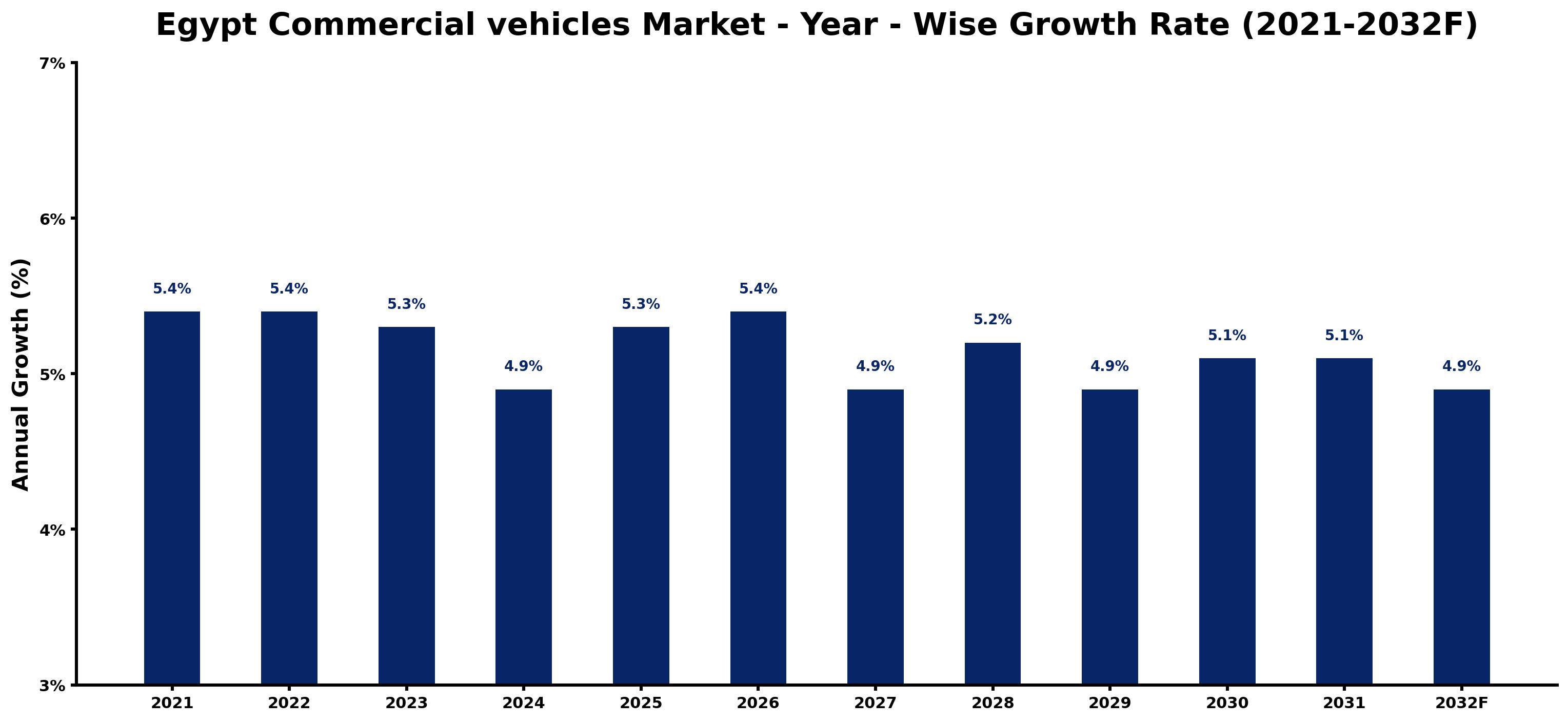
The table below presents the year wise growth rates along with the key drivers influencing the market
| Year | Growth Rate | Major Drivers |
| 2021 | 5.4% | The logistics sector faces challenges with outdated fleets, impacting transportation efficiency significantly. |
| 2022 | 5.4% | Emerging e-commerce platforms capitalize on last-mile delivery, necessitating more commercial vehicles. |
| 2023 | 5.3% | Infrastructure improvements, backed by foreign investments, enhance road networks across Egypt. |
| 2024 | 4.9% | Local manufacturers are increasingly producing vehicles, reducing reliance on imports and costs. |
| 2025 | 5.3% | Rural electrification projects drive demand for utility vehicles tailored for remote areas. |
| 2026 | 5.4% | Manufacturers respond to rising fuel efficiency standards, innovating hybrid and electric models. |
| 2027 | 4.9% | Urbanization trends push demand for cargo vans and light commercial vehicles dramatically. |
| 2028 | 5.2% | Increased focus on logistics hubs creates vibrant markets for specialized commercial vehicle types. |
| 2029 | 4.9% | Tourism rebound leads to a surge in demand for passenger transport vehicles across cities. |
| 2030 | 5.1% | Government investments in smart city initiatives revolutionize urban mobility and vehicle requirements. |
| 2031 | 5.1% | Export opportunities expand as regional trade agreements enhance Egypt's commercial transport capacity. |
| 2032 | 4.9% | Technological advancements in fleet management systems optimize vehicle operations and reduce costs. |
Note - Market size estimations and growth projections presented in this report are based on 6Wresearch's advanced forecasting approach, validated with industry datasets as of June 2026.
Egypt Commercial vehicles Market Synopsis
The Egypt Commercial vehicles Market is projected to reach 5.4% and witness significant growth during the forecast period (2026-2032). The market is anticipated to grow at a compound annual growth rate (CAGR) of 8.9%, driven by various factors including rising disposable incomes, increasing urbanization, and a growing demand for transportation services. The expansion of infrastructure projects and favorable government policies also play crucial roles in fostering a robust environment for commercial vehicle sales across the region.
Egypt Commercial vehicles Market Growth Drivers
Several key factors are acting as growth drivers for the Egypt Commercial vehicles Market. First, the increase in disposable income among the population allows for an expanded capability to invest in commercial vehicles. This trend is particularly evident in urban areas where the demand for logistics and transportation is escalating.
- The ongoing urbanization in Egypt contributes significantly to the demand for commercial vehicles as municipalities and private enterprises seek efficient transport solutions.
- Government incentives, including tax exemptions on imported heavy-duty trucks and buses, are motivating businesses to invest in new vehicles, thus stimulating market growth.
- Increased foreign direct investment is enhancing the economic landscape, leading to greater opportunities for transportation services in sectors such as agriculture and manufacturing.
- Rising consumer interest in electric vehicles is also influencing the market, as more businesses begin to adopt environmentally friendly options that promise lower operational costs and reduced emissions.
- Infrastructure development projects, such as road improvements and new logistics hubs, are creating a more conducive environment for commercial vehicle operations, further fueling demand.
Egypt Commercial vehicles Market Investment Opportunities
As the Egypt Commercial vehicles Market continues to grow, various investment opportunities emerge across different segments. Businesses looking to capitalize on this growth can explore several avenues.
- Investing in electric and hybrid vehicle technologies can be particularly lucrative as local manufacturers and importers respond to the shift toward sustainability.
- Partnerships with logistics and distribution companies can provide direct access to a burgeoning market, as these entities seek to upgrade their fleets to meet increasing demand.
- Research and development in smart vehicle technologies is a promising area for investment, as automation and telematics become increasingly significant in the commercial vehicle sector.
- Investments in fleet management software solutions can enhance operational efficiency for businesses, aligning with the growing demand for cost-effective transportation options.
- A focus on offering financing options for small and medium-sized enterprises (SMEs) can open doors to a broader customer base looking to invest in commercial vehicles.
Egypt Commercial vehicles Market Government Investment and Initiatives
The government of Egypt has implemented several initiatives to promote growth in the commercial vehicles sector. These initiatives encompass various policies aimed at enhancing infrastructure and incentivizing vehicle purchases.
- The government has launched infrastructure development projects designed to improve road networks, which will facilitate better movement of commercial vehicles across the country.
- Tax relief and exemptions for heavy-duty commercial vehicles are encouraging businesses to renew and expand their fleets, ultimately improving logistics capabilities.
- Public funding has been directed toward enhancing transportation services, particularly in urban areas, which in turn supports the growth of the commercial vehicle market.
- Regulatory frameworks are being established to streamline the process for importing electric vehicles, aligning with national sustainability goals and stimulating demand for greener options.
- Strategic public-private partnerships are being promoted to leverage funding and expertise in developing advanced transport solutions, ensuring the sector remains competitive.
Egypt Commercial vehicles Market Latest Developments (May 2025 - June 2026)
During the period from May 2025 to June 2026, the Egypt Commercial vehicles Market has witnessed several notable developments. These include increased investments in electric vehicle infrastructure as the government emphasizes sustainability. Additionally, advancements in logistics technology have prompted companies to adopt newer fleet management systems, enhancing operational efficiency.
- Initiatives to streamline import processes for commercial vehicles have been introduced to encourage more businesses to enter the market and upgrade their fleets.
- A growing focus on safety regulations has led to stricter compliance requirements for commercial vehicles, prompting manufacturers to innovate in safety features.
- Collaborations between private sectors and government bodies have resulted in the development of training programs aimed at improving driver skills and operational standards.
- The local automotive industry is placing greater emphasis on research and development, particularly in electric and hybrid technologies, to meet rising consumer demand.
- Market players are responding to changing consumer preferences by diversifying their product offerings, including a wider range of electric and alternative fuel vehicles.
Egypt Commercial vehicles Market - Key Attractiveness of the Report
- 10 Years of Market Numbers
- Historical Data Starting from 2022 to 2025
- Base Year: 2025
- Forecast Data until 2032
- Key Performance Indicators Impacting the Market
- Major Upcoming Developments and Projects
Key Highlights of the Report:
- Egypt Commercial vehicles Market Outlook
- Market Size of Egypt Commercial vehicles Market, 2025
- Forecast of Egypt Commercial vehicles Market, 2032F
- Historical Data and Forecast of Egypt Commercial vehicles Revenues & Volume for the Period 2022-2032F
- Egypt Commercial vehicles Market Trend Evolution
- Egypt Commercial vehicles Market Drivers and Challenges
- Egypt Commercial vehicles Price Trends
- Egypt Commercial vehicles Porter's Five Forces
- Egypt Commercial vehicles Industry Life Cycle
- Historical Data and Forecast of Egypt Commercial vehicles Market Revenues & Volume By Product for the Period 2022-2032F
- Historical Data and Forecast of Egypt Commercial vehicles Market Revenues & Volume By Light Commercial Vehicles (LCVs) for the Period 2022-2032F
- Historical Data and Forecast of Egypt Commercial vehicles Market Revenues & Volume By Heavy Trucks for the Period 2022-2032F
- Historical Data and Forecast of Egypt Commercial vehicles Market Revenues & Volume By Buses & Coaches for the Period 2022-2032F
- Historical Data and Forecast of Egypt Commercial vehicles Market Revenues & Volume By End-Users for the Period 2022-2032F
- Historical Data and Forecast of Egypt Commercial vehicles Market Revenues & Volume By Industrial for the Period 2022-2032F
- Historical Data and Forecast of Egypt Commercial vehicles Market Revenues & Volume By Mining & Construction for the Period 2022-2032F
- Historical Data and Forecast of Egypt Commercial vehicles Market Revenues & Volume By Logistics for the Period 2022-2032F
- Historical Data and Forecast of Egypt Commercial vehicles Market Revenues & Volume By Passenger Transportation for the Period 2022-2032F
- Historical Data and Forecast of Egypt Commercial vehicles Market Revenues & Volume By Others for the Period 2022-2032F
- Egypt Commercial vehicles Import Export Trade Statistics
- Market Opportunity Assessment By Product
- Market Opportunity Assessment By End-Users
- Egypt Commercial vehicles Top Companies Market Share
- Egypt Commercial vehicles Competitive Benchmarking By Technical and Operational Parameters
- Egypt Commercial vehicles Company Profiles
- Egypt Commercial vehicles Key Strategic Recommendations






































