Tunisia Commercial vehicles Market Summary
The tunisia commercial vehicles market was estimated at USD 1250 Million in 2025 and is projected to reach USD 1790 Million by 2032, growing at a CAGR of 5.9% from 2026 to 2032.
Tunisia Commercial vehicles Market Year-wise Growth Rate and Key Drivers
This graph highlights how the Tunisia Commercial vehicles Market has steadily grown over the past five years, supported by major growth factors.
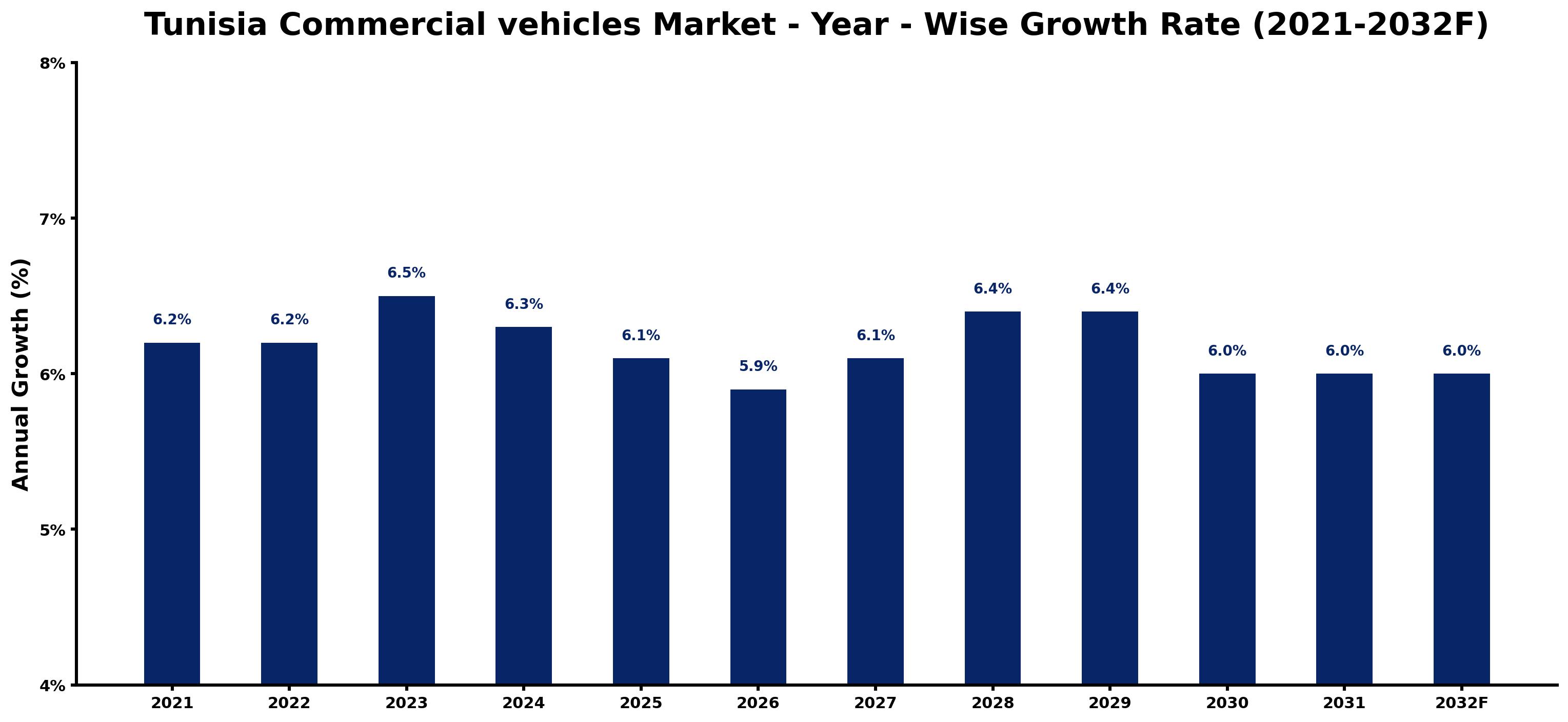
The table below presents the year wise growth rates along with the key drivers influencing the market
| Year | Growth Rate | Major Drivers |
| 2021 | 6.2% | Post-pandemic recovery led to increased logistics operations and commercial vehicle utilization. |
| 2022 | 6.2% | Local manufacturing efforts enhanced vehicle production, reducing reliance on imports significantly. |
| 2023 | 6.5% | Infrastructure investments spurred demand for larger, more robust commercial vehicles across sectors. |
| 2024 | 6.3% | Urbanization trends create a need for efficient transport solutions in growing cities. |
| 2025 | 6.1% | Rising e-commerce activities drive demand for last-mile delivery vehicles and logistics support. |
| 2026 | 5.9% | Technological upgrades in fleet management systems optimize vehicle usage and reduce operational costs. |
| 2027 | 6.1% | Increased foreign investments focus on enhancing transportation networks and commercial vehicle standards. |
| 2028 | 6.4% | Shifts towards sustainable practices prompt interest in electric commercial vehicle options. |
| 2029 | 6.4% | Growing tourism sector demands more commercial transport solutions for visitors and locals. |
| 2030 | 6.0% | Logistics hubs in coastal areas boost demand for specialized commercial vehicles and services. |
| 2031 | 6.0% | A competitive market landscape encourages innovation among manufacturers for enhanced vehicle features. |
| 2032 | 6.0% | Post-covid economic stability reinforces long-term investments in commercial vehicle fleets. |
Note - Market size estimations and growth projections presented in this report are based on 6Wresearch's advanced forecasting approach, validated with industry datasets as of June 2026.
Tunisia Commercial vehicles Market Synopsis
The Tunisia Commercial vehicles Market is projected to reach 5.9% and witness significant growth during the forecast period (2026-2032). The market is anticipated to expand at a compound annual growth rate (CAGR) of 4.8%, driven by increasing demand for various categories of commercial vehicles, including light and heavy-duty trucks, vans, and buses. This growth trajectory is supported by several factors, including government initiatives aimed at promoting green technology and advancements in production automation, while challenges such as rising fuel prices may pose constraints.
Tunisia Commercial vehicles Market Growth Drivers
Several key factors are propelling the Tunisia Commercial vehicles Market forward. Firstly, there is a notable increase in the demand for logistics and transportation solutions, spurred by economic growth and urbanization. Additionally, the expansion of the e-commerce sector has amplified the need for efficient delivery services, leading to a surge in demand for light-duty vehicles.
- The rising trend of urbanization in Tunisia creates a significant need for commercial vehicles to facilitate public transport and freight movement across cities.
- Government initiatives focused on infrastructure development are expected to enhance the operational efficiency of commercial vehicle fleets, particularly in urban areas.
- Investment in renewable energy sources by the government positions the market for growth in electric and hybrid commercial vehicles, aligning with global sustainability trends.
- Automation and technological advancements in manufacturing processes are resulting in cost-efficient production and improved vehicle quality, bolstering market growth.
- The integration of telematics in commercial vehicles for fleet management is becoming increasingly prevalent, improving operational efficiency and reducing costs for businesses.
Tunisia Commercial vehicles Market Challenges and Restraints
Despite the growth potential, the Tunisia Commercial vehicles Market faces several challenges that may hinder progress. One of the primary concerns is the rise in fuel prices, which can adversely affect operating costs for businesses relying on commercial vehicles. Furthermore, the ongoing economic fluctuations could impact consumer purchasing power, leading to reduced demand for new vehicles.
- High fuel prices can significantly increase operating expenses, making it difficult for businesses to maintain profitable margins in logistics.
- Economic instability may result in fluctuating demand, affecting vehicle sales and investment in commercial fleets.
- Lack of adequate infrastructure in certain regions can limit the efficiency and effectiveness of commercial vehicle operations.
- Competition from alternative transportation modes, such as rail and maritime, may limit market expansion for road-based commercial freight.
- Stringent regulations regarding emissions and vehicle safety standards can increase compliance costs for manufacturers and operators.
Tunisia Commercial vehicles Market Government Investment and Initiatives
The Tunisian government recognizes the importance of the commercial vehicles market and has initiated various policies aimed at fostering growth and sustainability. These initiatives include tax incentives for businesses investing in green automotive technologies and support for the adoption of electric and hybrid vehicles. By encouraging the modernization of the fleet, the government aims to improve air quality and reduce reliance on fossil fuels.
- Investment in infrastructure projects, such as highways and urban transport systems, enhances the operational landscape for commercial vehicles.
- Public spending on road maintenance and development is critical to ensuring that commercial vehicles can operate efficiently and safely.
- Initiatives promoting public transport will likely increase the demand for buses and other commercial vehicles that serve mass transit needs.
- Government grants and subsidies for businesses transitioning to electric vehicles help reduce the financial burden associated with upgrading fleets.
- Collaboration with international organizations and private sector stakeholders enhances funding opportunities for large-scale development projects related to commercial transportation.
Tunisia Commercial vehicles Market Latest Developments (May 2025 - June 2026)
Recent developments in the Tunisia Commercial vehicles Market indicate a strong focus on sustainable practices and technological advancements. The ongoing transition towards green automotive technology reflects a concerted effort among industry stakeholders to innovate in response to global environmental standards. Additionally, increased investment in automation technology is reshaping the manufacturing process, leading to more efficient and cost-effective production methods. The role of public-private partnerships is becoming increasingly significant, with collaborative efforts aimed at improving infrastructure and enhancing fleet management solutions. These developments signal a positive outlook for the market, aligning with both national and global trends.
Tunisia Commercial vehicles Market - Key Attractiveness of the Report
- 10 Years of Market Numbers
- Historical Data Starting from 2022 to 2025
- Base Year: 2025
- Forecast Data until 2032
- Key Performance Indicators Impacting the Market
- Major Upcoming Developments and Projects
Key Highlights of the Report:
- Tunisia Commercial vehicles Market Outlook
- Market Size of Tunisia Commercial vehicles Market, 2025
- Forecast of Tunisia Commercial vehicles Market, 2032F
- Historical Data and Forecast of Tunisia Commercial vehicles Revenues & Volume for the Period 2022-2032F
- Tunisia Commercial vehicles Market Trend Evolution
- Tunisia Commercial vehicles Market Drivers and Challenges
- Tunisia Commercial vehicles Price Trends
- Tunisia Commercial vehicles Porter's Five Forces
- Tunisia Commercial vehicles Industry Life Cycle
- Historical Data and Forecast of Tunisia Commercial vehicles Market Revenues & Volume By Product for the Period 2022-2032F
- Historical Data and Forecast of Tunisia Commercial vehicles Market Revenues & Volume By Light Commercial Vehicles (LCVs) for the Period 2022-2032F
- Historical Data and Forecast of Tunisia Commercial vehicles Market Revenues & Volume By Heavy Trucks for the Period 2022-2032F
- Historical Data and Forecast of Tunisia Commercial vehicles Market Revenues & Volume By Buses & Coaches for the Period 2022-2032F
- Historical Data and Forecast of Tunisia Commercial vehicles Market Revenues & Volume By End-Users for the Period 2022-2032F
- Historical Data and Forecast of Tunisia Commercial vehicles Market Revenues & Volume By Industrial for the Period 2022-2032F
- Historical Data and Forecast of Tunisia Commercial vehicles Market Revenues & Volume By Mining & Construction for the Period 2022-2032F
- Historical Data and Forecast of Tunisia Commercial vehicles Market Revenues & Volume By Logistics for the Period 2022-2032F
- Historical Data and Forecast of Tunisia Commercial vehicles Market Revenues & Volume By Passenger Transportation for the Period 2022-2032F
- Historical Data and Forecast of Tunisia Commercial vehicles Market Revenues & Volume By Others for the Period 2022-2032F
- Tunisia Commercial vehicles Import Export Trade Statistics
- Market Opportunity Assessment By Product
- Market Opportunity Assessment By End-Users
- Tunisia Commercial vehicles Top Companies Market Share
- Tunisia Commercial vehicles Competitive Benchmarking By Technical and Operational Parameters
- Tunisia Commercial vehicles Company Profiles
- Tunisia Commercial vehicles Key Strategic Recommendations






































