Algeria Commercial vehicles Market Summary
The algeria commercial vehicles market was estimated at USD 259 Million in 2025 and is projected to reach USD 342 Million by 2032, growing at a CAGR of 5.1% from 2026 to 2032.
Algeria Commercial vehicles Market Year-wise Growth Rate and Key Drivers
This graph highlights how the Algeria Commercial vehicles Market has steadily grown over the past five years, supported by major growth factors.
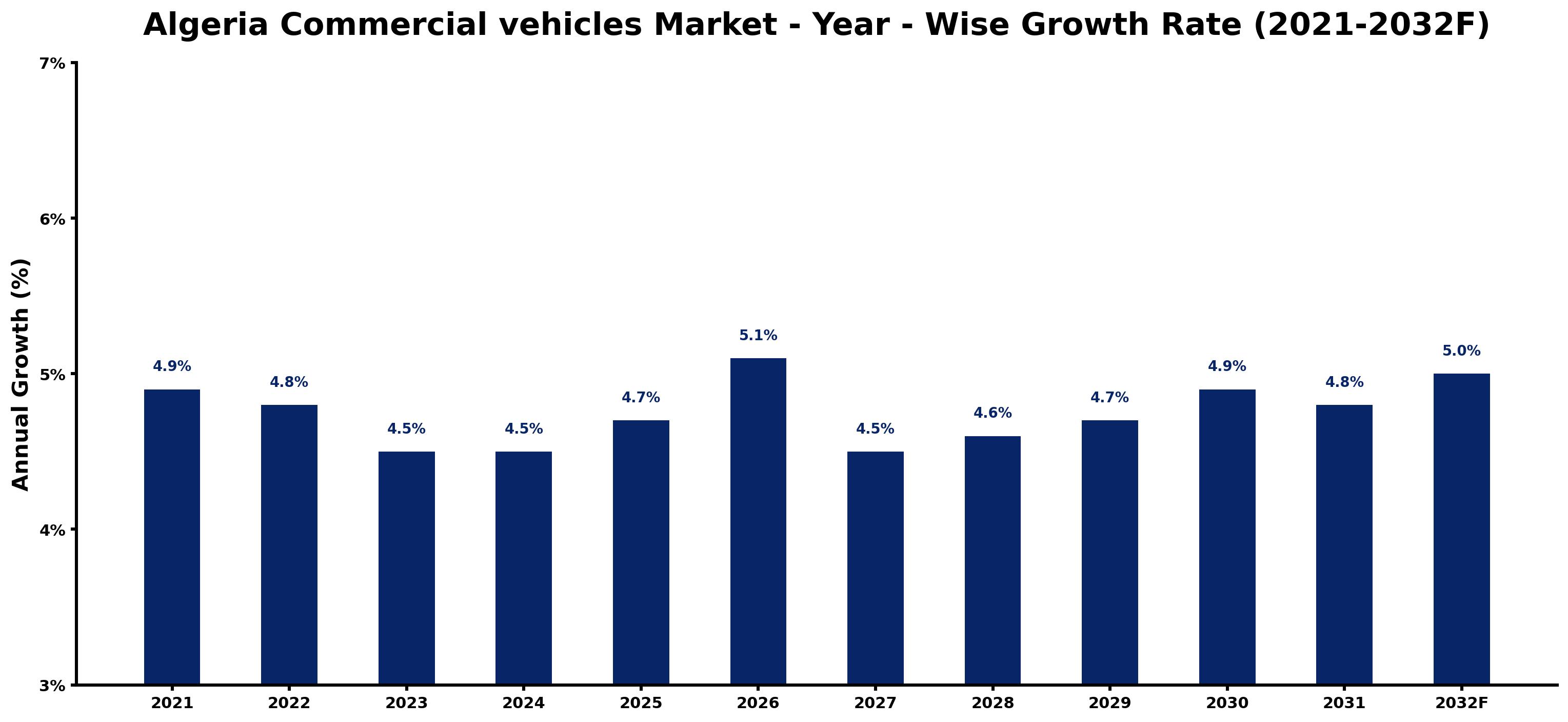
The table below presents the year wise growth rates along with the key drivers influencing the market
| Year | Growth Rate | Major Drivers |
| 2021 | 4.9% | Economic recovery sparks increased investment in infrastructure and transportation projects. |
| 2022 | 4.8% | Local manufacturers ramp up production to meet domestic commercial vehicle needs. |
| 2023 | 4.5% | Urbanization trends push logistics companies to expand their vehicle fleets significantly. |
| 2024 | 4.5% | Significant growth in e-commerce elevates the demand for delivery vehicles across cities. |
| 2025 | 4.7% | Emerging technologies in fleet management enhance operational efficiencies for businesses. |
| 2026 | 5.1% | Regional trade agreements facilitate easier cross-border transport and vehicle importation. |
| 2027 | 4.5% | Environmental concerns prompt companies to consider energy-efficient vehicle options. |
| 2028 | 4.6% | Infrastructure improvements by the government support heavier transportation demands nationwide. |
| 2029 | 4.7% | The rise of ride-sharing services influences commercial vehicle design specifications. |
| 2030 | 4.9% | Increased consumer goods production in Algeria necessitates more robust logistics solutions. |
| 2031 | 4.8% | The ongoing shift towards electric vehicles reshapes commercial transport landscapes considerably. |
| 2032 | 5.0% | Competitive market dynamics drive innovation in vehicle features and customer service offerings. |
Note - Market size estimations and growth projections presented in this report are based on 6Wresearch's advanced forecasting approach, validated with industry datasets as of June 2026.
Algeria Commercial vehicles Market Synopsis
The Algeria Commercial vehicles Market is projected to reach 5.1% and witness significant growth during the forecast period (2026-2032). The anticipated growth of the market is primarily driven by an increasing population and rapid urbanization within the country, which are propelling demand for various types of passenger and commercial vehicles. The evolving economic landscape, coupled with improvements in infrastructure, presents a favorable environment for expansion in the commercial vehicles segment.
Algeria Commercial vehicles Market Growth Drivers
Several factors are contributing to the growth of the Algeria Commercial vehicles Market. Firstly, the rising population necessitates enhanced transport solutions, as urban areas expand and require efficient logistics and mobility systems. Secondly, the ongoing urbanization process boosts demand for commercial vehicles, particularly in sectors such as retail, logistics, and public transport. Additionally, the government's commitment to infrastructure development plays a crucial role in promoting the commercial vehicle market.
- The growth of online platforms and e-commerce services is requiring a more robust logistics network, thereby increasing the demand for commercial vehicles that can facilitate deliveries and transportation.
- Modernization of agricultural equipment is creating a need for commercial vehicles capable of supporting agricultural practices, further invigorating the market.
- The expansion of the tourism industry necessitates reliable transportation options, driving demand for commercial vehicles that cater to tourists and tourism-related services.
- Improved access to finance enables businesses and individuals to invest in commercial vehicles, thus enhancing market potential and consumer spending.
- The government's focus on enhancing road infrastructure is expected to further stimulate the market by providing better routes and connectivity for commercial activities.
Algeria Commercial vehicles Market Challenges and Restraints
Despite its growth prospects, the Algeria Commercial vehicles Market faces several challenges and restraints that could impede its progress. One significant challenge is the fluctuating economy, which can affect consumer purchasing power and investment levels in new vehicles. Additionally, regulatory hurdles and bureaucratic processes can create barriers for companies looking to enter or expand within the market. Moreover, competition from used vehicles can restrict new vehicle sales, as many consumers opt for more affordable options.
- Economic instability may lead to uncertainty in investment and purchasing decisions, affecting both consumers and businesses in the commercial vehicles market.
- Regulatory constraints can complicate market entry and expansion, deterring potential investors.
- Increased competition from imported used vehicles may present a challenge for new commercial vehicle sales.
- Infrastructure limitations in certain regions may hinder the operational efficiency of commercial vehicles, impacting overall market growth.
- Variations in fuel prices can impact operating costs for commercial vehicle owners, potentially affecting demand.
Algeria Commercial vehicles Market Government Investment and Initiatives
The government of Algeria has implemented various initiatives aimed at facilitating the growth of the commercial vehicles market. Public investment in road infrastructure is paramount to ensure smooth transportation and logistics, which directly supports the commercial vehicle sector. Development plans focusing on enhancing urban mobility and logistics networks not only improve access but also attract potential investors to the market.
- The government's emphasis on enhancing public transport systems targets an increase in the demand for commercial vehicles that can serve urban transit needs.
- Incentives for local manufacturing of commercial vehicles may be introduced to reduce dependency on imports and stimulate local economies.
- Government programs aimed at improving access to financing for small and medium enterprises (SMEs) can expand the customer base for commercial vehicle purchases.
- Public-private partnerships (PPPs) are increasingly being explored to leverage investment in infrastructure projects beneficial to the commercial vehicle sector.
- Support for research and development in transportation technology is expected to yield innovations that can enhance the efficiency and appeal of commercial vehicles.
Algeria Commercial vehicles Market Latest Developments (May 2025 - June 2026)
Throughout the period from May 2025 to June 2026, the Algeria Commercial vehicles Market has seen several strategic developments that reflect its evolving landscape. Enhanced collaboration between the government and the private sector has led to initiatives focused on infrastructure improvement and transport policy enhancement, aiming to facilitate market growth. The rise in e-commerce has prompted logistics companies to invest in new commercial vehicles to meet increasing demand for timely deliveries.
- New government initiatives were launched focusing on promoting environmentally friendly commercial vehicles, aligning with global sustainability trends.
- Investments in technology advancements for commercial vehicle safety and efficiency have been prioritized, enhancing competitiveness within the market.
- Ongoing discussions regarding tariff adjustments on imported vehicles signal a shift towards supporting local manufacturing.
- Increased participation in international trade fairs has allowed local manufacturers to showcase their commercial vehicles and expand market reach.
- Supply chain disruptions experienced globally influenced local adaptations, leading businesses to diversify their sourcing strategies.
Algeria Commercial vehicles Market - Key Attractiveness of the Report
- 10 Years of Market Numbers
- Historical Data Starting from 2022 to 2025
- Base Year: 2025
- Forecast Data until 2032
- Key Performance Indicators Impacting the Market
- Major Upcoming Developments and Projects
Key Highlights of the Report:
- Algeria Commercial vehicles Market Outlook
- Market Size of Algeria Commercial vehicles Market, 2025
- Forecast of Algeria Commercial vehicles Market, 2032F
- Historical Data and Forecast of Algeria Commercial vehicles Revenues & Volume for the Period 2022-2032F
- Algeria Commercial vehicles Market Trend Evolution
- Algeria Commercial vehicles Market Drivers and Challenges
- Algeria Commercial vehicles Price Trends
- Algeria Commercial vehicles Porter's Five Forces
- Algeria Commercial vehicles Industry Life Cycle
- Historical Data and Forecast of Algeria Commercial vehicles Market Revenues & Volume By Product for the Period 2022-2032F
- Historical Data and Forecast of Algeria Commercial vehicles Market Revenues & Volume By Light Commercial Vehicles (LCVs) for the Period 2022-2032F
- Historical Data and Forecast of Algeria Commercial vehicles Market Revenues & Volume By Heavy Trucks for the Period 2022-2032F
- Historical Data and Forecast of Algeria Commercial vehicles Market Revenues & Volume By Buses & Coaches for the Period 2022-2032F
- Historical Data and Forecast of Algeria Commercial vehicles Market Revenues & Volume By End-Users for the Period 2022-2032F
- Historical Data and Forecast of Algeria Commercial vehicles Market Revenues & Volume By Industrial for the Period 2022-2032F
- Historical Data and Forecast of Algeria Commercial vehicles Market Revenues & Volume By Mining & Construction for the Period 2022-2032F
- Historical Data and Forecast of Algeria Commercial vehicles Market Revenues & Volume By Logistics for the Period 2022-2032F
- Historical Data and Forecast of Algeria Commercial vehicles Market Revenues & Volume By Passenger Transportation for the Period 2022-2032F
- Historical Data and Forecast of Algeria Commercial vehicles Market Revenues & Volume By Others for the Period 2022-2032F
- Algeria Commercial vehicles Import Export Trade Statistics
- Market Opportunity Assessment By Product
- Market Opportunity Assessment By End-Users
- Algeria Commercial vehicles Top Companies Market Share
- Algeria Commercial vehicles Competitive Benchmarking By Technical and Operational Parameters
- Algeria Commercial vehicles Company Profiles
- Algeria Commercial vehicles Key Strategic Recommendations






































