Nigeria Dairy Cream Market Top 5 Importing Countries and Market Competition (HHI) Analysis
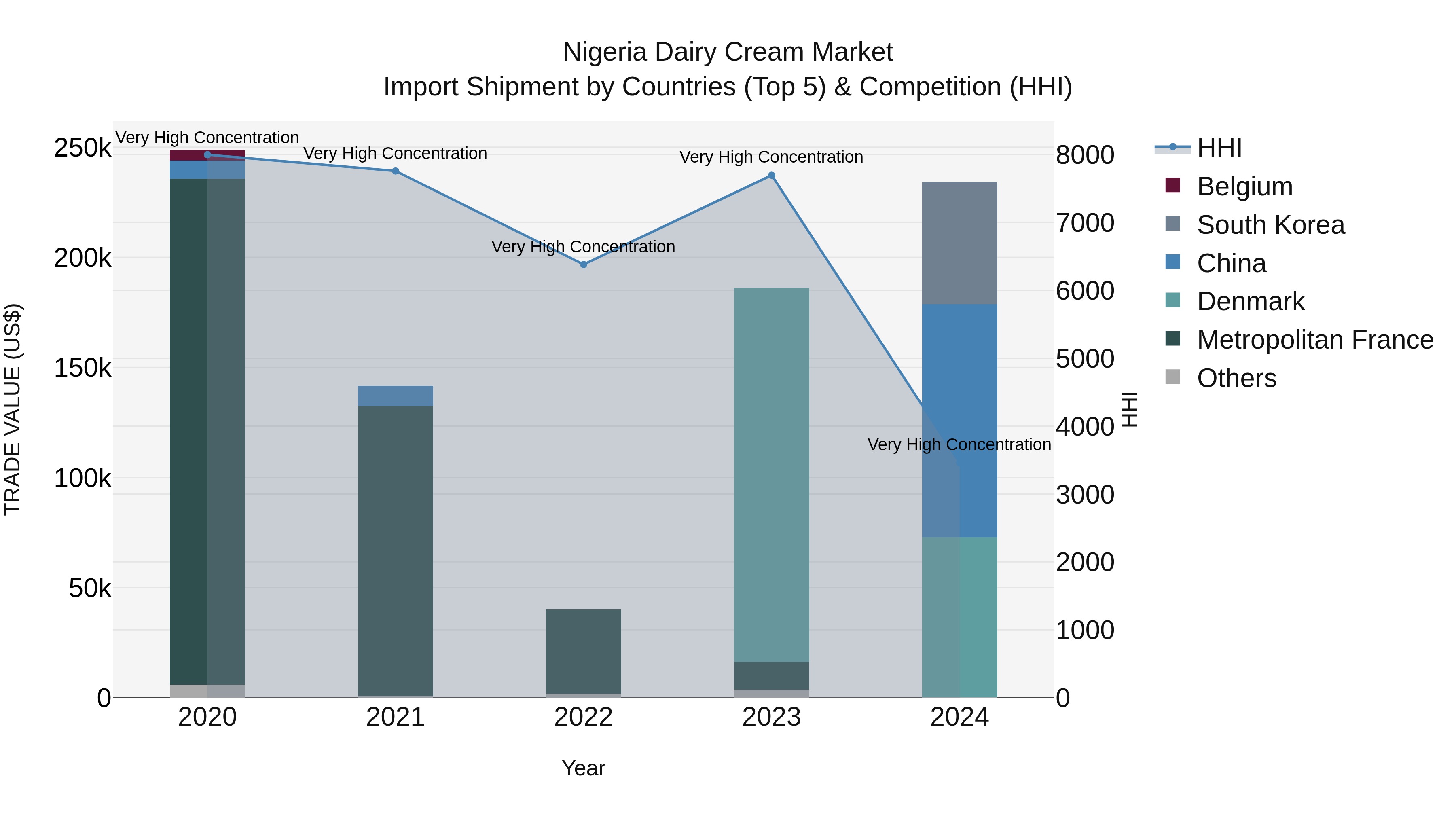
In 2024, Nigeria`s dairy cream import market continued to be dominated by top exporters including China, Denmark, South Korea, USA, and Germany. Despite a challenging CAGR of -1.48% from 2020 to 2024, the market showed a promising growth rate of 25.91% in 2023-24. The high Herfindahl-Hirschman Index (HHI) indicates a concentrated market structure, emphasizing the significance of key players. The consistent presence of these top exporting countries highlights the competitive dynamics shaping Nigeria`s dairy cream import industry in 2024.
Nigeria Dairy Cream Market Overview
The Nigeria Dairy Cream Market is experiencing significant growth driven by increasing consumer demand for dairy products, including cream, due to rising disposable incomes and changing dietary habits. The market is characterized by a wide range of products, including cooking cream, whipping cream, and coffee creamers, catering to various consumer preferences. Key players in the market are focusing on product innovation, including the introduction of flavored and premium cream products, to attract a broader customer base. Distribution channels such as supermarkets, hypermarkets, and online retail platforms play a crucial role in reaching consumers across urban and rural areas. However, challenges such as infrastructure limitations and fluctuating raw material costs are impacting the market`s growth potential, requiring strategic initiatives to ensure sustainable development and meet evolving consumer needs.
Nigeria Dairy Cream Market Trends
The Nigeria Dairy Cream Market is experiencing a growing demand for premium and innovative dairy cream products. Consumers are increasingly seeking healthier and more indulgent options, leading to a rise in demand for organic, low-fat, and lactose-free dairy creams. Additionally, there is a trend towards convenience and on-the-go consumption, driving the popularity of single-serve dairy cream products. Manufacturers are also focusing on product diversification and flavor innovation to cater to evolving consumer preferences. The market is witnessing increased competition among local and international dairy cream brands, leading to aggressive marketing strategies and promotional activities. Overall, the Nigeria Dairy Cream Market is poised for further growth and development as companies continue to cater to consumer demands for high-quality, diverse, and convenient dairy cream products.
Nigeria Dairy Cream Market Challenges
The Nigeria Dairy Cream Market faces several challenges, including limited access to quality raw materials, inconsistent supply chain infrastructure, and high production costs. Additionally, the market is highly fragmented, with many small-scale producers lacking the resources and technology to compete effectively. Consumer preferences and purchasing power also play a significant role, as dairy cream products are considered premium items in Nigeria and may be out of reach for a large portion of the population. Furthermore, regulatory issues, such as import restrictions and quality control measures, add complexity to the market environment. Overall, navigating these challenges requires innovative strategies, investment in infrastructure, and a deep understanding of consumer trends to drive growth in the Nigeria Dairy Cream Market.
Nigeria Dairy Cream Market Investment Opportunities
The Nigeria Dairy Cream Market presents attractive investment opportunities due to increasing demand for dairy products driven by a growing population and rising disposable income levels. Key opportunities include investing in dairy cream production facilities to meet the growing consumer demand for high-quality dairy products. Additionally, there is potential for investment in product innovation and marketing strategies to differentiate offerings, capitalize on changing consumer preferences, and expand market reach. Partnering with local dairy farmers to ensure a sustainable and consistent supply chain could also be a valuable investment opportunity. Overall, the Nigeria Dairy Cream Market offers potential for investors to capitalize on the rising demand for dairy products in the country and establish a strong presence in this growing market segment.
Nigeria Dairy Cream Market Government Policy
The Nigerian government has implemented various policies to support the dairy cream market in the country. One significant policy is the National Livestock Transformation Plan (NLTP) which aims to boost dairy production through improved breeding techniques and infrastructure development. Additionally, the Federal Ministry of Agriculture and Rural Development has introduced schemes such as the Dairy Development Program to enhance the productivity and efficiency of dairy farmers. The government also provides subsidies on key inputs like animal feed to reduce production costs and increase profitability for dairy cream producers. These policies demonstrate the government`s commitment to promoting the growth of the dairy cream market in Nigeria by supporting local producers and ensuring sustainable development in the sector.
Nigeria Dairy Cream Market Future Outlook
The Nigeria Dairy Cream Market is poised for steady growth in the coming years due to increasing consumer demand for dairy products, rising disposable incomes, and a growing population. Factors such as urbanization, changing dietary habits, and a shift towards convenience foods are expected to drive market growth. Additionally, the rising awareness of the health benefits of dairy products and the introduction of innovative product offerings by manufacturers are likely to further boost market expansion. However, challenges such as infrastructure limitations, supply chain issues, and fluctuating raw material prices may impact market growth to some extent. Overall, the Nigeria Dairy Cream Market is projected to experience a positive trajectory with opportunities for market players to capitalize on the growing demand for quality dairy products in the country.
Key Highlights of the Report:
- Nigeria Dairy Cream Market Outlook
- Market Size of Nigeria Dairy Cream Market, 2024
- Forecast of Nigeria Dairy Cream Market, 2031
- Historical Data and Forecast of Nigeria Dairy Cream Revenues & Volume for the Period 2021 - 2031
- Nigeria Dairy Cream Market Trend Evolution
- Nigeria Dairy Cream Market Drivers and Challenges
- Nigeria Dairy Cream Price Trends
- Nigeria Dairy Cream Porter's Five Forces
- Nigeria Dairy Cream Industry Life Cycle
- Historical Data and Forecast of Nigeria Dairy Cream Market Revenues & Volume By Type for the Period 2021 - 2031
- Historical Data and Forecast of Nigeria Dairy Cream Market Revenues & Volume By Fresh Cream for the Period 2021 - 2031
- Historical Data and Forecast of Nigeria Dairy Cream Market Revenues & Volume By Thickened Cream/Heavy Cream for the Period 2021 - 2031
- Historical Data and Forecast of Nigeria Dairy Cream Market Revenues & Volume By Whipping Cream for the Period 2021 - 2031
- Historical Data and Forecast of Nigeria Dairy Cream Market Revenues & Volume By Sour Cream for the Period 2021 - 2031
- Historical Data and Forecast of Nigeria Dairy Cream Market Revenues & Volume By Other Types for the Period 2021 - 2031
- Historical Data and Forecast of Nigeria Dairy Cream Market Revenues & Volume By Distribution Channel for the Period 2021 - 2031
- Historical Data and Forecast of Nigeria Dairy Cream Market Revenues & Volume By Supermarkets/ Hypermarkets for the Period 2021 - 2031
- Historical Data and Forecast of Nigeria Dairy Cream Market Revenues & Volume By Convenince Stores for the Period 2021 - 2031
- Historical Data and Forecast of Nigeria Dairy Cream Market Revenues & Volume By Online Retail Stores for the Period 2021 - 2031
- Historical Data and Forecast of Nigeria Dairy Cream Market Revenues & Volume By Other Distribution Channels for the Period 2021 - 2031
- Nigeria Dairy Cream Import Export Trade Statistics
- Market Opportunity Assessment By Type
- Market Opportunity Assessment By Distribution Channel
- Nigeria Dairy Cream Top Companies Market Share
- Nigeria Dairy Cream Competitive Benchmarking By Technical and Operational Parameters
- Nigeria Dairy Cream Company Profiles
- Nigeria Dairy Cream Key Strategic Recommendations






































