Nigeria Decentralized Identity Market Size & Growth Rate (2026-2032)
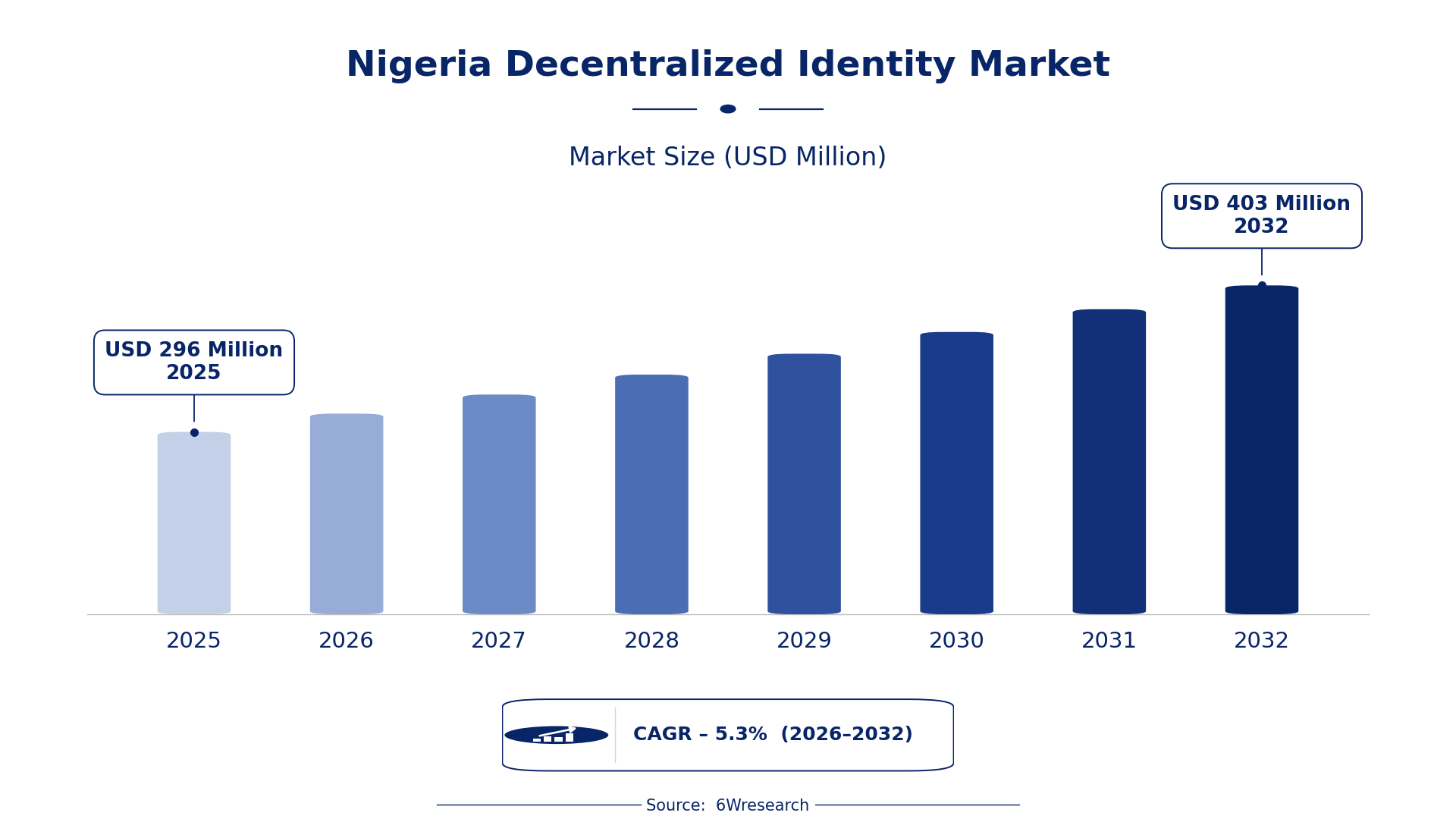
The Nigeria Decentralized Identity Market was estimated at USD 296 Million in 2025 and is projected to reach USD 403 Million by 2032, growing at a CAGR of 5.3% from 2026 to 2032.
Nigeria Decentralized Identity Market Synopsis
The Nigerian decentralized identity market is gaining traction as a fundamental solution to the challenges of traditional identity systems. Businesses and governments are looking for innovative ways to enhance security, particularly in sectors like finance and healthcare, where data integrity is paramount.
As the digital economy expands, the demand for user-controlled identity verification is increasing. This shift is crucial for ensuring privacy and trust among users who are increasingly concerned about data breaches and unauthorized access to their personal information.
Nigeria Decentralized Identity Market Year-wise Growth Rate and Key Drivers
This graph illustrates the annual growth rates of the Nigeria Decentralized Identity Market from 2021 to 2032, highlighting a steady upward trajectory and projected expansion over the forecast period.
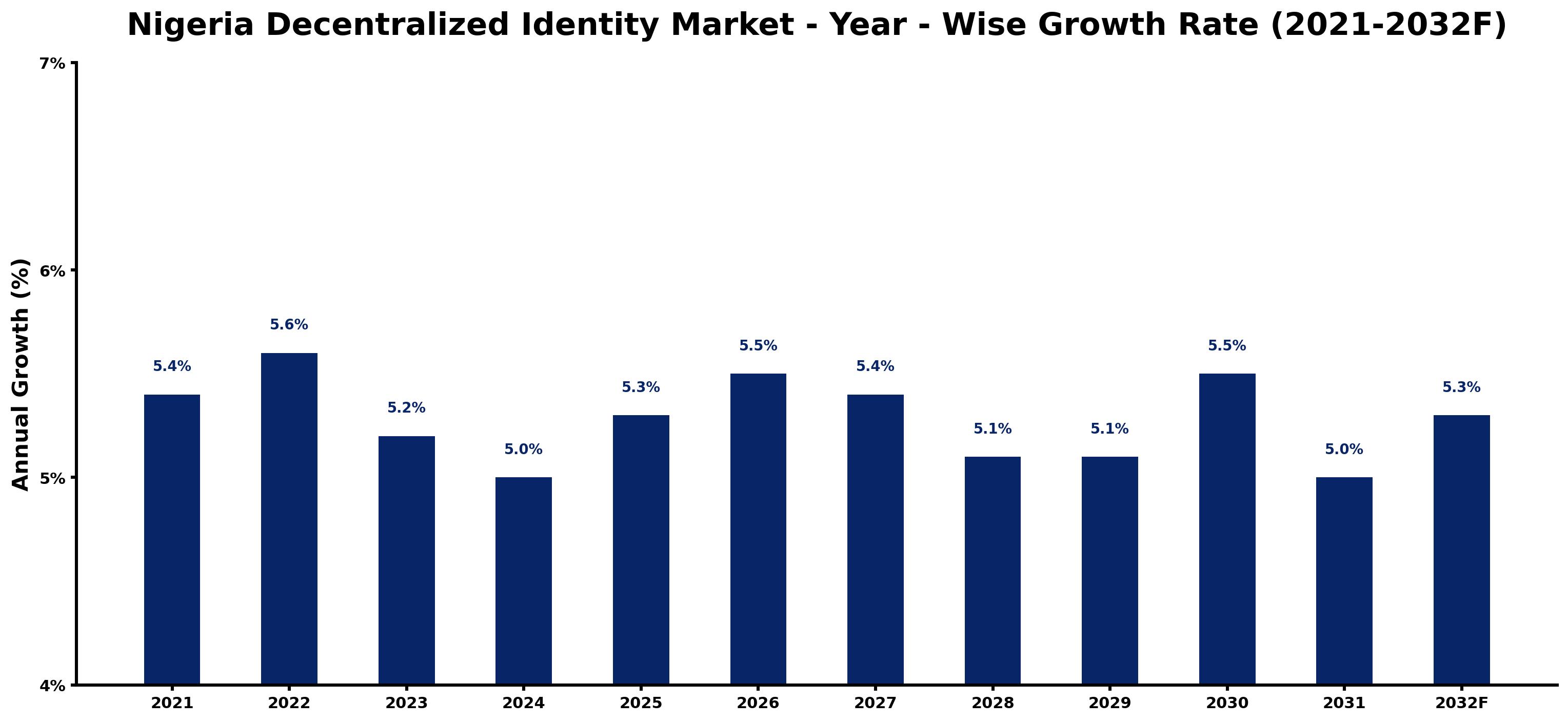
The table below presents the year‑wise growth rates along with the key drivers influencing the market
| Year | Growth Rate | Major Drivers |
| 2021 | 5.4% | National Identity Management Commission's digital ID initiatives |
| 2022 | 5.6% | Rise in mobile phone penetration enhancing identity solutions |
| 2023 | 5.2% | Government promotion of biometric verification systems |
| 2024 | 5.0% | Increased demand for KYC compliance in fintech sector |
| 2025 | 5.3% | Surge in remote work driving digital identity needs |
| 2026 | 5.5% | Policy shifts supporting blockchain-based identity solutions |
| 2027 | 5.4% | Growth in e-commerce fueling identity verification services |
| 2028 | 5.1% | Youth demographic's tech adoption stimulates decentralized identities |
| 2029 | 5.1% | Public-private partnerships advancing identity management frameworks |
| 2030 | 5.5% | Cybersecurity initiatives prioritizing secure digital identities |
| 2031 | 5.0% | Regulatory reforms enhancing trust in online identities |
| 2032 | 5.3% | Adoption of decentralized finance necessitating verified user identities |
Note: Market size estimations and growth projections presented in this report are based on 6Wresearch's proprietary forecasting methodology, utilizing the latest available industry data, government publications, and primary research inputs.
Nigeria Decentralized Identity Market Key Takeaways
Below are some of the specific key takeaways from the market, including:
- The decentralized identity market is primarily driven by a growing demand for security and privacy in digital transactions.
- Government policies are increasingly supportive of decentralized identity initiatives to enhance digital inclusion.
- Interoperability challenges remain a crucial issue that must be addressed for widespread adoption.
- The finance and healthcare sectors are leading the charge in adopting decentralized identity solutions.
- Cultural perceptions regarding data privacy will significantly impact market growth and acceptance.
Evaluation of Restraints in Nigeria Decentralized Identity Market
Despite the promising outlook, several factors are limiting the growth of the decentralized identity market in Nigeria. A major concern is the lack of interoperability among existing platforms, making it challenging for different systems to communicate with one another. Additionally, regulatory compliance remains a daunting task for developers, as existing laws may not fully accommodate this innovative approach to identity management.
Cultural attitudes toward data management and privacy also present hurdles. Many potential users are skeptical about adopting new technologies that promise enhanced security but lack familiarity and trust. For the market to truly flourish, these barriers must be recognized and systematically addressed.
Nigeria Decentralized Identity Market Trends
A notable trend shaping the Nigeria decentralized identity market is the increasing integration of blockchain technology across various applications. Organizations are harnessing blockchain's capabilities for not only securing identities but also for enabling smarter contracts and transparent transactions.
There's also a growing emphasis on user education as stakeholders recognize that empowering individuals with knowledge about decentralized identity systems is critical for widespread acceptance. Workshops and informational sessions are being organized to demystify the technology and its benefits.
Nigeria Decentralized Identity Market Opportunities
The opportunities in the Nigerian decentralized identity market are expansive. As regulatory frameworks evolve, new avenues for innovation and investment are opening up. Public-private partnerships offer a promising route for developing robust identity management systems that can operate efficiently and securely.
Emerging fintech companies are particularly well-positioned to integrate decentralized identity solutions into their offerings, thereby creating a more secure user experience. The healthcare sector, with its dire need for secure patient data handling, is also ripe for growth through these technological advancements.
Government Initiatives in the Nigeria Decentralized Identity Market
Government action plays a crucial role in shaping the Nigeria decentralized identity market. The Nigerian government has prioritized digital inclusion and data protection through supportive policies and frameworks aimed at encouraging decentralized identity solutions. This proactive stance not only promotes private sector investment but also aims to enhance user trust and security in digital transactions.
- A national digital identity strategy launched recently aims to bolster access to services while ensuring individuals retain control over their personal data.
- Currently underway is a public awareness campaign to educate citizens about the benefits and functionalities of decentralized identity systems.
- A regulatory framework was introduced in 2025 to establish guidelines for decentralized identity implementation, ensuring compliance with existing data protection laws.
- Investment in research and development for decentralized technologies is being encouraged, with a focus on fostering innovation within the tech ecosystem.
- Plans for a comprehensive pilot program targeting specific sectors, such as finance and healthcare, are in place to test and refine decentralized identity solutions.
Future Insights of the Nigeria Decentralized Identity Market
Looking towards 2026-2032, the Nigeria decentralized identity market appears set for steady growth. As regulatory frameworks become more defined and public awareness grows, adoption rates are expected to increase significantly. The integration of decentralized identity with emerging technologies such as artificial intelligence and the Internet of Things (IoT) will create new pathways for enhancing user experience and security.
This evolving market will not only transform individual identity management but also has the potential to reshape broader digital ecosystems across various sectors, driving efficiency, and user trust in digital transactions.
Nigeria Decentralized Identity Market Latest Developments
In the last year, the Nigeria decentralized identity market has seen a flurry of activity as stakeholders scramble to establish their presence. Increasing investment in technology and growing governmental support have created a vibrant atmosphere for innovation. The focus has been on building trust and educating the public on the benefits of decentralized identity systems.
- A major initiative aimed at developing a decentralized health record system was launched in Q3 2025, aimed at improving patient data security.
- Partnership agreements between several fintech companies and blockchain developers are ongoing to integrate decentralized identity solutions into financial services.
- A pilot program focused on the education sector is scheduled to launch in early 2026, designed to facilitate secure student identities.
- A leading tech firm announced plans for a decentralized identity service expected to be fully operational by mid-2026.
- Ongoing workshops and seminars are being conducted to enhance understanding of decentralized identity among business stakeholders.
Nigeria Decentralized Identity Market - Key Attractiveness of the Report
- 10 Years of Market Numbers
- Historical Data Starting from 2022 to 2025
- Base Year: 2025
- Forecast Data until 2032
- Key Performance Indicators Impacting the Market
- Major Upcoming Developments and Projects
Key Highlights of the Report:
- Nigeria Decentralized Identity Market Outlook
- Market Size of Nigeria Decentralized Identity Market, 2025
- Forecast of Nigeria Decentralized Identity Market, 2032
- Historical Data and Forecast of Nigeria Decentralized Identity Revenues & Volume for the Period 2022-2032F
- Nigeria Decentralized Identity Market Trend Evolution
- Nigeria Decentralized Identity Market Drivers and Challenges
- Nigeria Decentralized Identity Price Trends
- Nigeria Decentralized Identity Porter's Five Forces
- Nigeria Decentralized Identity Industry Life Cycle
- Historical Data and Forecast of Nigeria Decentralized Identity Market Revenues & Volume By Vertical for the Period 2022-2032F
- Historical Data and Forecast of Nigeria Decentralized Identity Market Revenues & Volume By BFSI for the Period 2022-2032F
- Historical Data and Forecast of Nigeria Decentralized Identity Market Revenues & Volume By Government for the Period 2022-2032F
- Historical Data and Forecast of Nigeria Decentralized Identity Market Revenues & Volume By Healthcare and Life Sciences for the Period 2022-2032F
- Historical Data and Forecast of Nigeria Decentralized Identity Market Revenues & Volume By Retail and eCommerce for the Period 2022-2032F
- Historical Data and Forecast of Nigeria Decentralized Identity Market Revenues & Volume By Telecom and IT for the Period 2022-2032F
- Historical Data and Forecast of Nigeria Decentralized Identity Market Revenues & Volume By Transport and Logistics for the Period 2022-2032F
- Historical Data and Forecast of Nigeria Decentralized Identity Market Revenues & Volume By Real Estate for the Period 2022-2032F
- Historical Data and Forecast of Nigeria BFSI Decentralized Identity Market Revenues & Volume By Others for the Period 2022-2032F
- Historical Data and Forecast of Nigeria Decentralized Identity Market Revenues & Volume By Identity Type for the Period 2022-2032F
- Historical Data and Forecast of Nigeria Decentralized Identity Market Revenues & Volume By Non- biometrics for the Period 2022-2032F
- Historical Data and Forecast of Nigeria Decentralized Identity Market Revenues & Volume By Biometrics for the Period 2022-2032F
- Historical Data and Forecast of Nigeria Decentralized Identity Market Revenues & Volume By End User for the Period 2022-2032F
- Historical Data and Forecast of Nigeria Decentralized Identity Market Revenues & Volume By Enterprises for the Period 2022-2032F
- Historical Data and Forecast of Nigeria Decentralized Identity Market Revenues & Volume By Individual for the Period 2022-2032F
- Historical Data and Forecast of Nigeria Decentralized Identity Market Revenues & Volume By Organization Size for the Period 2022-2032F
- Historical Data and Forecast of Nigeria Decentralized Identity Market Revenues & Volume By Large Enterprises for the Period 2022-2032F
- Historical Data and Forecast of Nigeria Decentralized Identity Market Revenues & Volume By SMEs for the Period 2022-2032F
- Nigeria Decentralized Identity Import Export Trade Statistics
- Market Opportunity Assessment By Vertical
- Market Opportunity Assessment By Identity Type
- Market Opportunity Assessment By End User
- Market Opportunity Assessment By Organization Size
- Nigeria Decentralized Identity Top Companies Market Share
- Nigeria Decentralized Identity Competitive Benchmarking By Technical and Operational Parameters
- Nigeria Decentralized Identity Company Profiles
- Nigeria Decentralized Identity Key Strategic Recommendations






































