Nigeria Document Management System Market Size, Share & Growth Rate
The Nigeria Document Management System Market was estimated at USD 200 Million in 2025 and is projected to reach USD 268 Million by 2032, growing at a CAGR of 4.3% from 2026 to 2032. This upward trajectory is fueled by the rapid digitization of businesses, particularly in sectors such as healthcare, banking, and education, where efficient data organization is paramount. With increasing regulatory requirements and a growing emphasis on operational efficiency, organizations are prioritizing the implementation of robust document management solutions.
Nigeria Document Management System Market Year-wise Growth Rate and Key Drivers
This graph highlights how the Nigeria Document Management System Market has steadily grown over the years, supported by major growth factors.
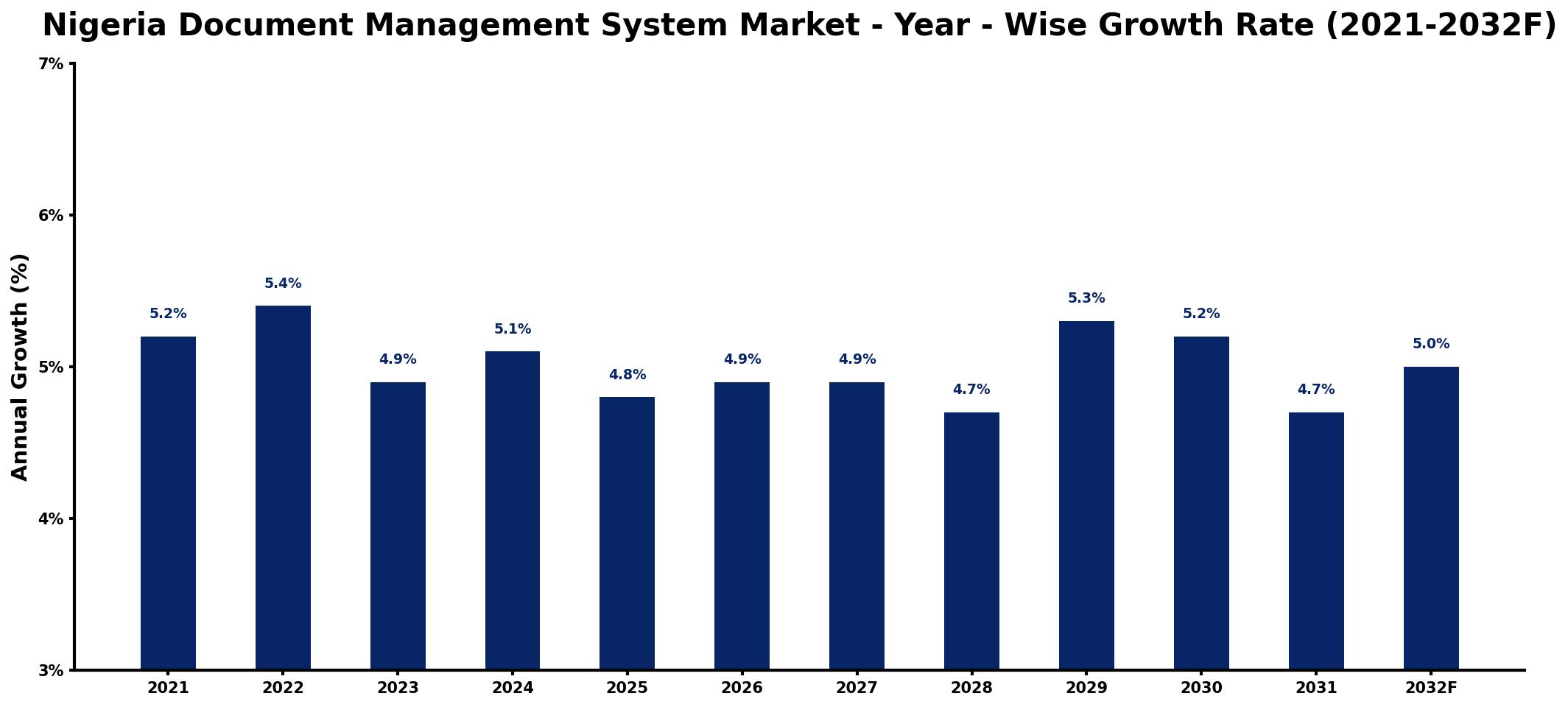
The table below presents the year‑wise growth rates along with the key drivers influencing the market
| Year | Growth Rate | Major Drivers |
| 2021 | 5.2% | rising interest in digital solutions |
| 2022 | 5.4% | increased regulatory compliance requirements |
| 2023 | 4.9% | growing remote work adoption rates |
| 2024 | 5.1% | expansion of cloud technology usage |
| 2025 | 4.8% | investments in cybersecurity infrastructure |
| 2026 | 4.9% | emphasis on sustainability practices |
| 2027 | 4.9% | enhanced data analytics capabilities |
| 2028 | 4.7% | increased demand for automation tools |
| 2029 | 5.3% | growth in e-commerce sector |
| 2030 | 5.2% | rising need for collaboration platforms |
| 2031 | 4.7% | emerging trends in mobile accessibility |
| 2032 | 5.0% | focus on operational efficiency improvements |
Note: Market size estimations and growth projections presented in this report are based on 6Wresearch's proprietary forecasting methodology, utilizing the latest available industry data, government publications, and primary research inputs.
Nigeria Document Management System Market Synopsis
In Nigeria, the adoption of Document Management Systems is gaining momentum, driven by the need for streamlined workflows and enhanced data security. As enterprises seek to transition to more agile and scalable solutions, cloud-based document management systems have emerged as the preferred choice, allowing organizations to optimize their operations while reducing costs associated with traditional paper-based systems.
The DMS landscape is evolving rapidly, reflecting the broader digital transformation trends across the nation. With the increasing demand for collaboration tools, companies are turning to integrated platforms that support mobile access and facilitate seamless document sharing, thereby fostering a culture of efficiency and productivity.
Nigeria Document Management System Market Key Takeaways
- Robust growth driven by digitization across various sectors, notably healthcare and finance.
- Cloud-based solutions are increasingly favored for their flexibility and scalability.
- Advanced features such as AI integration and automation are shaping market demand.
- Regulatory compliance and data security are top priorities influencing investment decisions.
- SMEs in Nigeria represent a growing segment seeking cost-effective document management solutions.
Evaluation of Restraints in Nigeria Document Management System Market
Despite the promising growth trajectory, the Nigerian Document Management System market faces several significant hurdles. Low awareness and adoption rates among businesses remain critical issues, compounded by inadequate infrastructure for digital storage. Additionally, concerns about data security and privacy continue to deter organizations from fully embracing document management technologies. The high initial investment required for implementation also acts as a barrier, particularly for small and medium enterprises. Moreover, the dearth of skilled professionals in this domain further exacerbates the challenges, stalling progress toward digital transformation.
Nigeria Document Management System Market Trends
Several trends are shaping the Nigeria Document Management System market. The shift toward cloud-based solutions is gaining traction, driven by their inherent scalability and cost-effectiveness. As businesses increasingly adopt remote work models, there's a growing demand for DMS that enable mobile access and facilitate collaboration among dispersed teams. Advanced functionalities, including AI-driven data extraction and automated workflows, are becoming essential as organizations seek to enhance productivity and streamline operations. This trend is indicative of a broader movement towards integrated solutions that encompass a full suite of document management capabilities.
Nigeria Document Management System Market Opportunities
Investment opportunities within the Nigeria Document Management System market are abundant. The ongoing digital transformation across various industries is creating a pressing need for innovative document management solutions. Businesses looking to go paperless are eager for systems that not only enhance efficiency but also cater to specific local requirements. Focusing on the development of user-friendly, secure, and compliant solutions can yield significant returns. Moreover, the rise of small and medium-sized enterprises presents a fertile ground for tailored offerings that address budget constraints while delivering impactful results.
Government Initiatives in the Nigeria Document Management System Market
The Nigerian government is actively promoting the adoption of digital technologies to improve efficiency in public sector operations. Through initiatives like the Nigeria e-Government Master Plan, efforts are underway to implement electronic document management systems that enhance transparency and reduce reliance on paper. Furthermore, the National Digital Economy Policy and Strategy underscores the government's commitment to facilitating digitization across various sectors, creating a conducive environment for the DMS market to thrive. Public sector investments in technology-driven solutions are likely to drive further adoption among private enterprises.
Future Insights of the Nigeria Document Management System Market
Looking ahead to 2026-2032, the Nigeria Document Management System market is poised for substantial growth. The convergence of increasing digitization efforts, evolving workplace dynamics, and a focus on data security will propel market expansion. As organizations continue to prioritize operational efficiency, the demand for advanced document management systems will likely intensify. Moreover, the proliferation of SMEs seeking scalable and cost-effective solutions will drive innovation and competition among providers, further enriching the market landscape.
Nigeria Document Management System Market Latest Developments (2025 - 2026)
Recent industry developments indicate a shift towards more integrated document management solutions, with an emphasis on enhancing user experience and data security. Companies are increasingly focusing on the development of AI-powered features that streamline document processing. Additionally, partnerships between technology providers and local firms are on the rise, aimed at addressing the unique challenges faced by Nigerian businesses. These collaborations are expected to foster innovation and drive the uptake of DMS solutions across various sectors.
Nigeria Document Management System Market - Key Attractiveness of the Report
- 10 Years of Market Numbers
- Historical Data Starting from 2022 to 2025
- Base Year: 2025
- Forecast Data until 2032
- Key Performance Indicators Impacting the Market
- Major Upcoming Developments and Projects
Key Highlights of the Report:
- Nigeria Document Management System Market Outlook
- Market Size of Nigeria Document Management System Market, 2025
- Forecast of Nigeria Document Management System Market, 2032
- Historical Data and Forecast of Nigeria Document Management System Revenues & Volume for the Period 2022-2032F
- Nigeria Document Management System Market Trend Evolution
- Nigeria Document Management System Market Drivers and Challenges
- Nigeria Document Management System Price Trends
- Nigeria Document Management System Porter's Five Forces
- Nigeria Document Management System Industry Life Cycle
- Historical Data and Forecast of Nigeria Document Management System Market Revenues & Volume By Component for the Period 2022-2032F
- Historical Data and Forecast of Nigeria Document Management System Market Revenues & Volume By Solution for the Period 2022-2032F
- Historical Data and Forecast of Nigeria Document Management System Market Revenues & Volume By Services for the Period 2022-2032F
- Historical Data and Forecast of Nigeria Document Management System Market Revenues & Volume By Deployment for the Period 2022-2032F
- Historical Data and Forecast of Nigeria Document Management System Market Revenues & Volume By Cloud for the Period 2022-2032F
- Historical Data and Forecast of Nigeria Document Management System Market Revenues & Volume By On-Premises for the Period 2022-2032F
- Historical Data and Forecast of Nigeria Document Management System Market Revenues & Volume By Organization Size for the Period 2022-2032F
- Historical Data and Forecast of Nigeria Document Management System Market Revenues & Volume By Large Enterprises for the Period 2022-2032F
- Historical Data and Forecast of Nigeria Document Management System Market Revenues & Volume By Small & Medium Enterprises for the Period 2022-2032F
- Historical Data and Forecast of Nigeria Document Management System Market Revenues & Volume By Industry for the Period 2022-2032F
- Historical Data and Forecast of Nigeria Document Management System Market Revenues & Volume By BFSI for the Period 2022-2032F
- Historical Data and Forecast of Nigeria Document Management System Market Revenues & Volume By IT & Telecommunication for the Period 2022-2032F
- Historical Data and Forecast of Nigeria Document Management System Market Revenues & Volume By Government for the Period 2022-2032F
- Historical Data and Forecast of Nigeria Document Management System Market Revenues & Volume By Manufacturing for the Period 2022-2032F
- Historical Data and Forecast of Nigeria Document Management System Market Revenues & Volume By Retail for the Period 2022-2032F
- Historical Data and Forecast of Nigeria Document Management System Market Revenues & Volume By Healthcare for the Period 2022-2032F
- Historical Data and Forecast of Nigeria Document Management System Market Revenues & Volume By Others for the Period 2022-2032F
- Nigeria Document Management System Import Export Trade Statistics
- Market Opportunity Assessment By Component
- Market Opportunity Assessment By Deployment
- Market Opportunity Assessment By Organization Size
- Market Opportunity Assessment By Industry
- Nigeria Document Management System Top Companies Market Share
- Nigeria Document Management System Competitive Benchmarking By Technical and Operational Parameters
- Nigeria Document Management System Company Profiles
- Nigeria Document Management System Key Strategic Recommendations






































