Nigeria Electric Mobility Market Top 5 Importing Countries and Market Competition (HHI) Analysis
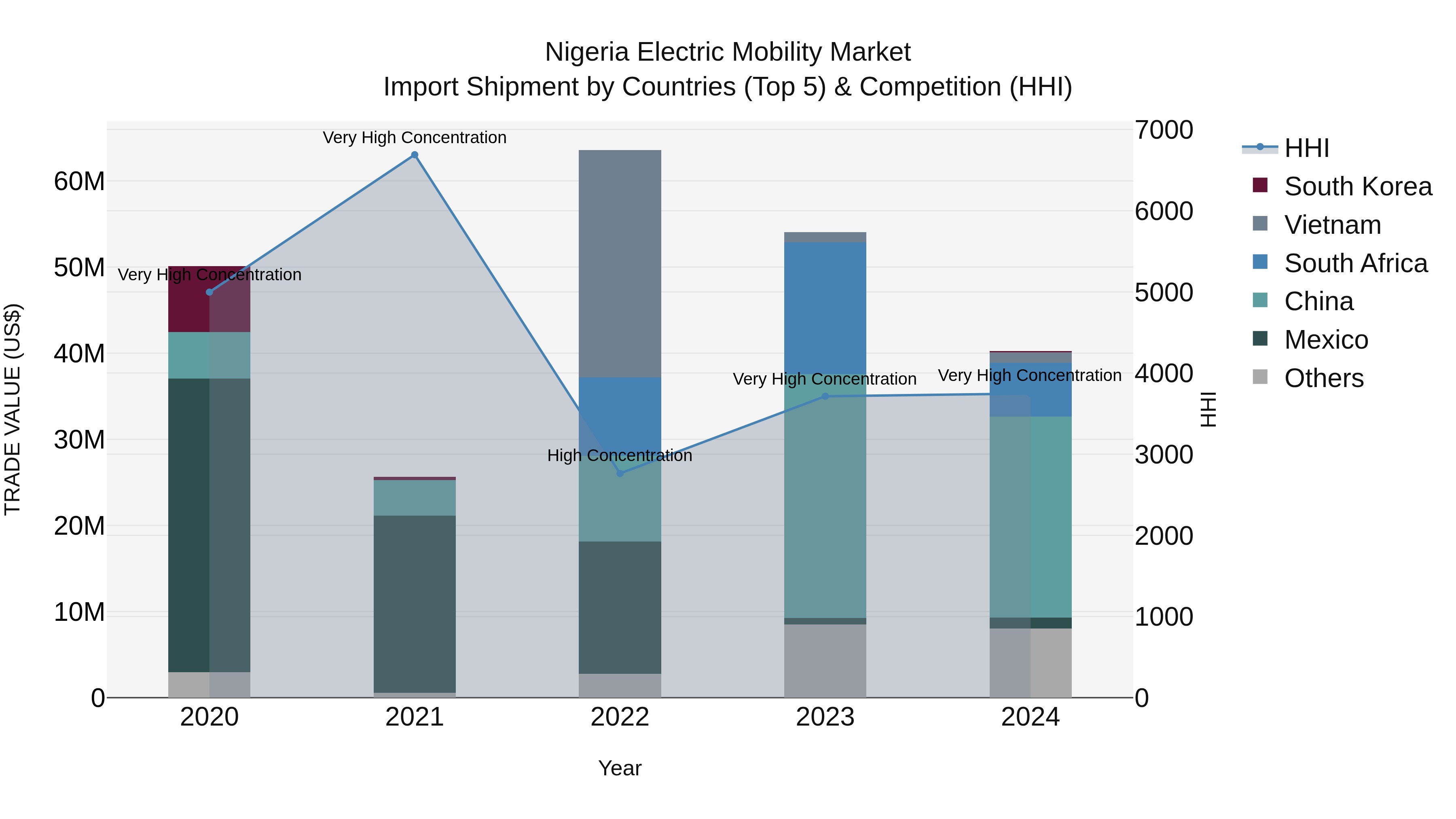
In 2024, Nigeria continued to see a significant influx of electric mobility imports, with top exporters being China, South Africa, Cyprus, Metropolitan France, and Mexico. Despite a negative CAGR of -5.33% from 2020 to 2024 and a sharp decline in growth rate of -25.55% from 2023 to 2024, the Herfindahl-Hirschman Index (HHI) indicated a very high concentration within the market. This suggests that while the import volumes may have decreased, the market remains dominated by a few key players, highlighting the competitive landscape of electric mobility imports in Nigeria.
Nigeria Electric Mobility Market Overview
The Nigeria Electric Mobility Market is experiencing significant growth driven by factors such as increasing environmental awareness, government initiatives promoting electric vehicles (EVs), and a growing infrastructure for EV charging stations. The market is witnessing a shift towards electric two-wheelers, three-wheelers, and buses, with passenger cars also gaining traction. However, challenges such as high upfront costs, limited charging infrastructure, and range anxiety among consumers are hindering rapid adoption. Key players in the market include automobile manufacturers introducing EV models, startups offering electric mobility solutions, and government bodies supporting the transition to cleaner transportation. With ongoing efforts to address these challenges and promote sustainable mobility options, the Nigeria Electric Mobility Market holds promising opportunities for growth and innovation in the coming years.
Nigeria Electric Mobility Market Trends and Opportunities
The Nigeria Electric Mobility Market is experiencing rapid growth driven by increasing awareness of environmental sustainability and government initiatives to reduce carbon emissions. The market is seeing a surge in the adoption of electric vehicles, with a focus on two and three-wheelers for last-mile transportation solutions in urban areas. Opportunities exist for manufacturers to invest in charging infrastructure development, battery technology advancements, and partnerships with local governments to promote electric vehicle usage. The government`s support through incentives such as tax breaks and import duty waivers for electric vehicles is also fueling market growth. Overall, the Nigeria Electric Mobility Market presents a promising landscape for stakeholders looking to capitalize on the shift towards sustainable transportation solutions.
Nigeria Electric Mobility Market Challenges
In the Nigeria electric mobility market, several challenges are faced that hinder the widespread adoption of electric vehicles. These challenges include inadequate charging infrastructure, high upfront costs of electric vehicles, limited availability of EV models, range anxiety among consumers, and the lack of supportive government policies and incentives. Additionally, the unstable power supply in Nigeria poses a significant obstacle to the successful implementation of electric mobility solutions. Overcoming these challenges will require investment in charging infrastructure, collaboration between the government and private sector to drive policy changes and incentives, and increased awareness and education about the benefits of electric vehicles to shift consumer perceptions and drive demand in the market.
Nigeria Electric Mobility Market Drivers
The Nigeria Electric Mobility Market is primarily being driven by several key factors. One of the main drivers is the government`s initiatives and policies aimed at promoting sustainable transportation solutions to reduce carbon emissions and combat air pollution. Additionally, rising concerns about energy security and the volatility of fuel prices have led to a growing interest in electric vehicles as a more cost-effective and environmentally friendly alternative. The increasing availability of charging infrastructure and advancements in battery technology are also contributing to the market growth. Furthermore, the rising awareness among consumers about the benefits of electric vehicles in terms of lower operating costs and reduced maintenance requirements is fueling adoption. Overall, these factors are driving the growth of the electric mobility market in Nigeria.
Nigeria Electric Mobility Market Government Policy
The Nigerian government has shown a commitment to promoting electric mobility through various policies and initiatives. One key policy is the National Electric Vehicle (EV) Policy, which aims to create an enabling environment for the adoption of EVs in the country. The government offers incentives such as import duty waivers on EV components and vehicles to drive investment in the sector. Additionally, the Federal Government has set a target for 30% of vehicles in the country to be electric-powered by 2025 as part of efforts to reduce carbon emissions and dependence on fossil fuels. To support the infrastructure needed for electric vehicles, the government is also working on implementing charging stations across the country. These policies aim to boost the electric mobility market in Nigeria and drive sustainable transportation practices.
Nigeria Electric Mobility Market Future Outlook
The future outlook for the Nigeria Electric Mobility Market appears promising as the country aims to reduce its carbon footprint and embrace sustainable transportation solutions. With increasing awareness of the environmental benefits of electric vehicles (EVs) and government initiatives to support their adoption, such as tax incentives and infrastructure development, the market is expected to experience significant growth. Additionally, rising fuel costs and the need to diversify the transportation sector are likely to drive consumer interest in EVs. Challenges such as high initial costs and limited charging infrastructure remain, but collaborations between stakeholders, advancements in technology, and the emergence of local EV manufacturers are expected to address these obstacles and pave the way for a thriving electric mobility market in Nigeria.
Key Highlights of the Report:
- Nigeria Electric Mobility Market Outlook
- Market Size of Nigeria Electric Mobility Market, 2024
- Forecast of Nigeria Electric Mobility Market, 2031
- Historical Data and Forecast of Nigeria Electric Mobility Revenues & Volume for the Period 2021- 2031
- Nigeria Electric Mobility Market Trend Evolution
- Nigeria Electric Mobility Market Drivers and Challenges
- Nigeria Electric Mobility Price Trends
- Nigeria Electric Mobility Porter's Five Forces
- Nigeria Electric Mobility Industry Life Cycle
- Historical Data and Forecast of Nigeria Electric Mobility Market Revenues & Volume By Product for the Period 2021- 2031
- Historical Data and Forecast of Nigeria Electric Mobility Market Revenues & Volume By Electric Bikes for the Period 2021- 2031
- Historical Data and Forecast of Nigeria Electric Mobility Market Revenues & Volume By Electric Scooters for the Period 2021- 2031
- Historical Data and Forecast of Nigeria Electric Mobility Market Revenues & Volume By Electric Motorized Scooters for the Period 2021- 2031
- Historical Data and Forecast of Nigeria Electric Mobility Market Revenues & Volume By Electric Motorcycles for the Period 2021- 2031
- Historical Data and Forecast of Nigeria Electric Mobility Market Revenues & Volume By Drive for the Period 2021- 2031
- Historical Data and Forecast of Nigeria Electric Mobility Market Revenues & Volume By Belt Drive for the Period 2021- 2031
- Historical Data and Forecast of Nigeria Electric Mobility Market Revenues & Volume By Chain Drive for the Period 2021- 2031
- Historical Data and Forecast of Nigeria Electric Mobility Market Revenues & Volume By Hub Drive for the Period 2021- 2031
- Historical Data and Forecast of Nigeria Electric Mobility Market Revenues & Volume By Battery for the Period 2021- 2031
- Historical Data and Forecast of Nigeria Electric Mobility Market Revenues & Volume By Lead Acid Battery for the Period 2021- 2031
- Historical Data and Forecast of Nigeria Electric Mobility Market Revenues & Volume By Li-Ion Battery for the Period 2021- 2031
- Historical Data and Forecast of Nigeria Electric Mobility Market Revenues & Volume By End-use for the Period 2021- 2031
- Historical Data and Forecast of Nigeria Electric Mobility Market Revenues & Volume By Personal for the Period 2021- 2031
- Historical Data and Forecast of Nigeria Electric Mobility Market Revenues & Volume By Commercial for the Period 2021- 2031
- Nigeria Electric Mobility Import Export Trade Statistics
- Market Opportunity Assessment By Product
- Market Opportunity Assessment By Drive
- Market Opportunity Assessment By Battery
- Market Opportunity Assessment By End-use
- Nigeria Electric Mobility Top Companies Market Share
- Nigeria Electric Mobility Competitive Benchmarking By Technical and Operational Parameters
- Nigeria Electric Mobility Company Profiles
- Nigeria Electric Mobility Key Strategic Recommendations






































