Nigeria Electrical Steel Market Size, Share & Growth Rate
The Nigeria Electrical Steel Market was estimated at USD 537 Million in 2025 and is projected to reach USD 780 Million by 2032, growing at a CAGR of 5.5% from 2026 to 2032. This upward trajectory is primarily driven by a surge in demand across various sectors, including power generation and automotive manufacturing. Additionally, the government's efforts to enhance local production capabilities and reduce reliance on imports are poised to further stimulate growth in this dynamic market.
Nigeria Electrical Steel Market Year-wise Growth Rate and Key Drivers
This graph highlights how the Nigeria Electrical Steel Market has steadily grown over the years, supported by major growth factors.
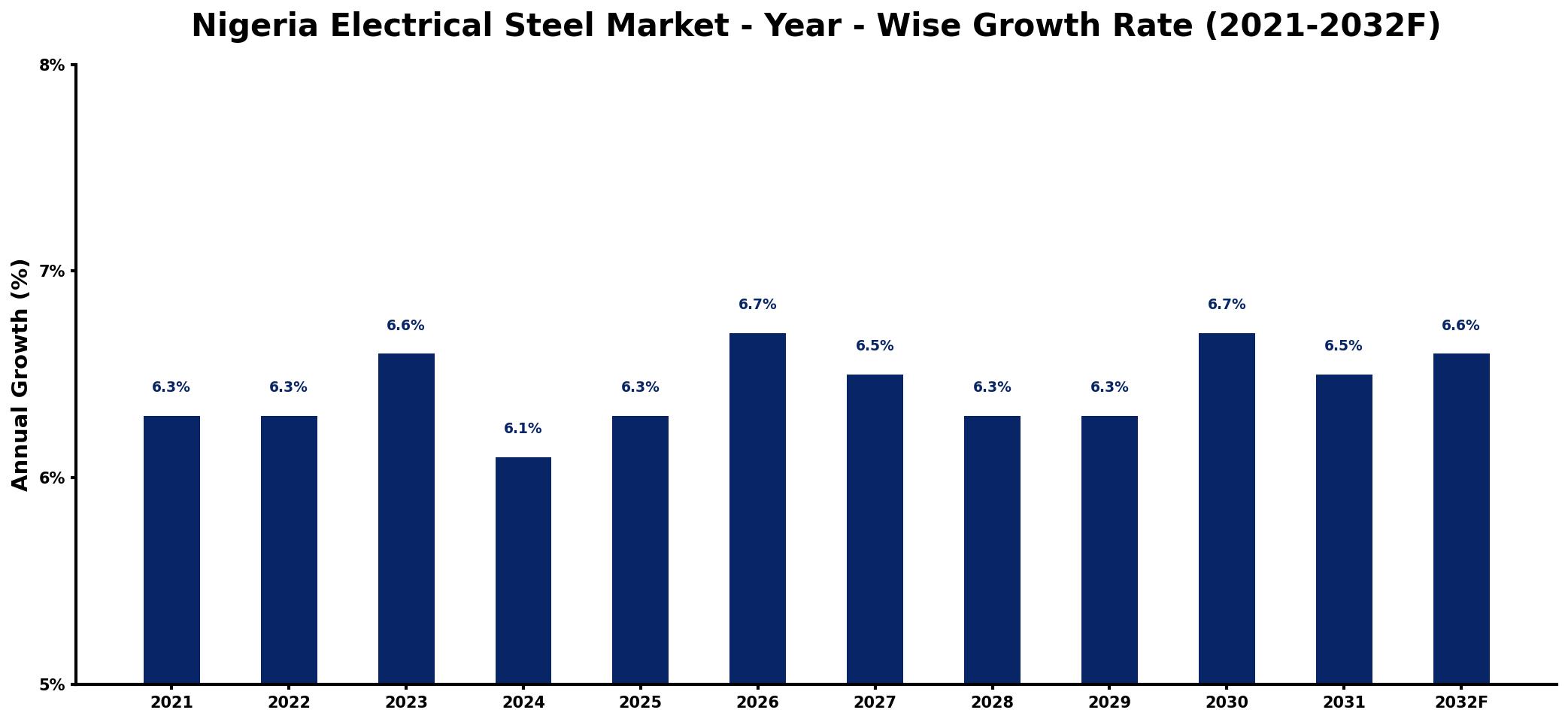
The table below presents the year‑wise growth rates along with the key drivers influencing the market
| Year | Growth Rate | Major Drivers |
| 2021 | 6.3% | Rising demand from energy sector |
| 2022 | 6.3% | Increased investments in infrastructure |
| 2023 | 6.6% | Expansion of manufacturing facilities |
| 2024 | 6.1% | Growth in renewable energy projects |
| 2025 | 6.3% | Surge in automotive production rates |
| 2026 | 6.7% | Technological advancements in production |
| 2027 | 6.5% | Emergence of new industrial applications |
| 2028 | 6.3% | Strengthening regional supply chains |
| 2029 | 6.3% | Growing exports to neighboring countries |
| 2030 | 6.7% | Increased government infrastructure spending |
| 2031 | 6.5% | Development of smart grid technologies |
| 2032 | 6.6% | Rising consumer electronics demand |
Note: Market size estimations and growth projections presented in this report are based on 6Wresearch's proprietary forecasting methodology, utilizing the latest available industry data, government publications, and primary research inputs.
Nigeria Electrical Steel Market Synopsis
The Nigeria Electrical Steel Market has gained significant momentum, fueled by increasing industrial activity and urbanization. While imports have historically dominated this sector, the trend is shifting towards local manufacturing, thanks to supportive government policies aimed at bolstering domestic production.
Looking ahead, the market is set for continued expansion as demand for high-quality electrical steel grades rises. This demand is driven by the pressing need for energy-efficient technologies across the country's infrastructure and manufacturing sectors, positioning Nigeria as a promising hub for electrical steel production.
Nigeria Electrical Steel Market Key Takeaways
- Strong growth potential driven by increasing local demand for electrical steel across multiple sectors.
- Government initiatives aimed at promoting domestic production are reshaping the market landscape.
- Growing interest in high-performance electrical steel grades to enhance energy efficiency.
- Challenges remain, particularly with inconsistent power supply and high import costs impacting local producers.
- Strategic investments in infrastructure and renewable energy will bolster market dynamics moving forward.
Evaluation of Restraints in Nigeria Electrical Steel Market
Despite the positive outlook, the Nigeria Electrical Steel Market grapples with significant hurdles. Inconsistent power supply undermines manufacturing capabilities, creating uncertainty for producers. Furthermore, limited access to essential raw materials coupled with high importation costs hampers local manufacturing growth. Inadequate infrastructure for transportation and storage complicates distribution efforts. These factors collectively pose challenges that must be navigated to unlock the market's full potential.
Nigeria Electrical Steel Market Trends
The Nigeria Electrical Steel Market is currently witnessing several transformative trends. A marked shift towards high-quality electrical steel grades is becoming apparent as industries aim to improve energy efficiency and reduce core losses in electric equipment. Additionally, manufacturers are increasingly focused on research and development, creating innovative products with advanced magnetic properties to cater to evolving market needs. The drive toward renewable energy and sustainable practices is also influencing product development and application in the market.
Nigeria Electrical Steel Market Opportunities
With the surging demand for electricity and ongoing infrastructure development, the Nigeria Electrical Steel Market presents lucrative investment opportunities. Establishing local production facilities or forming partnerships with existing manufacturers can yield substantial returns as the demand for transformers, electric motors, and generators grows. The government's commitment to enhancing the power sector and incentivizing local production further highlights the potential for investors looking to make impactful contributions to this burgeoning market.
Government Initiatives in the Nigeria Electrical Steel Market
The Nigerian government has implemented several policies to enhance the electrical steel sector. Key initiatives include the Nigerian Industrial Revolution Plan (NIRP), designed to boost local production through various incentives for domestic manufacturers. Additionally, import restrictions and tariffs have been introduced to protect local producers from foreign competition. The Nigerian Electricity Regulatory Commission (NERC) sets quality and safety standards for electrical steel applications, ensuring that the sector adheres to established guidelines as part of the broader industrialization objectives.
Future Insights of the Nigeria Electrical Steel Market
The outlook for the Nigeria Electrical Steel Market remains robust through 2026-2032. Ongoing investments in infrastructure and a strong push towards industrialization are key factors supporting market growth. Furthermore, as demand for renewable energy projects escalates, the need for high-quality electrical steel will correspondingly increase. Challenges such as fluctuating raw material prices and global competition must be addressed, yet the overall prospects for the market appear positive, driven by supportive government policies and rising sectoral demands.
Nigeria Electrical Steel Market Latest Developments (2025 - 2026)
Recent developments in the Nigeria Electrical Steel Market indicate a strategic focus on local manufacturing capabilities. Several initiatives aimed at enhancing supply chains for raw materials have been discussed in industry forums. Furthermore, collaborations between government bodies and private sectors are being explored to elevate the standards of electrical steel production and implementation of new technologies to optimize efficiency across manufacturing processes. Such proactive measures reflect a collective ambition to strengthen the market's foundation.
Nigeria Electrical Steel Market - Key Attractiveness of the Report
- 10 Years of Market Numbers
- Historical Data Starting from 2022 to 2025
- Base Year: 2025
- Forecast Data until 2032
- Key Performance Indicators Impacting the Market
- Major Upcoming Developments and Projects
Key Highlights of the Report:
- Nigeria Electrical Steel Market Outlook
- Market Size of Nigeria Electrical Steel Market, 2025
- Forecast of Nigeria Electrical Steel Market, 2032
- Historical Data and Forecast of Nigeria Electrical Steel Revenues & Volume for the Period 2022-2032F
- Nigeria Electrical Steel Market Trend Evolution
- Nigeria Electrical Steel Market Drivers and Challenges
- Nigeria Electrical Steel Price Trends
- Nigeria Electrical Steel Porter's Five Forces
- Nigeria Electrical Steel Industry Life Cycle
- Historical Data and Forecast of Nigeria Electrical Steel Market Revenues & Volume By Type for the Period 2022-2032F
- Historical Data and Forecast of Nigeria Electrical Steel Market Revenues & Volume By Grain-oriented for the Period 2022-2032F
- Historical Data and Forecast of Nigeria Electrical Steel Market Revenues & Volume By Non-grain-oriented for the Period 2022-2032F
- Historical Data and Forecast of Nigeria Electrical Steel Market Revenues & Volume By End Use for the Period 2022-2032F
- Historical Data and Forecast of Nigeria Electrical Steel Market Revenues & Volume By Energy for the Period 2022-2032F
- Historical Data and Forecast of Nigeria Electrical Steel Market Revenues & Volume By Automotive for the Period 2022-2032F
- Historical Data and Forecast of Nigeria Electrical Steel Market Revenues & Volume By Household Appliances for the Period 2022-2032F
- Historical Data and Forecast of Nigeria Electrical Steel Market Revenues & Volume By Manufacturing for the Period 2022-2032F
- Historical Data and Forecast of Nigeria Electrical Steel Market Revenues & Volume By Others for the Period 2022-2032F
- Historical Data and Forecast of Nigeria Electrical Steel Market Revenues & Volume By Application for the Period 2022-2032F
- Historical Data and Forecast of Nigeria Electrical Steel Market Revenues & Volume By Transformers for the Period 2022-2032F
- Historical Data and Forecast of Nigeria Electrical Steel Market Revenues & Volume By Motors for the Period 2022-2032F
- Historical Data and Forecast of Nigeria Electrical Steel Market Revenues & Volume By Inductors for the Period 2022-2032F
- Historical Data and Forecast of Nigeria Electrical Steel Market Revenues & Volume By Others for the Period 2022-2032F
- Nigeria Electrical Steel Import Export Trade Statistics
- Market Opportunity Assessment By Type
- Market Opportunity Assessment By End Use
- Market Opportunity Assessment By Application
- Nigeria Electrical Steel Top Companies Market Share
- Nigeria Electrical Steel Competitive Benchmarking By Technical and Operational Parameters
- Nigeria Electrical Steel Company Profiles
- Nigeria Electrical Steel Key Strategic Recommendations






































