Nigeria Enterprise Video Market Size & Growth Rate (2026-2032)
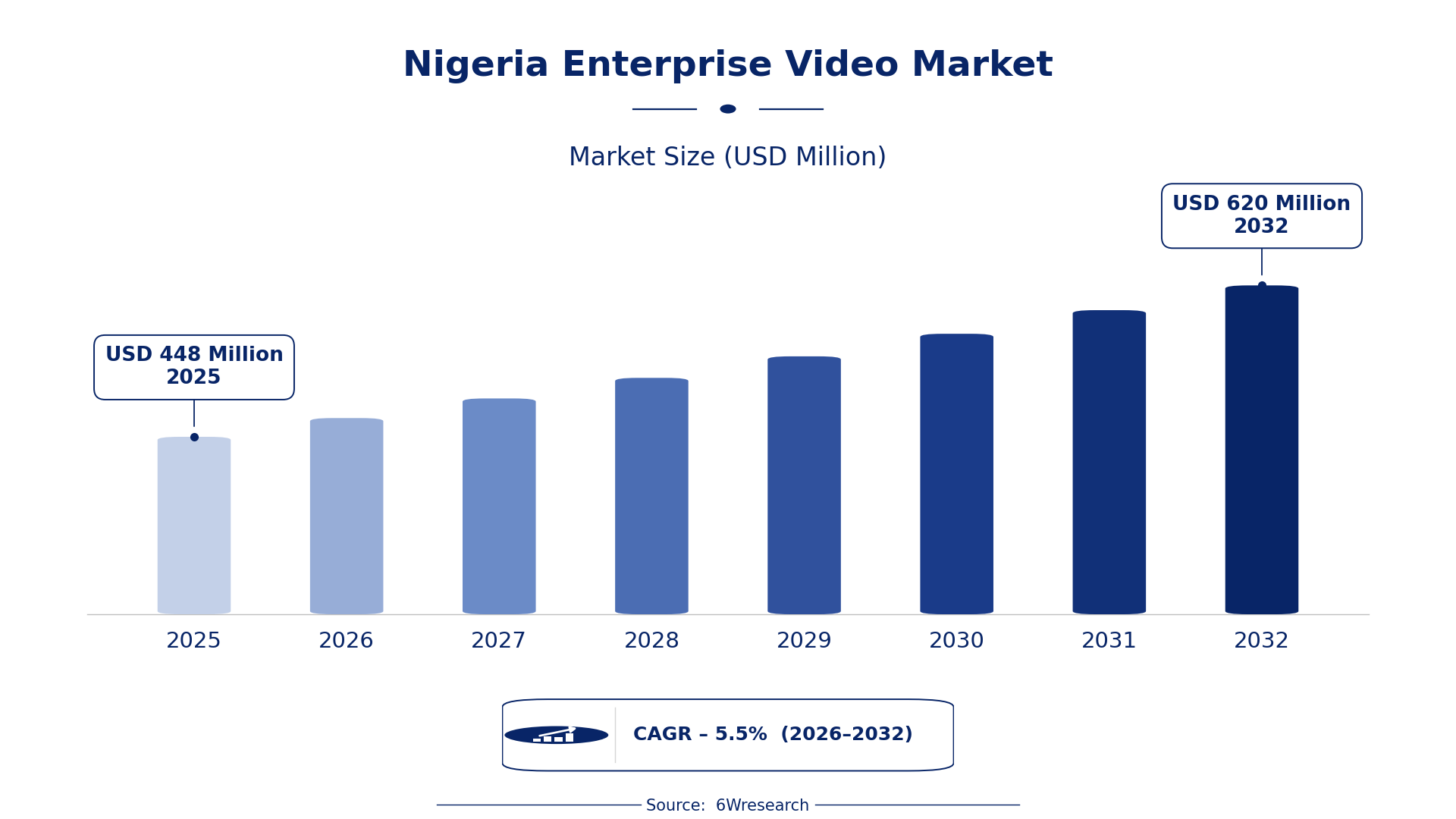
The Nigeria Enterprise Video Market was estimated at USD 448 Million in 2025 and is projected to reach USD 620 Million by 2032, growing at a CAGR of 5.5% from 2026 to 2032.
Nigeria Enterprise Video Market Synopsis
The demand for video conferencing solutions in Nigeria is escalating, driven by the need for effective remote communication and collaboration among businesses. As organizations increasingly adopt video tools for training, meetings, and customer interactions, the enterprise video market is becoming a crucial component of the corporate communication strategy.
The shift towards cloud-based video solutions is notable, offering enterprises a scalable and cost-effective way to enhance their communication capabilities. This transition is further supported by improvements in internet infrastructure and the growing penetration of mobile devices across Nigeria.
Nigeria Enterprise Video Market Year-wise Growth Rate and Key Drivers
This graph illustrates the annual growth rates of the Nigeria Enterprise Video Market from 2021 to 2032, highlighting a steady upward trajectory and projected expansion over the forecast period.
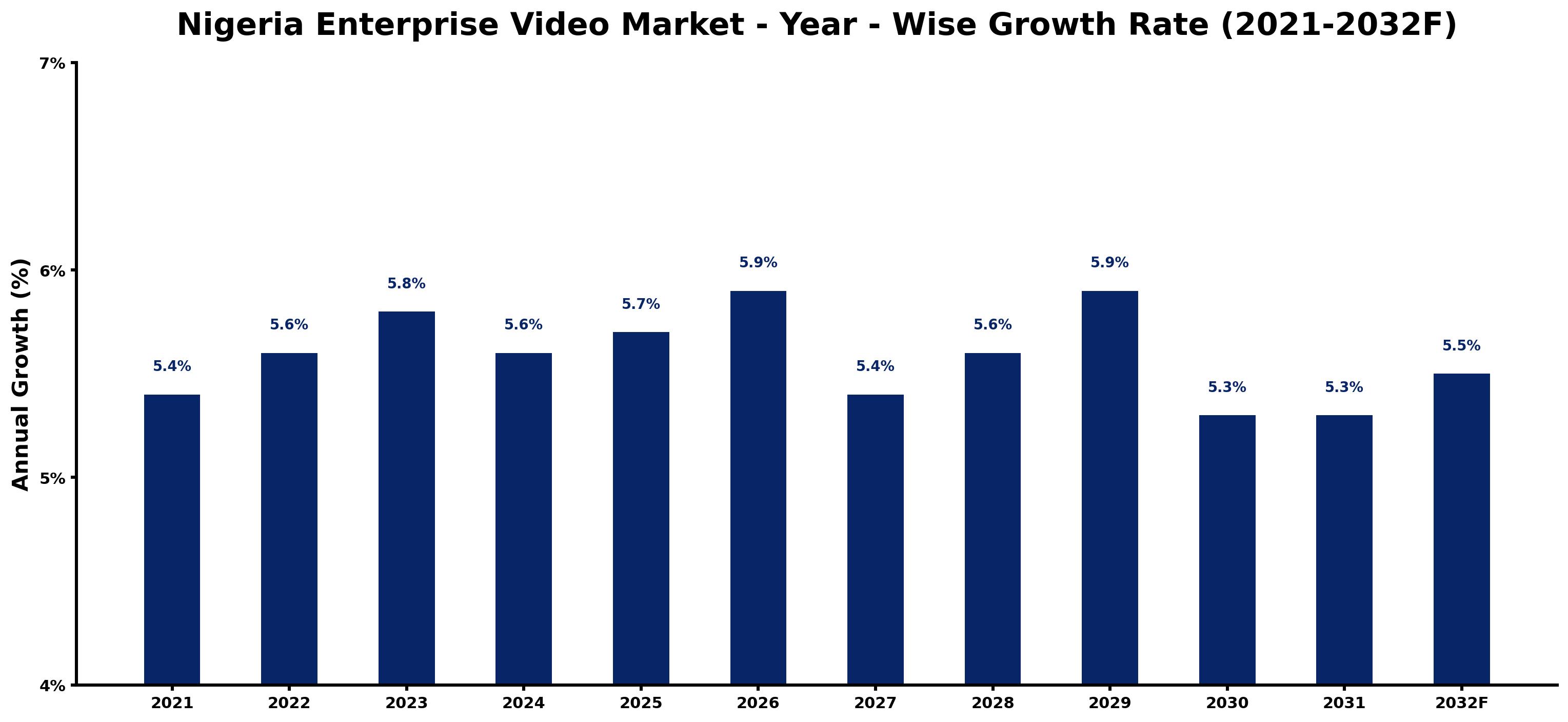
The table below presents the year‑wise growth rates along with the key drivers influencing the market
| Year | Growth Rate | Major Drivers |
| 2021 | 5.4% | Rise in remote work increasing video communication adoption. |
| 2022 | 5.6% | Investment in local data centers enhancing video service reliability. |
| 2023 | 5.8% | Youth demographic driving demand for digital content consumption. |
| 2024 | 5.6% | Local partnerships boosting video platform accessibility in communities. |
| 2025 | 5.7% | Increased smartphone penetration facilitating video collaboration tools. |
| 2026 | 5.9% | Regulatory support encouraging local video content production. |
| 2027 | 5.4% | Growing entertainment sector boosting corporate video investments. |
| 2028 | 5.6% | Improved internet infrastructure supporting high-quality video services. |
| 2029 | 5.9% | Demand for e-learning solutions increasing video technology usage. |
| 2030 | 5.3% | Corporate training programs utilizing video conferencing technologies. |
| 2031 | 5.3% | High mobile internet adoption enhancing video conferencing reach. |
| 2032 | 5.5% | Government initiatives fostering digital skills among professionals. |
Note: Market size estimations and growth projections presented in this report are based on 6Wresearch's proprietary forecasting methodology, utilizing the latest available industry data, government publications, and primary research inputs.
Nigeria Enterprise Video Market Key Takeaways
Below are some of the specific key takeaways from the market, including:
- Strong demand for cloud-based video conferencing solutions among Nigerian businesses.
- Increasing focus on interactive and engaging video content for training and webinars.
- Growing integration of artificial intelligence for enhanced video analytics and user experience.
- Challenges posed by limited internet infrastructure and high data costs impacting adoption rates.
- Government initiatives aimed at improving broadband access are crucial for market growth.
Evaluation of Restraints in Nigeria Enterprise Video Market
The Nigeria Enterprise Video Market faces several constraints that hinder its growth potential. Limited internet infrastructure remains a significant barrier, often resulting in poor connectivity and frustrating user experiences. High data costs also inhibit widespread adoption, particularly among small and medium-sized enterprises that may lack the budget for extensive video services.
on top of that, many businesses are still unaware of the advantages that video communication can bring, particularly in marketing and engagement strategies. Concerns regarding data privacy and security also linger, adding another layer of complexity for enterprises considering video solutions.
Nigeria Enterprise Video Market Trends
Several trends are shaping the Nigeria Enterprise Video Market. The rise of cloud-based video platforms is leading to increased demand for scalable, cost-effective solutions that can be easily deployed. Companies are particularly interested in interactive video conferencing tools that enhance engagement and collaboration among teams.
In addition, the integration of artificial intelligence is becoming more common, allowing for advanced video analytics that can improve decision-making and user experience. As remote work continues to be a viable option, businesses are increasingly turning to video solutions that facilitate seamless connectivity and collaboration.
Nigeria Enterprise Video Market Opportunities
Opportunities abound in the Nigeria Enterprise Video Market as businesses seek to enhance their communication capabilities. The demand for remote workforce management solutions is on the rise, prompting vendors to develop tailored offerings that cater to the unique needs of Nigerian enterprises. Virtual events and online training solutions also present significant growth avenues.
As organizations strive to improve collaboration and productivity, there is a strong need for scalable and secure video solutions that provide user-friendly interfaces. Technology providers who can innovate and address these specific demands will find a receptive market eager for new solutions.
Government Initiatives in the Nigeria Enterprise Video Market
Government policies play a crucial role in shaping the Nigeria Enterprise Video Market. Recent initiatives aimed at enhancing broadband infrastructure are vital for facilitating the adoption of video-based services. The regulatory framework is increasingly focused on protecting intellectual property rights and promoting investment in the digital media sector.
- A national digital infrastructure upgrade programme now in its rollout phase aims to expand internet access across urban and rural areas.
- Current initiatives include the establishment of regulations that promote billing transparency in video service offerings.
- A planned public-private partnership is expected to enhance telecom infrastructure access by 2028.
- Ongoing training programmes are being developed to improve workforce skills in digital media and video production.
- Recently completed projects focus on supporting local content creation and distribution to foster innovation in the sector.
Future Insights of the Nigeria Enterprise Video Market
Looking ahead to 2026-2032, the Nigeria Enterprise Video Market is set for substantial growth. As digital technology adoption accelerates, businesses will increasingly rely on video communication tools to improve engagement and efficiency. The corporate sector's expansion will further drive demand for cloud-based solutions and innovative video platforms.
With ongoing improvements in internet connectivity and infrastructure development, video communication will become a cornerstone of organizational communication strategies. The shift towards remote work and virtual interactions will continue to create new opportunities for technology providers and service vendors in the Nigerian market.
Nigeria Enterprise Video Market Latest Developments
Recent developments in the Nigeria Enterprise Video Market indicate a dynamic shift towards advanced video solutions. Over the past year, several initiatives have emerged, focusing on enhancing video capabilities and expanding service offerings.
- A major technology vendor launched a new interactive video platform in early 2025, aimed at improving engagement for corporate training sessions.
- An initiative that began in mid-2025 focuses on developing cloud-based video solutions tailored for small businesses, now underway.
- A partnership between local telecom providers is currently ongoing, aimed at improving broadband access for video services.
- Upcoming projects include a rollout of enhanced video conferencing tools expected to begin in the second half of 2026.
- A new service upgrade initiative was completed in late 2025, enhancing the quality and reliability of video streaming for enterprises.
Nigeria Enterprise Video Market - Key Attractiveness of the Report
- 10 Years of Market Numbers
- Historical Data Starting from 2022 to 2025
- Base Year: 2025
- Forecast Data until 2032
- Key Performance Indicators Impacting the Market
- Major Upcoming Developments and Projects
Key Highlights of the Report:
- Nigeria Enterprise Video Market Outlook
- Market Size of Nigeria Enterprise Video Market, 2025
- Forecast of Nigeria Enterprise Video Market, 2032
- Historical Data and Forecast of Nigeria Enterprise Video Revenues & Volume for the Period 2022-2032F
- Nigeria Enterprise Video Market Trend Evolution
- Nigeria Enterprise Video Market Drivers and Challenges
- Nigeria Enterprise Video Price Trends
- Nigeria Enterprise Video Porter's Five Forces
- Nigeria Enterprise Video Industry Life Cycle
- Historical Data and Forecast of Nigeria Enterprise Video Market Revenues & Volume By Application for the Period 2022-2032F
- Historical Data and Forecast of Nigeria Enterprise Video Market Revenues & Volume By Corporate Communications for the Period 2022-2032F
- Historical Data and Forecast of Nigeria Enterprise Video Market Revenues & Volume By Training & Development for the Period 2022-2032F
- Historical Data and Forecast of Nigeria Enterprise Video Market Revenues & Volume By Marketing & Client Engagement for the Period 2022-2032F
- Historical Data and Forecast of Nigeria Enterprise Video Market Revenues & Volume By Delivery Technique for the Period 2022-2032F
- Historical Data and Forecast of Nigeria Enterprise Video Market Revenues & Volume By Downloading/Traditional Streaming for the Period 2022-2032F
- Historical Data and Forecast of Nigeria Enterprise Video Market Revenues & Volume By Adaptive Streaming for the Period 2022-2032F
- Historical Data and Forecast of Nigeria Enterprise Video Market Revenues & Volume By Progressive Downloading for the Period 2022-2032F
- Historical Data and Forecast of Nigeria Enterprise Video Market Revenues & Volume By Deployment mode for the Period 2022-2032F
- Historical Data and Forecast of Nigeria Enterprise Video Market Revenues & Volume By On-Premises for the Period 2022-2032F
- Historical Data and Forecast of Nigeria Enterprise Video Market Revenues & Volume By Cloud for the Period 2022-2032F
- Historical Data and Forecast of Nigeria Enterprise Video Market Revenues & Volume By Organization Size for the Period 2022-2032F
- Historical Data and Forecast of Nigeria Enterprise Video Market Revenues & Volume By SMEs for the Period 2022-2032F
- Historical Data and Forecast of Nigeria Enterprise Video Market Revenues & Volume By Large Enterprises for the Period 2022-2032F
- Historical Data and Forecast of Nigeria Enterprise Video Market Revenues & Volume By Vertical for the Period 2022-2032F
- Historical Data and Forecast of Nigeria Enterprise Video Market Revenues & Volume By Telecom for the Period 2022-2032F
- Historical Data and Forecast of Nigeria Enterprise Video Market Revenues & Volume By BFSI for the Period 2022-2032F
- Historical Data and Forecast of Nigeria Enterprise Video Market Revenues & Volume By Healthcare and Life Sciences for the Period 2022-2032F
- Historical Data and Forecast of Nigeria Enterprise Video Market Revenues & Volume By Media and Entertainment for the Period 2022-2032F
- Historical Data and Forecast of Nigeria Enterprise Video Market Revenues & Volume By Education for the Period 2022-2032F
- Historical Data and Forecast of Nigeria Enterprise Video Market Revenues & Volume By Retail and Consumer Goods for the Period 2022-2032F
- Historical Data and Forecast of Nigeria Enterprise Video Market Revenues & Volume By IT and ITeS for the Period 2022-2032F
- Historical Data and Forecast of Nigeria Enterprise Video Market Revenues & Volume By Others for the Period 2022-2032F
- Nigeria Enterprise Video Import Export Trade Statistics
- Market Opportunity Assessment By Application
- Market Opportunity Assessment By Delivery Technique
- Market Opportunity Assessment By Deployment mode
- Market Opportunity Assessment By Organization Size
- Market Opportunity Assessment By Vertical
- Nigeria Enterprise Video Top Companies Market Share
- Nigeria Enterprise Video Competitive Benchmarking By Technical and Operational Parameters
- Nigeria Enterprise Video Company Profiles
- Nigeria Enterprise Video Key Strategic Recommendations






































