Nigeria Facial Recognition Market Size & Growth Rate (2026-2032)
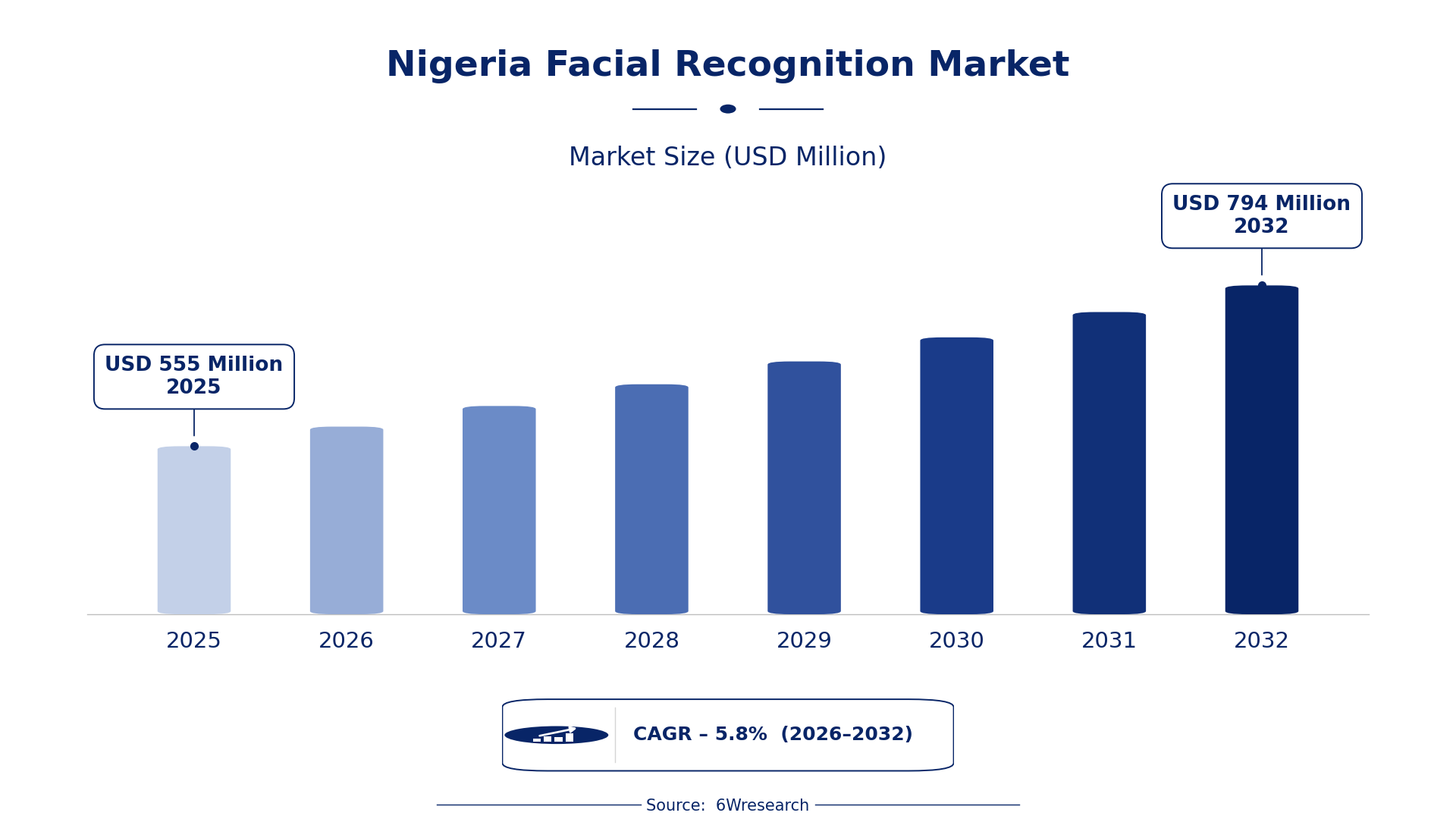
The Nigeria Facial Recognition Market was estimated at USD 555 Million in 2025 and is projected to reach USD 794 Million by 2032, growing at a CAGR of 5.8% from 2026 to 2032.
Nigeria Facial Recognition Market Synopsis
The demand for facial recognition technology in Nigeria is surging across various sectors, particularly in law enforcement and banking, as organizations seek enhanced security measures. This technology is increasingly recognized for its potential to streamline identification processes, reduce fraud, and improve customer experiences.
Government initiatives aimed at bolstering public safety are further accelerating market growth. The push for digital transformation, coupled with rising awareness of the benefits associated with facial recognition technology, suggests a promising trajectory for this market in the coming years.
Nigeria Facial Recognition Market Year-wise Growth Rate and Key Drivers
This graph illustrates the annual growth rates of the Nigeria Facial Recognition Market from 2021 to 2032, highlighting a steady upward trajectory and projected expansion over the forecast period.
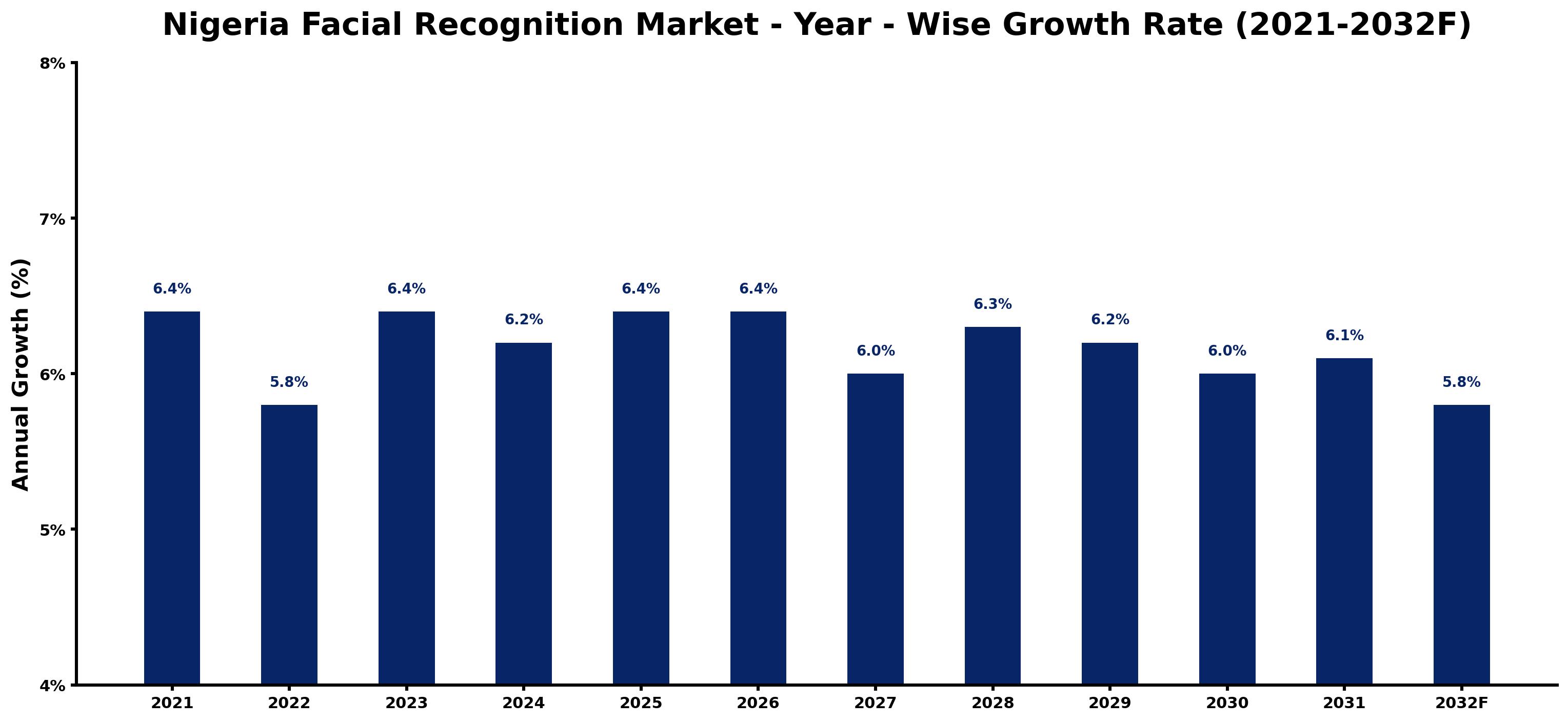
The table below presents the year‑wise growth rates along with the key drivers influencing the market
| Year | Growth Rate | Major Drivers |
| 2021 | 6.4% | Increase in biometric data regulations by NIMC. |
| 2022 | 5.8% | Surge in demand for secure financial transactions. |
| 2023 | 6.4% | Government initiatives enhancing digital identity verification. |
| 2024 | 6.2% | Adoption of facial recognition by local law enforcement. |
| 2025 | 6.4% | Rising public interest in digital security solutions. |
| 2026 | 6.4% | Emerging startups focused on biometric technology solutions. |
| 2027 | 6.0% | Local partnerships to enhance facial recognition accuracy. |
| 2028 | 6.3% | Increased usage in mobile payment authentication systems. |
| 2029 | 6.2% | Regulatory support for tech innovations in identity management. |
| 2030 | 6.0% | Growth in e-commerce necessitating robust security measures. |
| 2031 | 6.1% | Rising urban population driving demand for security technology. |
| 2032 | 5.8% | Enhanced cybersecurity laws promoting biometric company growth. |
Note: Market size estimations and growth projections presented in this report are based on 6Wresearch's proprietary forecasting methodology, utilizing the latest available industry data, government publications, and primary research inputs.
Nigeria Facial Recognition Market Key Takeaways
Below are some of the specific key takeaways from the market, including:
- The Nigeria Facial Recognition Market is experiencing robust growth driven by demand from law enforcement, banking, and retail sectors.
- Government initiatives are fostering the integration of facial recognition technology in public safety and security measures.
- Advancements in AI and machine learning are enhancing the accuracy and efficiency of facial recognition systems.
- Challenges such as data privacy concerns and high implementation costs remain significant barriers.
- Future opportunities exist for market players to innovate and expand their offerings within the Nigerian context.
Evaluation of Restraints in Nigeria Facial Recognition Market
Several constraints hinder the growth of the Nigeria Facial Recognition Market. A major concern is the absence of a comprehensive regulatory framework, which raises issues around data privacy and security. The implementation costs associated with facial recognition systems can be prohibitive for many organizations, particularly smaller enterprises. on top of that, the limited pool of skilled professionals in this field presents a significant challenge, impeding the effective deployment and management of these technologies. Lastly, algorithm bias and concerns about accuracy, particularly in diverse populations, are critical hurdles that must be addressed to foster wider acceptance and use of facial recognition technologies.
Nigeria Facial Recognition Market Trends
The increasing integration of facial recognition technology into everyday applications is a key trend shaping this market. Retailers are utilizing this technology for enhanced customer service and personalized experiences. Additionally, banks are adopting facial recognition for secure transactions and fraud prevention, aligning with global trends towards contactless authentication. The growing emphasis on smart city initiatives is also leading to increased investments in surveillance and security systems that leverage facial recognition capabilities.
Nigeria Facial Recognition Market Opportunities
The market is ripe with opportunities for growth and investment. The rising demand for advanced security solutions in both public and private sectors offers a fertile ground for innovative product development. Partnerships between tech firms and governmental bodies can lead to the creation of tailored solutions that address local needs while enhancing security protocols. on top of that, as awareness about the benefits of facial recognition technology spreads, more sectors, such as healthcare and transportation, are likely to explore its applications, presenting new avenues for market expansion.
Government Initiatives in the Nigeria Facial Recognition Market
The Nigerian government is increasingly recognizing the potential of facial recognition technology to enhance security and streamline various processes. While specific regulations are still being developed, there are ongoing efforts to create a framework that ensures ethical usage and protects citizens' data. This regulatory environment is crucial for fostering trust and encouraging investment in the market.
- A national digital infrastructure upgrade programme launched in 2025 aims to incorporate biometric technologies, including facial recognition, to enhance security in public spaces.
- A current initiative focuses on deploying facial recognition systems in major airports to improve passenger security and streamline identity verification.
- Plans are underway for a comprehensive regulatory framework expected to be introduced by mid-2026, aimed at addressing data privacy and ethical concerns in the use of facial recognition technologies.
- A pilot project currently in progress is testing facial recognition technology in urban surveillance systems in select Nigerian cities.
- A public-private initiative planned for 2027 aims to expand the use of facial recognition technology in educational institutions for identity verification and security purposes.
Future Insights of the Nigeria Facial Recognition Market
Looking ahead to 2026-2032, the Nigeria Facial Recognition Market is set to flourish, driven by increased adoption across government, healthcare, and private sectors. The demand for enhanced security measures will continue to rise, particularly as urban areas grow and new challenges emerge. With the potential for technological advancements to improve system accuracy and reduce costs, companies that innovate will likely capture significant market share. As regulatory frameworks evolve, they will also play a critical role in shaping the industry's growth trajectory, ensuring responsible and effective deployment of facial recognition technologies.
Nigeria Facial Recognition Market Latest Developments
Recent activity in the Nigeria Facial Recognition Market has highlighted a surge in technological advancements and collaborations aimed at enhancing system capabilities. Stakeholders are increasingly focused on addressing privacy concerns while promoting the utility of facial recognition technologies across various applications.
- A new partnership announced in early 2025 between technology firms and a national security agency aims to integrate advanced facial recognition capabilities into public security systems.
- A major technology vendor launched a facial recognition platform in Q1 2025 that emphasizes ethical data handling and user privacy.
- An ongoing initiative began in mid-2025 to assess the effectiveness of facial recognition in urban traffic management, with preliminary results expected by late 2026.
- A rollout of facial recognition kiosks in retail environments is planned for late 2026, aimed at enhancing customer service and security.
- A government-funded research project, currently underway, is exploring algorithm improvements to reduce bias in facial recognition systems, with expected findings to be released by early 2027.
Nigeria Facial Recognition Market - Key Attractiveness of the Report
- 10 Years of Market Numbers
- Historical Data Starting from 2022 to 2025
- Base Year: 2025
- Forecast Data until 2032
- Key Performance Indicators Impacting the Market
- Major Upcoming Developments and Projects
Key Highlights of the Report:
- Nigeria Facial Recognition Market Outlook
- Market Size of Nigeria Facial Recognition Market, 2025
- Forecast of Nigeria Facial Recognition Market, 2032
- Historical Data and Forecast of Nigeria Facial Recognition Revenues & Volume for the Period 2022-2032F
- Nigeria Facial Recognition Market Trend Evolution
- Nigeria Facial Recognition Market Drivers and Challenges
- Nigeria Facial Recognition Price Trends
- Nigeria Facial Recognition Porter's Five Forces
- Nigeria Facial Recognition Industry Life Cycle
- Historical Data and Forecast of Nigeria Facial Recognition Market Revenues & Volume By Component for the Period 2022-2032F
- Historical Data and Forecast of Nigeria Facial Recognition Market Revenues & Volume By Software for the Period 2022-2032F
- Historical Data and Forecast of Nigeria Facial Recognition Market Revenues & Volume By Services for the Period 2022-2032F
- Historical Data and Forecast of Nigeria Facial Recognition Market Revenues & Volume By Application for the Period 2022-2032F
- Historical Data and Forecast of Nigeria Facial Recognition Market Revenues & Volume By Access Control for the Period 2022-2032F
- Historical Data and Forecast of Nigeria Facial Recognition Market Revenues & Volume By Attendance Tracking & Monitoring for the Period 2022-2032F
- Historical Data and Forecast of Nigeria Facial Recognition Market Revenues & Volume By Emotion Recognition for the Period 2022-2032F
- Historical Data and Forecast of Nigeria Facial Recognition Market Revenues & Volume By Security & Surveillance for the Period 2022-2032F
- Historical Data and Forecast of Nigeria Facial Recognition Market Revenues & Volume By Others for the Period 2022-2032F
- Historical Data and Forecast of Nigeria Facial Recognition Market Revenues & Volume By Vertical for the Period 2022-2032F
- Historical Data and Forecast of Nigeria Facial Recognition Market Revenues & Volume By Retail & E-Commerce for the Period 2022-2032F
- Historical Data and Forecast of Nigeria Facial Recognition Market Revenues & Volume By Media & Entertainment for the Period 2022-2032F
- Historical Data and Forecast of Nigeria Facial Recognition Market Revenues & Volume By BFSI for the Period 2022-2032F
- Historical Data and Forecast of Nigeria Facial Recognition Market Revenues & Volume By Automobile & Transportation for the Period 2022-2032F
- Historical Data and Forecast of Nigeria Facial Recognition Market Revenues & Volume By Telecom & IT for the Period 2022-2032F
- Historical Data and Forecast of Nigeria Facial Recognition Market Revenues & Volume By Government for the Period 2022-2032F
- Historical Data and Forecast of Nigeria Facial Recognition Market Revenues & Volume By Healthcare for the Period 2022-2032F
- Historical Data and Forecast of Nigeria Facial Recognition Market Revenues & Volume By Others for the Period 2022-2032F
- Historical Data and Forecast of Nigeria Facial Recognition Market Revenues & Volume By Technology for the Period 2022-2032F
- Historical Data and Forecast of Nigeria Facial Recognition Market Revenues & Volume By 2D for the Period 2022-2032F
- Historical Data and Forecast of Nigeria Facial Recognition Market Revenues & Volume By 3D for the Period 2022-2032F
- Historical Data and Forecast of Nigeria Facial Recognition Market Revenues & Volume By Facial Analytics for the Period 2022-2032F
- Nigeria Facial Recognition Import Export Trade Statistics
- Market Opportunity Assessment By Component
- Market Opportunity Assessment By Application
- Market Opportunity Assessment By Vertical
- Market Opportunity Assessment By Technology
- Nigeria Facial Recognition Top Companies Market Share
- Nigeria Facial Recognition Competitive Benchmarking By Technical and Operational Parameters
- Nigeria Facial Recognition Company Profiles
- Nigeria Facial Recognition Key Strategic Recommendations






































