Nigeria Fruit Pulp Market Top 5 Importing Countries and Market Competition (HHI) Analysis
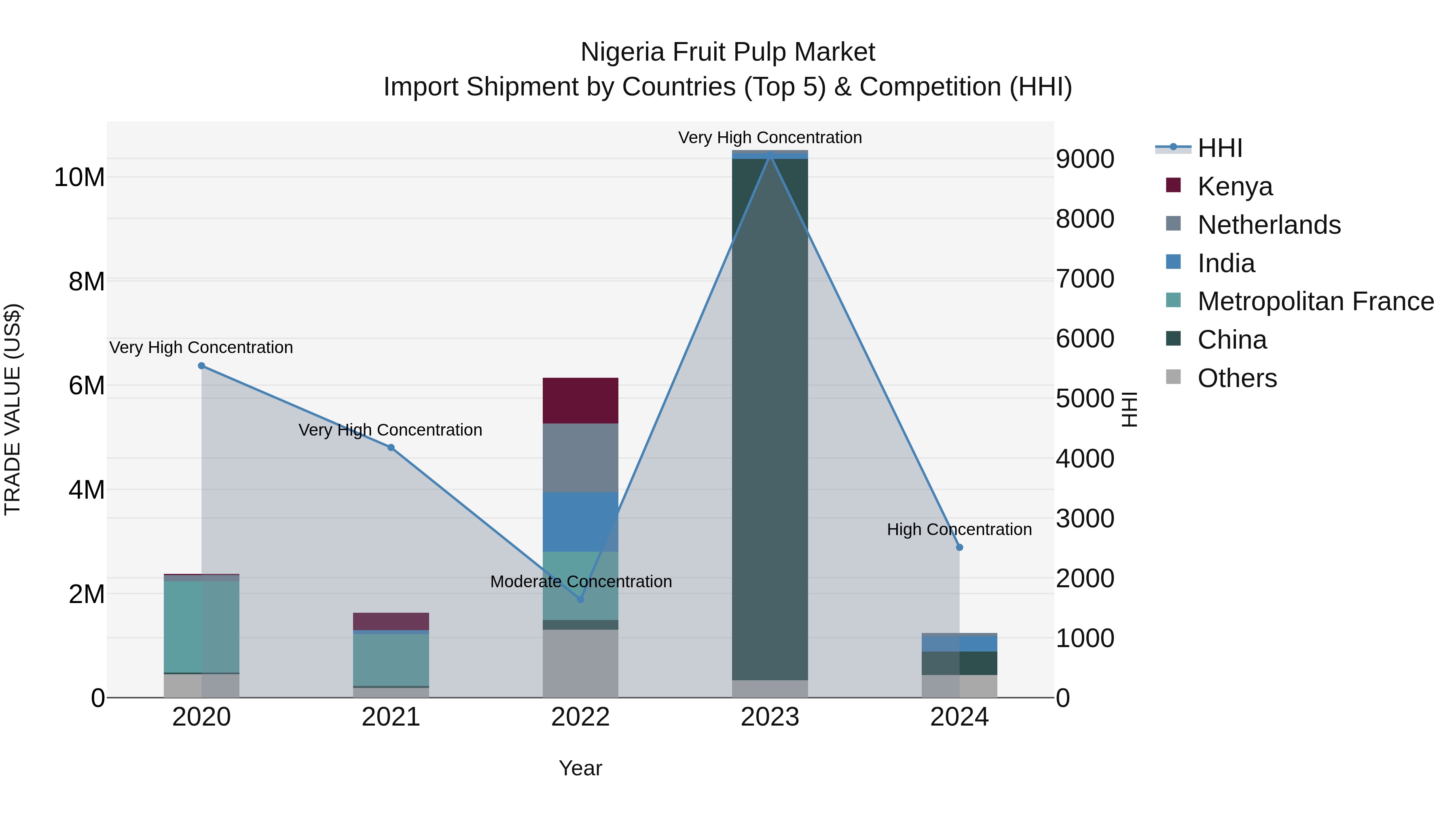
Despite a decline in growth rate from 2023 to 2024, Nigeria saw a significant level of fruit pulp imports from top exporters such as China, UK, India, Indonesia, and Netherlands. The high concentration levels in the market indicate a competitive landscape dominated by a few key players. The negative CAGR from 2020 to 2024 suggests a challenging period for the industry, which was further exacerbated by the sharp decrease in growth rate in 2024. Stakeholders should closely monitor market trends and explore strategies to stimulate growth and mitigate risks in the fruit pulp import sector in Nigeria.
Nigeria Fruit Pulp Market Overview
The Nigeria Fruit Pulp Market is expanding with the growing demand for processed fruit products, including juices, jams, and ice creams. Fruit pulp is a key ingredient in these products, providing natural flavors and nutrients. The market growth is driven by increasing urbanization, changing dietary habits, and the availability of a wide variety of tropical fruits.
Drivers of the market
The fruit pulp market in Nigeria is expanding due to the country`s rich agricultural resources and growing food processing industry. Fruit pulp is widely used in the production of juices, beverages, jams, and dairy products. The increasing consumer demand for natural and nutritious food products is driving the demand for fruit pulp. Moreover, the government`s support for agribusiness and food processing industries, along with rising exports of fruit pulp to international markets, is further boosting the market growth.
Challenges of the market
The Nigeria Fruit Pulp Market encounters challenges such as post-harvest losses due to inadequate storage and transportation infrastructure. Issues related to inconsistent supply and quality of raw materials also impact market stability. Furthermore, the market faces challenges in accessing modern processing technologies and techniques, which limits production efficiency and product quality. Regulatory hurdles and export restrictions further constrain market growth.
Government Policy of the market
The Nigeria government has introduced policies to support the development and expansion of the fruit pulp processing industry. The Ministry of Agriculture and Rural Development provides subsidies and incentives for fruit farmers and processors to increase production and improve quality standards. The government collaborates with research institutions and universities to develop new technologies for fruit pulp processing and preservation. Additionally, the Nigeria Export Promotion Council (NEPC) supports fruit pulp exporters to comply with international quality and safety standards.
Key Highlights of the Report:
- Nigeria Fruit Pulp Market Outlook
- Market Size of Nigeria Fruit Pulp Market, 2024
- Forecast of Nigeria Fruit Pulp Market, 2031
- Historical Data and Forecast of Nigeria Fruit Pulp Revenues & Volume for the Period 2021-2031
- Nigeria Fruit Pulp Market Trend Evolution
- Nigeria Fruit Pulp Market Drivers and Challenges
- Nigeria Fruit Pulp Price Trends
- Nigeria Fruit Pulp Porter's Five Forces
- Nigeria Fruit Pulp Industry Life Cycle
- Historical Data and Forecast of Nigeria Fruit Pulp Market Revenues & Volume By Fruit Type for the Period 2021-2031
- Historical Data and Forecast of Nigeria Fruit Pulp Market Revenues & Volume By Mango for the Period 2021-2031
- Historical Data and Forecast of Nigeria Fruit Pulp Market Revenues & Volume By Strawberry for the Period 2021-2031
- Historical Data and Forecast of Nigeria Fruit Pulp Market Revenues & Volume By Apple for the Period 2021-2031
- Historical Data and Forecast of Nigeria Fruit Pulp Market Revenues & Volume By Guava for the Period 2021-2031
- Historical Data and Forecast of Nigeria Fruit Pulp Market Revenues & Volume By Berries for the Period 2021-2031
- Historical Data and Forecast of Nigeria Fruit Pulp Market Revenues & Volume By Citrus Fruits for the Period 2021-2031
- Historical Data and Forecast of Nigeria Fruit Pulp Market Revenues & Volume By Others for the Period 2021-2031
- Historical Data and Forecast of Nigeria Fruit Pulp Market Revenues & Volume By Form for the Period 2021-2031
- Historical Data and Forecast of Nigeria Fruit Pulp Market Revenues & Volume By Liquid for the Period 2021-2031
- Historical Data and Forecast of Nigeria Fruit Pulp Market Revenues & Volume By Powder for the Period 2021-2031
- Historical Data and Forecast of Nigeria Fruit Pulp Market Revenues & Volume By Application for the Period 2021-2031
- Historical Data and Forecast of Nigeria Fruit Pulp Market Revenues & Volume By Food and Beverages for the Period 2021-2031
- Historical Data and Forecast of Nigeria Fruit Pulp Market Revenues & Volume By Distribution for the Period 2021-2031
- Historical Data and Forecast of Nigeria Fruit Pulp Market Revenues & Volume By E-Commerce for the Period 2021-2031
- Historical Data and Forecast of Nigeria Fruit Pulp Market Revenues & Volume By Convenience Stores for the Period 2021-2031
- Historical Data and Forecast of Nigeria Fruit Pulp Market Revenues & Volume By Supermarkets/Hypermarkets for the Period 2021-2031
- Historical Data and Forecast of Nigeria Fruit Pulp Market Revenues & Volume By Specialty Stores for the Period 2021-2031
- Historical Data and Forecast of Nigeria Fruit Pulp Market Revenues & Volume By Others for the Period 2021-2031
- Nigeria Fruit Pulp Import Export Trade Statistics
- Market Opportunity Assessment By Fruit Type
- Market Opportunity Assessment By Form
- Market Opportunity Assessment By Application
- Market Opportunity Assessment By Distribution
- Nigeria Fruit Pulp Top Companies Market Share
- Nigeria Fruit Pulp Competitive Benchmarking By Technical and Operational Parameters
- Nigeria Fruit Pulp Company Profiles
- Nigeria Fruit Pulp Key Strategic Recommendations






































