Nigeria LED Professional Lighting Market Summary
The nigeria led professional lighting market was estimated at USD 490 Million in 2025 and is projected to reach USD 661 Million by 2032, growing at a CAGR of 5.4% from 2026 to 2032.
Nigeria LED Professional Lighting Market Year-wise Growth Rate and Key Drivers
This graph highlights how the Nigeria LED Professional Lighting Market has steadily grown over the past five years, supported by major growth factors.
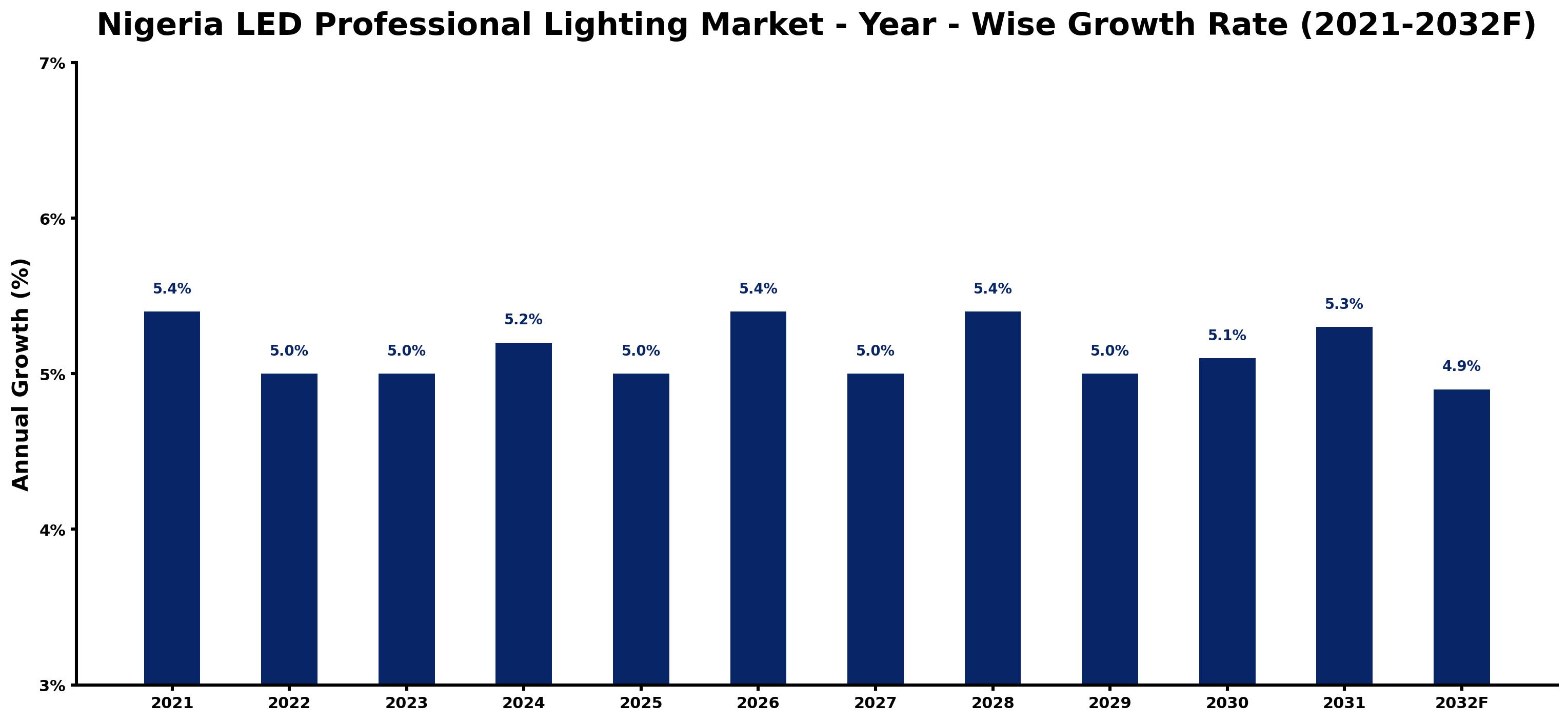
The table below presents the year wise growth rates along with the key drivers influencing the market
| Year | Growth Rate | Major Drivers |
| 2021 | 5.4% | Post-lockdown retail projects accelerated the shift towards energy-efficient lighting solutions. |
| 2022 | 5.0% | Rising urbanization in Nigerian cities highlighted the need for sustainable lighting options. |
| 2023 | 5.0% | Technological improvements in LED manufacturing reduced costs, increasing market penetration opportunities. |
| 2024 | 5.2% | Infrastructure development projects demand reliable lighting, amplifying the LED market expansion. |
| 2025 | 5.0% | Increased awareness of energy savings motivates businesses to invest in LED technologies. |
| 2026 | 5.4% | Corporate sustainability goals drive organizations to transition towards LED lighting solutions. |
| 2027 | 5.0% | Emerging smart building trends integrate LED systems, aligning with modern architectural demands. |
| 2028 | 5.4% | Enhanced distribution networks streamline access to LED products across urban and rural areas. |
| 2029 | 5.0% | Partnerships between local manufacturers and international brands boost product availability and expertise. |
| 2030 | 5.1% | Consumer preferences for eco-friendly products significantly impact lighting purchasing decisions. |
| 2031 | 5.3% | Technological innovations in smart lighting systems create new market opportunities and applications. |
| 2032 | 4.9% | Increased competition among suppliers leads to better pricing and product diversity in the market. |
Note - Market size estimations and growth projections presented in this report are based on 6Wresearch's advanced forecasting approach, validated with industry datasets as of June 2026.
Nigeria LED Professional Lighting Market Synopsis
The Nigeria LED Professional Lighting Market is projected to reach 5.4% and witness significant growth during the forecast period (2026-2032). This growth is primarily driven by the increasing adoption of energy-efficient lighting solutions, which offer substantial advantages over traditional incandescent and halogen alternatives. The favorable shift towards LED technology is further bolstered by government initiatives promoting energy conservation and sustainability across the nation. With a significant emphasis on infrastructure development, the market is expected to flourish, fueled by technological advancements in smart lighting solutions and heightened consumer awareness regarding energy costs.
Nigeria LED Professional Lighting Market Growth Drivers
The expansion of the Nigeria LED professional lighting market is primarily attributed to several key factors:
- The increasing focus on energy efficiency among consumers and businesses is paramount. LED lighting systems reduce energy consumption significantly compared to traditional lighting solutions, translating into lower electricity bills and a smaller carbon footprint.
- Government policies advocating for energy-efficient solutions play a crucial role. Various initiatives are being implemented to encourage the adoption of LEDs, which include subsidies and rebates for consumers opting for energy-efficient lighting technologies.
- The ongoing infrastructural expansion in Nigeria, including commercial and residential developments, is driving demand for advanced lighting systems. New construction projects increasingly incorporate LED solutions as standard due to their long-life and lower maintenance costs.
- Technological advancements in smart lighting systems are gaining prevalence. These systems integrate IoT (Internet of Things) capabilities, allowing for remote management and automation, thereby enhancing user convenience and energy management.
- Growing public awareness about the environmental benefits of using LED lighting over traditional options has influenced consumer behavior, leading to a more substantial market presence of LED products.
Nigeria LED Professional Lighting Market Challenges and Restraints
Despite considerable growth prospects, the Nigeria LED professional lighting market faces several challenges that could hinder its development:
- The initial high cost of LED lighting products compared to traditional options remains a significant barrier for adoption, particularly in cost-sensitive markets where budget constraints are common.
- Consumer misconceptions surrounding the quality and performance of LED technology can impede market growth. Many people still associate LEDs with issues such as color rendering and dimming capabilities.
- The prevalence of counterfeit and substandard LED products in the market can undermine consumer trust and stall growth. This necessitates stricter regulatory measures and consumer education to protect customers.
- Limited access to financing options for new entrants and smaller companies can hinder innovation and market participation, thereby slowing down overall growth.
- The fluctuating prices of raw materials used in LED manufacturing can create instability in the market, affecting pricing strategies and profit margins for companies operating in the sector.
Nigeria LED Professional Lighting Market Government Investment and Initiatives
The Nigerian government recognizes the importance of transitioning to energy-efficient lighting solutions as part of its broader sustainability goals. Several initiatives have been implemented to create a conducive environment for the growth of the Nigeria LED professional lighting market:
- Public sector investments have been directed towards upgrading existing infrastructure with energy-efficient lighting systems, particularly in urban areas, enhancing overall energy savings.
- Government incentives, including tax breaks and subsidies for manufacturers and consumers investing in LED technology, aim to stimulate market growth and increase adoption rates.
- Efforts to promote awareness around energy conservation through educational campaigns are being conducted, informing the public about the benefits of LED lighting systems.
- Collaboration with international bodies on sustainability initiatives helps align local policies with global standards, encouraging investment and innovation in the LED sector.
- Regulatory frameworks are being strengthened to ensure quality standards for LED products, which helps to combat the prevalence of counterfeit goods in the market.
Nigeria LED Professional Lighting Market Latest Developments (May 2025 - June 2026)
Recent developments in the Nigeria LED professional lighting market indicate a dynamic shift towards innovation and sustainability:
- There has been a noticeable uptick in the introduction of smart LED solutions, which feature connectivity options that allow for integrated systems management, appealing to both commercial and residential sectors.
- Major urban centers have initiated projects aimed at retrofitting public lighting infrastructure with energy-efficient LED technology, thus enhancing public safety and reducing operational costs.
- Industry workshops and exhibitions have been organized to showcase the latest advancements in LED technology, fostering collaboration and knowledge exchange among stakeholders.
- Research and development efforts have intensified, focusing on improving the efficiency and performance of LED products while reducing their production costs, making them more accessible.
- Sustainability initiatives are increasingly prominent, with companies pledging to reduce their environmental impact by implementing eco-friendly practices in production and distribution.
Nigeria LED Professional Lighting Market - Key Attractiveness of the Report
- 10 Years of Market Numbers
- Historical Data Starting from 2022 to 2025
- Base Year: 2025
- Forecast Data until 2032
- Key Performance Indicators Impacting the Market
- Major Upcoming Developments and Projects
Key Highlights of the Report:
- Nigeria LED Professional Lighting Market Outlook
- Market Size of Nigeria LED Professional Lighting Market, 2025
- Forecast of Nigeria LED Professional Lighting Market, 2032
- Historical Data and Forecast of Nigeria LED Professional Lighting Revenues & Volume for the Period 2022-2032
- Nigeria LED Professional Lighting Market Trend Evolution
- Nigeria LED Professional Lighting Market Drivers and Challenges
- Nigeria LED Professional Lighting Price Trends
- Nigeria LED Professional Lighting Porter's Five Forces
- Nigeria LED Professional Lighting Industry Life Cycle
- Historical Data and Forecast of Nigeria LED Professional Lighting Market Revenues & Volume By Product Type for the Period 2022-2032
- Historical Data and Forecast of Nigeria LED Professional Lighting Market Revenues & Volume By LED Bulbs for the Period 2022-2032
- Historical Data and Forecast of Nigeria LED Professional Lighting Market Revenues & Volume By LED Fixtures for the Period 2022-2032
- Historical Data and Forecast of Nigeria LED Professional Lighting Market Revenues & Volume By Bare LED Tubes for the Period 2022-2032
- Historical Data and Forecast of Nigeria LED Professional Lighting Market Revenues & Volume By LED Down lights for the Period 2022-2032
- Historical Data and Forecast of Nigeria LED Professional Lighting Market Revenues & Volume By Applications for the Period 2022-2032
- Historical Data and Forecast of Nigeria LED Professional Lighting Market Revenues & Volume By Indoor for the Period 2022-2032
- Historical Data and Forecast of Nigeria LED Professional Lighting Market Revenues & Volume By Outdoor for the Period 2022-2032
- Historical Data and Forecast of Nigeria LED Professional Lighting Market Revenues & Volume By Automotive for the Period 2022-2032
- Historical Data and Forecast of Nigeria LED Professional Lighting Market Revenues & Volume By Backlighting for the Period 2022-2032
- Nigeria LED Professional Lighting Import Export Trade Statistics
- Market Opportunity Assessment By Product Type
- Market Opportunity Assessment By Applications
- Nigeria LED Professional Lighting Top Companies Market Share
- Nigeria LED Professional Lighting Competitive Benchmarking By Technical and Operational Parameters
- Nigeria LED Professional Lighting Company Profiles
- Nigeria LED Professional Lighting Key Strategic Recommendations
Market Covered
This report offers a comprehensive study of the subsequent market segments:
By Product Type
- LED Bulbs
- LED Fixtures
- Bare LED Tubes
- LED Down lights
By Applications
- Indoor, Outdoor
- Automotive
- Backlighting






































