Nigeria Mineral Processing Equipment Market Size, Share & Growth Rate
The Nigeria Mineral Processing Equipment Market was estimated at USD 159 Million in 2025 and is projected to reach USD 209 Million by 2032, growing at a CAGR of 4.0% from 2026 to 2032. This growth trajectory is significantly driven by the increasing mining activities in Nigeria and the urgent need for advanced processing technologies. The focus on improving efficiency and productivity in mineral extraction and processing is compelling stakeholders to invest heavily in modern equipment and innovative solutions.
Nigeria Mineral Processing Equipment Market Year-wise Growth Rate and Key Drivers
This graph highlights how the Nigeria Mineral Processing Equipment Market has steadily grown over the years, supported by major growth factors.
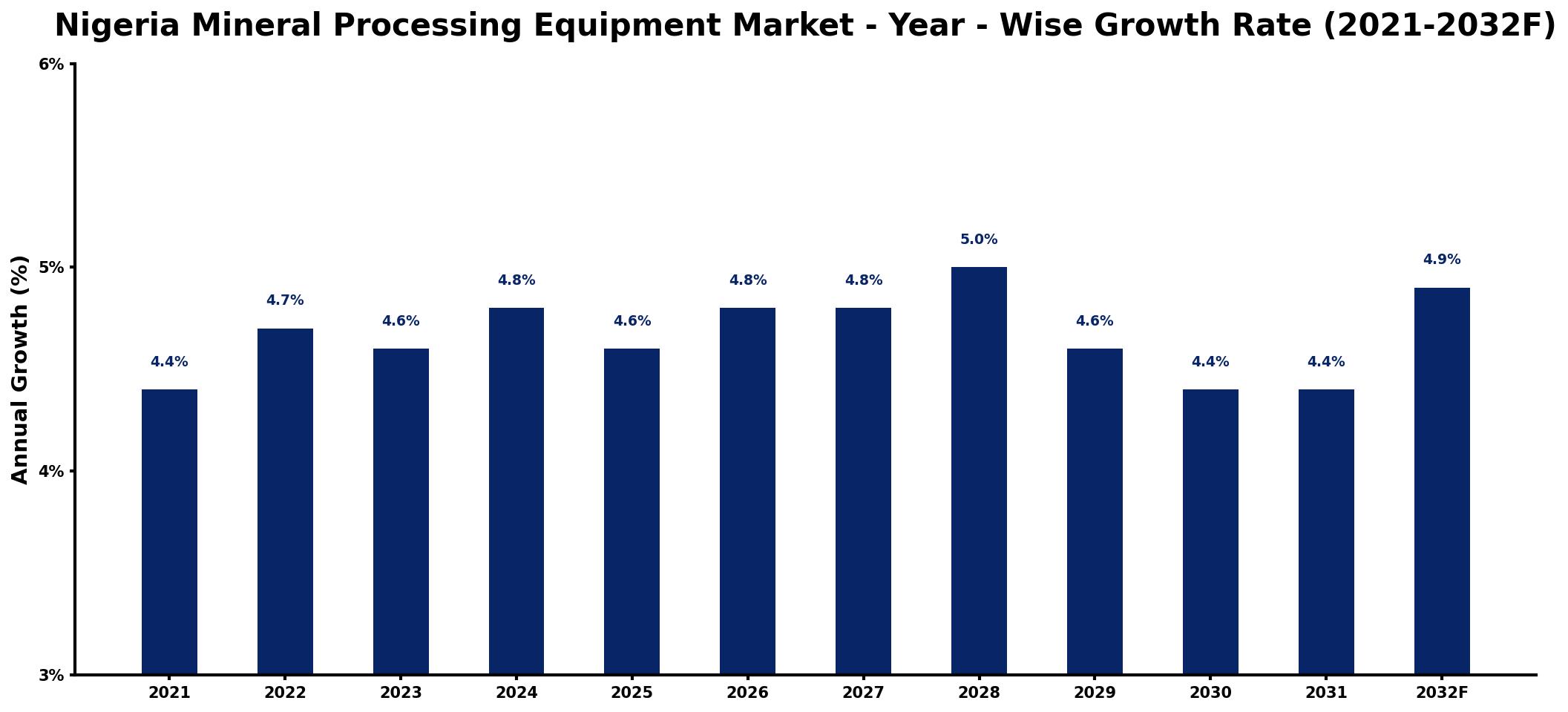
The table below presents the year‑wise growth rates along with the key drivers influencing the market
| Year | Growth Rate | Major Drivers |
| 2021 | 4.4% | Increased demand from construction sector |
| 2022 | 4.7% | Rising investments in mining projects |
| 2023 | 4.6% | Expansion of renewable energy initiatives |
| 2024 | 4.8% | Growing infrastructure development projects |
| 2025 | 4.6% | Higher consumer demand for metals |
| 2026 | 4.8% | Strengthening international trade relations |
| 2027 | 4.8% | Technological advancements in extraction |
| 2028 | 5.0% | Government incentives for local production |
| 2029 | 4.6% | Growing interest in sustainable practices |
| 2030 | 4.4% | Increased foreign direct investments |
| 2031 | 4.4% | Emergence of new market players |
| 2032 | 4.9% | rising procurement volume requirements |
Note: Market size estimations and growth projections presented in this report are based on 6Wresearch's proprietary forecasting methodology, utilizing the latest available industry data, government publications, and primary research inputs.
Nigeria Mineral Processing Equipment Market Synopsis
The strongest force shaping the Nigeria Mineral Processing Equipment Market is the burgeoning mining sector, characterized by a surge in exploration and production activities. This boom is propelled by the country's vast mineral resources, particularly gold, iron ore, and coal, which are driving demand for sophisticated processing equipment.
Furthermore, the market's evolution is bolstered by technological advancements that are reshaping operational paradigms. Stakeholders are increasingly seeking equipment that not only enhances performance but also aligns with environmental sustainability goals, thus setting the stage for innovative solutions.
Nigeria Mineral Processing Equipment Market Key Takeaways
- The market is experiencing steady growth due to heightened mining activities and the need for advanced equipment.
- Technological innovations, including automation and AI-powered tools, are becoming pivotal in enhancing operational efficiencies.
- There is a growing emphasis on environmentally friendly equipment to meet sustainability regulations.
- Investment opportunities are expanding, with potential partnerships between local firms and international manufacturers.
- Government policies are increasingly supportive of local manufacturing and investment in the mineral processing sector.
Evaluation of Restraints in Nigeria Mineral Processing Equipment Market
Despite its promising growth trajectory, the Nigeria Mineral Processing Equipment Market faces several significant restraints. The inadequacy of infrastructure—particularly inconsistent power supply and poor transportation networks—poses a considerable challenge to the efficient operation of processing equipment. Additionally, limited access to financing restricts the capacity for upgrading and expanding operations. Bureaucratic red tape can slow down the importation of necessary technologies, while the shortage of skilled labor hampers the effective utilization of advanced equipment, ultimately affecting productivity levels within the sector.
Nigeria Mineral Processing Equipment Market Trends
The current trends within the Nigeria Mineral Processing Equipment Market are heavily oriented towards the adoption of cutting-edge technologies. Industry players are increasingly investing in automation and digital monitoring systems to streamline operations and minimize downtime. Moreover, there's a marked shift towards sustainability, with manufacturers focusing on producing equipment that not only performs well but also adheres to environmental standards, significantly reducing energy consumption and carbon footprints.
Nigeria Mineral Processing Equipment Market Opportunities
The Nigeria Mineral Processing Equipment Market presents substantial investment opportunities due to the countrys rich mineral deposits and the rising demand for processed minerals across various industries. Areas poised for growth include advanced equipment for crushing, grinding, screening, and separation processes specific to minerals like gold, iron ore, and coal. With government initiatives aimed at attracting foreign investments and fostering local partnerships, there is a notable potential for investors to establish a strong foothold in this vibrant market.
Government Initiatives in the Nigeria Mineral Processing Equipment Market
The Nigerian government has been proactive in implementing policies to enhance the mineral processing equipment market. Initiatives like the National Industrial Revolution Plan (NIRP) and the Mining and Minerals Act aim to boost local manufacturing capabilities and reduce reliance on imports. Additionally, incentives such as tax breaks and duty exemptions are being offered to encourage local production of processing equipment. These measures are designed to foster transparency, attract investment, and ultimately enhance the industrial capacity of Nigeria's mineral processing sector.
Future Insights of the Nigeria Mineral Processing Equipment Market
Looking ahead, the Nigeria Mineral Processing Equipment Market is poised for continuous growth through 2032. Factors such as the increasing industrialization in Nigeria and the rising need for minerals in construction, manufacturing, and energy sectors will be key drivers. Technological advancements, particularly in automation and digital solutions, will also play a crucial role in improving operational efficiencies. As the mining sector evolves, equipment manufacturers are expected to adapt swiftly to meet the changing demands, creating a dynamic and competitive market landscape.
Nigeria Mineral Processing Equipment Market Latest Developments (2025 - 2026)
In recent months, the Nigeria Mineral Processing Equipment Market has seen a noticeable shift toward increased investments in automation technologies. Manufacturers are exploring innovative partnerships to leverage new technologies, enhancing overall productivity and operational efficiency. Moreover, there is an ongoing focus on compliance with international environmental standards, prompting several companies to upgrade their equipment offerings. The trend towards localization of manufacturing capabilities continues, driven by supportive government policies aimed at nurturing domestic industry.
Nigeria Mineral Processing Equipment Market - Key Attractiveness of the Report
- 10 Years of Market Numbers
- Historical Data Starting from 2022 to 2025
- Base Year: 2025
- Forecast Data until 2032
- Key Performance Indicators Impacting the Market
- Major Upcoming Developments and Projects
Key Highlights of the Report:
- Nigeria Mineral Processing Equipment Market Outlook
- Market Size of Nigeria Mineral Processing Equipment Market, 2025
- Forecast of Nigeria Mineral Processing Equipment Market, 2032
- Historical Data and Forecast of Nigeria Mineral Processing Equipment Revenues & Volume for the Period 2022-2032F
- Nigeria Mineral Processing Equipment Market Trend Evolution
- Nigeria Mineral Processing Equipment Market Drivers and Challenges
- Nigeria Mineral Processing Equipment Price Trends
- Nigeria Mineral Processing Equipment Porter's Five Forces
- Nigeria Mineral Processing Equipment Industry Life Cycle
- Historical Data and Forecast of Nigeria Mineral Processing Equipment Market Revenues & Volume By Mineral Mining Sector for the Period 2022-2032F
- Historical Data and Forecast of Nigeria Mineral Processing Equipment Market Revenues & Volume By Bauxite for the Period 2022-2032F
- Historical Data and Forecast of Nigeria Mineral Processing Equipment Market Revenues & Volume By Iron for the Period 2022-2032F
- Historical Data and Forecast of Nigeria Mineral Processing Equipment Market Revenues & Volume By Lithium for the Period 2022-2032F
- Historical Data and Forecast of Nigeria Mineral Processing Equipment Market Revenues & Volume By Others for the Period 2022-2032F
- Historical Data and Forecast of Nigeria Mineral Processing Equipment Market Revenues & Volume By Equipment for the Period 2022-2032F
- Historical Data and Forecast of Nigeria Mineral Processing Equipment Market Revenues & Volume By Crushers for the Period 2022-2032F
- Historical Data and Forecast of Nigeria Mineral Processing Equipment Market Revenues & Volume By Feeders for the Period 2022-2032F
- Historical Data and Forecast of Nigeria Mineral Processing Equipment Market Revenues & Volume By Conveyors for the Period 2022-2032F
- Historical Data and Forecast of Nigeria Mineral Processing Equipment Market Revenues & Volume By Drills & Breakers for the Period 2022-2032F
- Historical Data and Forecast of Nigeria Mineral Processing Equipment Market Revenues & Volume By Others for the Period 2022-2032F
- Historical Data and Forecast of Nigeria Mineral Processing Equipment Market Revenues & Volume By Application for the Period 2022-2032F
- Historical Data and Forecast of Nigeria Mineral Processing Equipment Market Revenues & Volume By Construction for the Period 2022-2032F
- Historical Data and Forecast of Nigeria Mineral Processing Equipment Market Revenues & Volume By Mining for the Period 2022-2032F
- Historical Data and Forecast of Nigeria Mineral Processing Equipment Market Revenues & Volume By Others for the Period 2022-2032F
- Nigeria Mineral Processing Equipment Import Export Trade Statistics
- Market Opportunity Assessment By Mineral Mining Sector
- Market Opportunity Assessment By Equipment
- Market Opportunity Assessment By Application
- Nigeria Mineral Processing Equipment Top Companies Market Share
- Nigeria Mineral Processing Equipment Competitive Benchmarking By Technical and Operational Parameters
- Nigeria Mineral Processing Equipment Company Profiles
- Nigeria Mineral Processing Equipment Key Strategic Recommendations






































