Bahrain Mineral Processing Equipment Market Size, Share & Growth Rate
The Bahrain Mineral Processing Equipment Market was estimated at USD 1105 Million in 2025 and is projected to reach USD 1925 Million by 2032, growing at a CAGR of 8.3% from 2026 to 2032. This growth trajectory is significantly driven by Bahrain's strategic investments in its mining and natural resources sectors. As the country seeks to enhance its industrial capabilities, the demand for advanced and efficient mineral processing machinery is set to surge, positioning local operations to benefit from improved recovery rates and productivity.
Bahrain Mineral Processing Equipment Market Year-wise Growth Rate and Key Drivers
This graph highlights how the Bahrain Mineral Processing Equipment Market has steadily grown over the years, supported by major growth factors.
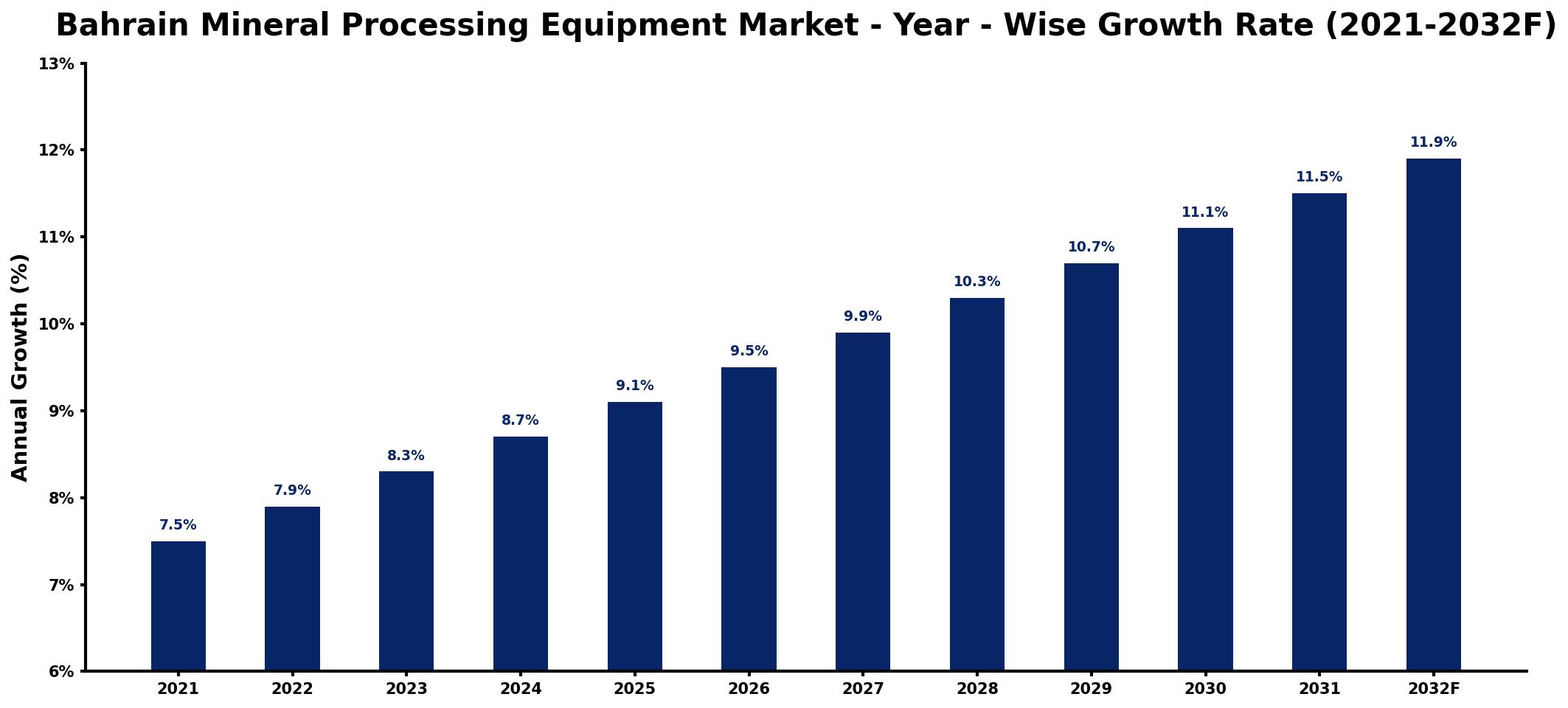
The table below presents the year‑wise growth rates along with the key drivers influencing the market
| Year | Growth Rate | Major Drivers |
| 2021 | 7.5% | Rising demand in construction sector |
| 2022 | 7.9% | Increased infrastructure development projects |
| 2023 | 8.3% | Growing investments in mining activities |
| 2024 | 8.7% | Expansion of manufacturing facilities |
| 2025 | 9.1% | Surge in energy sector projects |
| 2026 | 9.5% | Technological advancements driving efficiency |
| 2027 | 9.9% | Growing focus on sustainable practices |
| 2028 | 10.3% | Emerging markets boosting demand |
| 2029 | 10.7% | Increased government funding initiatives |
| 2030 | 11.1% | enhanced product quality standards |
| 2031 | 11.5% | Strengthening regional trade partnerships |
| 2032 | 11.9% | Innovations in resource extraction methods |
Note: Market size estimations and growth projections presented in this report are based on 6Wresearch's proprietary forecasting methodology, utilizing the latest available industry data, government publications, and primary research inputs.
Bahrain Mineral Processing Equipment Market Synopsis
Bahrains mineral processing equipment market is increasingly being shaped by the need for sophisticated technologies that can address the challenges of modern mining operations. With local industries striving for efficiency, the market is witnessing a pivot towards energy-efficient and automated solutions that align with global sustainability standards.
The landscape is further influenced by the demand from key sectors like aluminum production and construction. As industries adapt to evolving environmental regulations, the introduction of modular and scalable equipment becomes essential, allowing facilities to optimize their processing capabilities in a flexible manner.
Bahrain Mineral Processing Equipment Market Key Takeaways
- Significant projected growth driven by increased investment in advanced processing technologies.
- A shift towards energy-efficient and automated solutions to enhance operational sustainability.
- Demand for modular designs that offer flexibility and adaptability to various processing needs.
- Reliance on imported equipment due to limited local manufacturing capabilities, influencing market dynamics.
- Key sectors such as aluminum and construction underpinning the growth of processing equipment demand.
Evaluation of Restraints in Bahrain Mineral Processing Equipment Market
The Bahrain Mineral Processing Equipment Market faces several constraints that may impact its growth trajectory. One primary limitation is the nations relatively restricted mining activities, which inherently curtail local demand for advanced processing machinery. This results in a heavy reliance on imports, elevating costs and complicating logistics for domestic businesses. Moreover, the competitive landscape is challenging, as international suppliers often present more advanced technologies at lower price points, making it difficult for local entities to maintain a competitive edge. Additionally, the absence of in-country manufacturing capabilities and skilled technicians further exacerbates operational challenges, hindering the ability to fully leverage available processing equipment.
Bahrain Mineral Processing Equipment Market Trends
Current trends in the Bahrain Mineral Processing Equipment Market highlight a strong shift towards automation and digital control systems. By integrating these technologies, operators are optimizing their processing performance while effectively reducing operational costs. Furthermore, there is a notable emphasis on environmentally friendly practices, leading to the development and implementation of equipment designed to minimize energy consumption and enhance recovery rates from complex ore bodies. This trend reflects a broader commitment to sustainability within the regions industrial framework.
Bahrain Mineral Processing Equipment Market Opportunities
Despite its limitations, the Bahrain Mineral Processing Equipment Market presents numerous investment opportunities, particularly in refining imported raw materials for various industries. Companies engaged in construction, metallurgy, and chemical processing stand to benefit from upgrading their processing technologies to improve efficiency and reduce waste. Furthermore, as the government continues to invest in infrastructure and industrial zones, the demand for reliable and efficient mineral processing solutions is expected to grow, fostering opportunities for innovative equipment suppliers.
Government Initiatives in the Bahrain Mineral Processing Equipment Market
Government initiatives play a crucial role in shaping the Bahrain Mineral Processing Equipment Market. With a focus on enhancing industrial capabilities, the government is actively promoting investments in mining and processing sectors. Policies that foster the establishment of industrial zones, particularly for the extraction of limestone and other aggregates, are paving the way for equipment demand. Additionally, stringent environmental regulations and worker safety standards are guiding equipment choices, ensuring that only the most efficient and compliant machinery is utilized within processing facilities.
Future Insights of the Bahrain Mineral Processing Equipment Market
Looking ahead to the period from 2026 to 2032, the Bahrain Mineral Processing Equipment Market is expected to evolve significantly. As industries increasingly prioritize sustainability and efficiency, the adoption of cutting-edge processing technologies will likely become standard. Furthermore, as the local economy diversifies, with investments in sectors such as construction and metallurgy, the demand for sophisticated mineral processing solutions is anticipated to rise. This trajectory not only reflects the growing industrial capabilities of Bahrain but also aligns with broader regional trends towards modernization in the mining sector.
Bahrain Mineral Processing Equipment Market Latest Developments (2025 - 2026)
Recent developments within the Bahrain Mineral Processing Equipment Market indicate a continued emphasis on innovative technologies and sustainability initiatives. Industry stakeholders are increasingly exploring partnerships aimed at enhancing operational efficiencies while minimizing environmental impact. Moreover, there are efforts to establish training programs for skilled technicians to support the growing need for expertise in operating advanced processing equipment. These trends underscore a commitment to improving local capabilities while aligning with international best practices in mineral processing.
Bahrain Mineral Processing Equipment Market - Key Attractiveness of the Report
- 10 Years of Market Numbers
- Historical Data Starting from 2022 to 2025
- Base Year: 2025
- Forecast Data until 2032
- Key Performance Indicators Impacting the Market
- Major Upcoming Developments and Projects
Key Highlights of the Report:
- Bahrain Mineral Processing Equipment Market Outlook
- Market Size of Bahrain Mineral Processing Equipment Market, 2025
- Forecast of Bahrain Mineral Processing Equipment Market, 2032
- Historical Data and Forecast of Bahrain Mineral Processing Equipment Revenues & Volume for the Period 2022-2032F
- Bahrain Mineral Processing Equipment Market Trend Evolution
- Bahrain Mineral Processing Equipment Market Drivers and Challenges
- Bahrain Mineral Processing Equipment Price Trends
- Bahrain Mineral Processing Equipment Porter's Five Forces
- Bahrain Mineral Processing Equipment Industry Life Cycle
- Historical Data and Forecast of Bahrain Mineral Processing Equipment Market Revenues & Volume By Mineral Mining Sector for the Period 2022-2032F
- Historical Data and Forecast of Bahrain Mineral Processing Equipment Market Revenues & Volume By Bauxite for the Period 2022-2032F
- Historical Data and Forecast of Bahrain Mineral Processing Equipment Market Revenues & Volume By Iron for the Period 2022-2032F
- Historical Data and Forecast of Bahrain Mineral Processing Equipment Market Revenues & Volume By Lithium for the Period 2022-2032F
- Historical Data and Forecast of Bahrain Mineral Processing Equipment Market Revenues & Volume By Others for the Period 2022-2032F
- Historical Data and Forecast of Bahrain Mineral Processing Equipment Market Revenues & Volume By Equipment for the Period 2022-2032F
- Historical Data and Forecast of Bahrain Mineral Processing Equipment Market Revenues & Volume By Crushers for the Period 2022-2032F
- Historical Data and Forecast of Bahrain Mineral Processing Equipment Market Revenues & Volume By Feeders for the Period 2022-2032F
- Historical Data and Forecast of Bahrain Mineral Processing Equipment Market Revenues & Volume By Conveyors for the Period 2022-2032F
- Historical Data and Forecast of Bahrain Mineral Processing Equipment Market Revenues & Volume By Drills & Breakers for the Period 2022-2032F
- Historical Data and Forecast of Bahrain Mineral Processing Equipment Market Revenues & Volume By Others for the Period 2022-2032F
- Historical Data and Forecast of Bahrain Mineral Processing Equipment Market Revenues & Volume By Application for the Period 2022-2032F
- Historical Data and Forecast of Bahrain Mineral Processing Equipment Market Revenues & Volume By Construction for the Period 2022-2032F
- Historical Data and Forecast of Bahrain Mineral Processing Equipment Market Revenues & Volume By Mining for the Period 2022-2032F
- Historical Data and Forecast of Bahrain Mineral Processing Equipment Market Revenues & Volume By Others for the Period 2022-2032F
- Bahrain Mineral Processing Equipment Import Export Trade Statistics
- Market Opportunity Assessment By Mineral Mining Sector
- Market Opportunity Assessment By Equipment
- Market Opportunity Assessment By Application
- Bahrain Mineral Processing Equipment Top Companies Market Share
- Bahrain Mineral Processing Equipment Competitive Benchmarking By Technical and Operational Parameters
- Bahrain Mineral Processing Equipment Company Profiles
- Bahrain Mineral Processing Equipment Key Strategic Recommendations






































