Nigeria Policy Management in Telecom Market Size & Growth Rate (2026-2032)
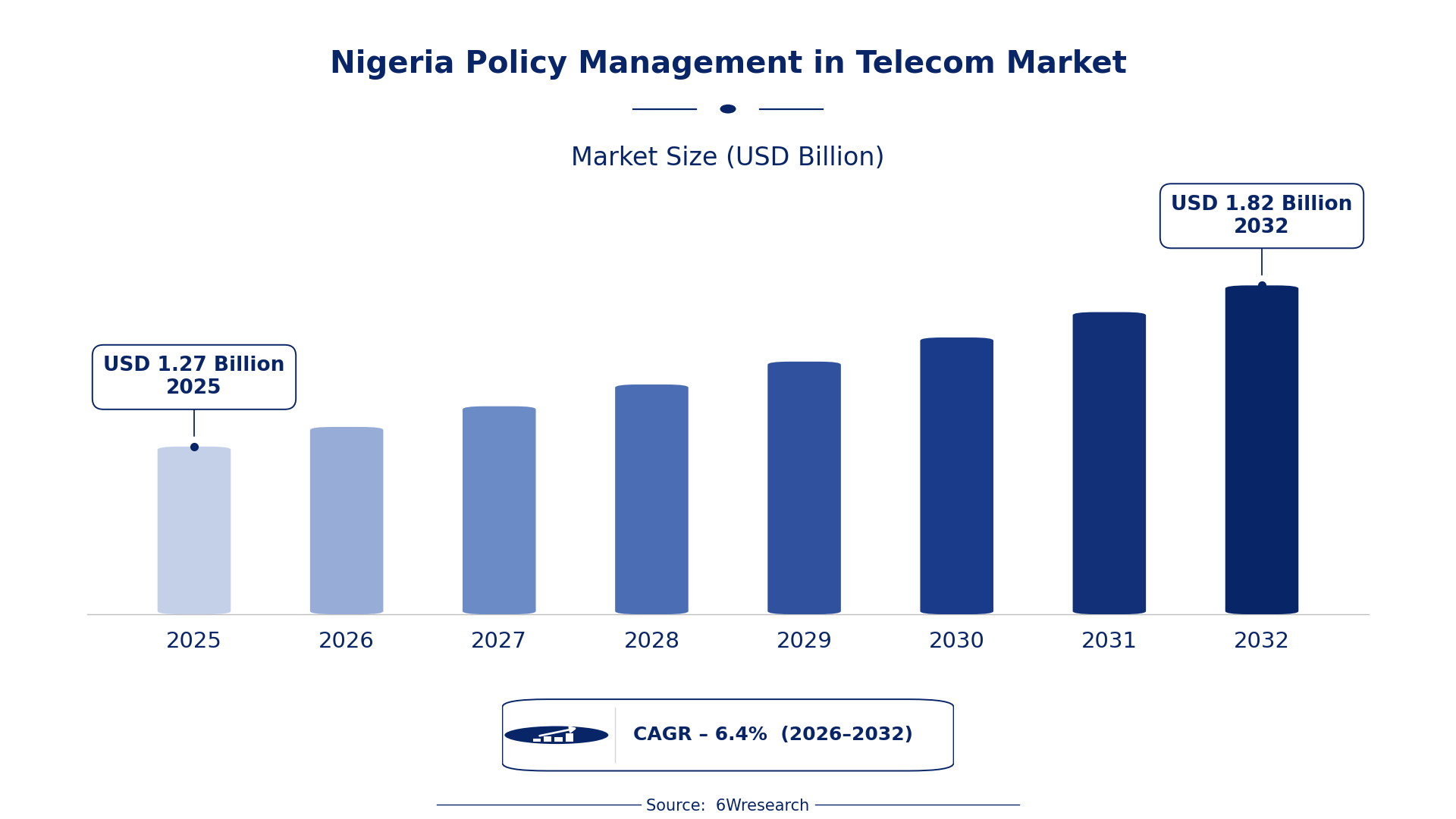
The Nigeria Policy Management in Telecom Market was estimated at USD 1274 Million in 2025 and is projected to reach USD 1825 Million by 2032, growing at a CAGR of 6.4% from 2026 to 2032.
Nigeria Policy Management in Telecom Market Synopsis
The Nigeria Policy Management in Telecom Market is increasingly becoming a cornerstone for telecommunications operators seeking to enhance network efficiency and customer satisfaction. As the demand for data services escalates, policy management solutions are essential for optimizing resources and enforcing service quality standards.
With advancements in technology, particularly in machine learning and artificial intelligence, the market is evolving rapidly. These tools allow telecom companies to implement adaptive policies that enhance both performance and user experience, shaping a more competitive and responsive environment.
Nigeria Policy Management in Telecom Market Year-wise Growth Rate and Key Drivers
This graph illustrates the annual growth rates of the Nigeria Policy Management in Telecom Market from 2021 to 2032, highlighting a steady upward trajectory and projected expansion over the forecast period.
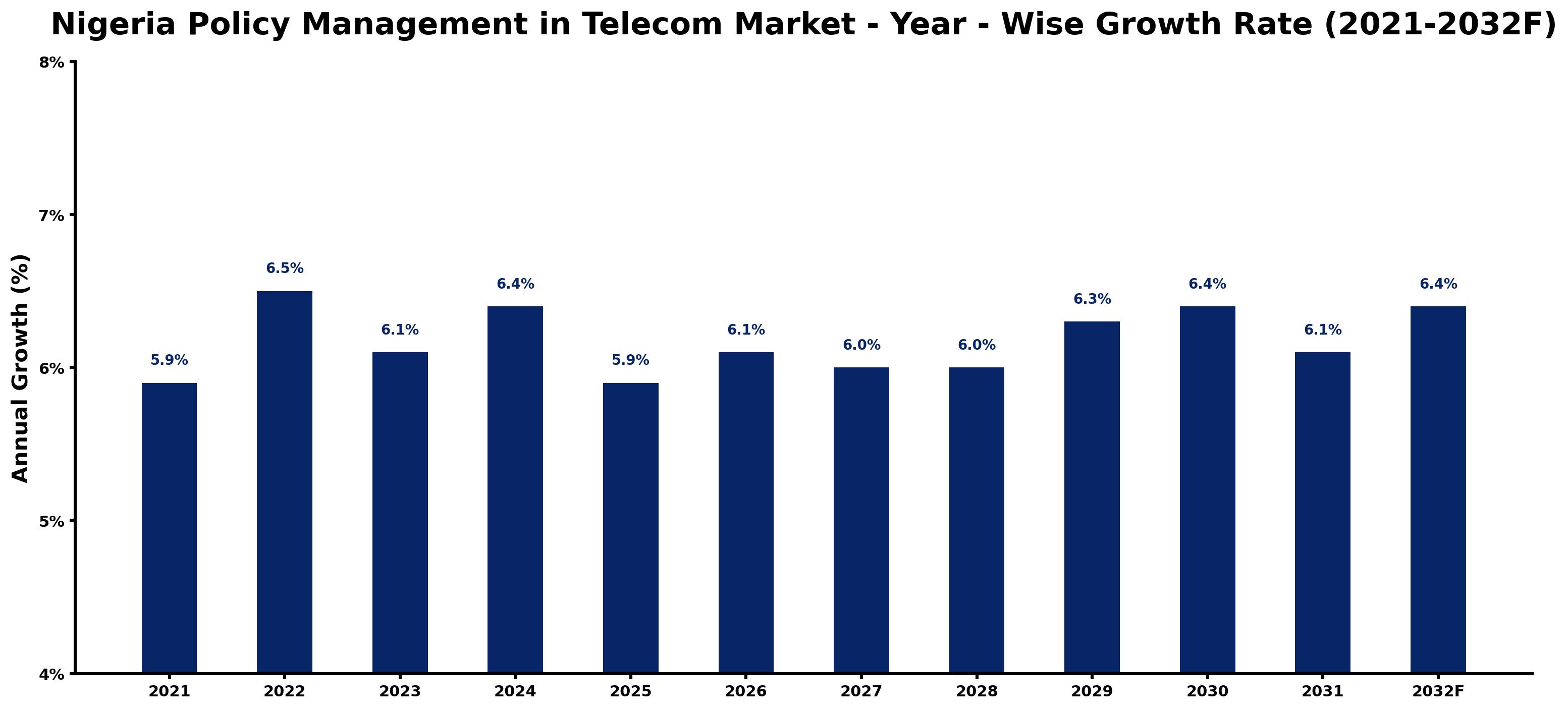
The table below presents the year‑wise growth rates along with the key drivers influencing the market
| Year | Growth Rate | Major Drivers |
| 2021 | 5.9% | NCC's new regulations streamlining telecom licensing processes. |
| 2022 | 6.5% | Boost in mobile payment adoption driven by fintech growth. |
| 2023 | 6.1% | Government's Digital Nigeria policy enhancing digital infrastructure. |
| 2024 | 6.4% | Increased foreign investments in telecom network expansion. |
| 2025 | 5.9% | Local startups driving innovative telecom service offerings. |
| 2026 | 6.1% | Rising smartphone penetration stimulating data service demand. |
| 2027 | 6.0% | Initiatives promoting local content and digital initiatives. |
| 2028 | 6.0% | Enhanced cybersecurity laws fostering trust in telecom services. |
| 2029 | 6.3% | Collaboration with tech companies improving telecom service efficiency. |
| 2030 | 6.4% | Emergence of 5G technology boosting telecommunications competition. |
| 2031 | 6.1% | Youth demographic favoring mobile connectivity and digital services. |
| 2032 | 6.4% | Continued investments in rural telecom infrastructure development. |
Note: Market size estimations and growth projections presented in this report are based on 6Wresearch's proprietary forecasting methodology, utilizing the latest available industry data, government publications, and primary research inputs.
Nigeria Policy Management in Telecom Market Key Takeaways
Below are some of the specific key takeaways from the market, including:
- The market is driven by the growing need for efficient data management and service quality in telecommunications.
- Advancements in AI and machine learning are significantly enhancing the capabilities of policy management systems.
- Regulatory compliance is a critical factor influencing investment in policy management technologies.
- Telecom operators are under pressure to adopt flexible solutions that can adapt to changing consumer demands.
- There is a strong emphasis on ensuring fair competition and protecting consumer interests through government initiatives.
Evaluation of Restraints in Nigeria Policy Management in Telecom Market
Several factors hinder the growth of the Nigeria Policy Management in Telecom Market. A notable challenge is the complex regulatory environment that requires telecom operators to constantly adapt their policies. The disconnect between telecom operators and regulatory authorities can also impede collaboration needed for effective policy implementation. Rapid technological changes can leave operators struggling to keep up with consumer expectations, leading to gaps in service quality and customer satisfaction. The interaction between these dynamics creates a multifaceted challenge for growth.
Nigeria Policy Management in Telecom Market Trends
One prominent trend is the shift towards data-driven decision-making in policy management. Operators are increasingly utilizing analytics to understand user behavior and to tailor services accordingly. The integration of machine learning tools is becoming more common, enabling predictive analytics for network optimization. As competition intensifies, a focus on enhancing user experience through personalized services is gaining traction.
Another trend is the rising concern over data privacy and security, pushing companies to invest in more stringent policies and compliance measures. This trend is further supported by consumer awareness regarding their data rights and the growing demand for transparency in billing and service agreements.
Nigeria Policy Management in Telecom Market Opportunities
The market presents various opportunities for growth, particularly in innovative service offerings. Companies that invest in next-generation policy management systems stand to gain a competitive advantage by enhancing service delivery and operational efficiencies. There's also a growing demand for systems that can integrate with existing infrastructure while ensuring compliance with evolving regulatory standards. Operators are keen on exploring partnerships that can facilitate technological advancements and lead to new revenue streams.
Government Initiatives in the Nigeria Policy Management in Telecom Market
Government policies play a crucial role in shaping the Nigeria Policy Management in Telecom Market. With a clear focus on regulatory frameworks that promote fair competition and consumer protection, the government is actively working on initiatives that support the telecommunications sector. This involves collaboration with various stakeholders to ensure that policies are well-designed and effectively implemented, paving the way for a more robust telecom environment.
- A national digital infrastructure upgrade programme recently completed aimed at enhancing broadband access across urban and rural areas.
- Ongoing initiatives focus on developing a regulatory framework that mandates transparency in billing practices, ensuring consumers are well-informed.
- Plans are underway for a public-private partnership aimed at boosting telecom infrastructure investment expected to begin in late 2026.
- The establishment of a regulatory body focused on spectrum management that was implemented in 2025 to address frequency allocation challenges.
- Initiatives promoting digital inclusion through targeted programs are currently being reviewed for implementation to foster broader access to services.
Future Insights of the Nigeria Policy Management in Telecom Market
Looking ahead to 2026-2032, the Nigeria Policy Management in Telecom Market is likely to experience transformative changes. With regulatory frameworks becoming more conducive to innovation, telecom operators will benefit from integrating advanced technologies. The growing demand for personalized services will push companies to refine their policy management systems further. Additionally, as consumer awareness increases, a strong emphasis on transparency and data protection will redefine customer engagement strategies in the sector.
Nigeria Policy Management in Telecom Market Latest Developments
Over the past year, the Nigeria Policy Management in Telecom Market has seen a wave of activity, with telecom operators striving to enhance their offerings amid rising competition. Significant advancements in policy management technology have come to the forefront, enabling operators to improve their responsiveness to customer needs. The landscape is also witnessing a heightened focus on regulatory compliance as new standards are introduced.
- A leading regional operator launched an AI-driven policy management system in Q3 2025, enabling real-time network optimization.
- In early 2025, a major technology vendor announced a partnership with telecom providers to develop advanced analytics tools for better resource allocation.
- A pilot program aimed at enhancing billing transparency was completed successfully by mid-2025, garnering positive feedback from consumers.
- Ongoing efforts to integrate machine learning capabilities into existing infrastructure are set to accelerate by the end of 2026.
- Upcoming is a regulatory initiative scheduled for late 2026 that will introduce new compliance standards focused on consumer rights.
Nigeria Policy Management in Telecom Market - Key Attractiveness of the Report
- 10 Years of Market Numbers
- Historical Data Starting from 2022 to 2025
- Base Year: 2025
- Forecast Data until 2032
- Key Performance Indicators Impacting the Market
- Major Upcoming Developments and Projects
Key Highlights of the Report:
- Nigeria Policy Management in Telecom Market Outlook
- Market Size of Nigeria Policy Management in Telecom Market, 2025
- Forecast of Nigeria Policy Management in Telecom Market, 2032
- Historical Data and Forecast of Nigeria Policy Management in Telecom Revenues & Volume for the Period 2022-2032F
- Nigeria Policy Management in Telecom Market Trend Evolution
- Nigeria Policy Management in Telecom Market Drivers and Challenges
- Nigeria Policy Management in Telecom Price Trends
- Nigeria Policy Management in Telecom Porter's Five Forces
- Nigeria Policy Management in Telecom Industry Life Cycle
- Historical Data and Forecast of Nigeria Policy Management in Telecom Market Revenues & Volume By Network for the Period 2022-2032F
- Historical Data and Forecast of Nigeria Policy Management in Telecom Market Revenues & Volume By Fixed for the Period 2022-2032F
- Historical Data and Forecast of Nigeria Policy Management in Telecom Market Revenues & Volume By Wireless for the Period 2022-2032F
- Historical Data and Forecast of Nigeria Policy Management in Telecom Market Revenues & Volume By Component for the Period 2022-2032F
- Historical Data and Forecast of Nigeria Policy Management in Telecom Market Revenues & Volume By Solutions for the Period 2022-2032F
- Historical Data and Forecast of Nigeria Policy Management in Telecom Market Revenues & Volume By Services for the Period 2022-2032F
- Historical Data and Forecast of Nigeria Policy Management in Telecom Market Revenues & Volume By Deployment for the Period 2022-2032F
- Historical Data and Forecast of Nigeria Policy Management in Telecom Market Revenues & Volume By Cloud for the Period 2022-2032F
- Historical Data and Forecast of Nigeria Policy Management in Telecom Market Revenues & Volume By On-Premises for the Period 2022-2032F
- Nigeria Policy Management in Telecom Import Export Trade Statistics
- Market Opportunity Assessment By Network
- Market Opportunity Assessment By Component
- Market Opportunity Assessment By Deployment
- Nigeria Policy Management in Telecom Top Companies Market Share
- Nigeria Policy Management in Telecom Competitive Benchmarking By Technical and Operational Parameters
- Nigeria Policy Management in Telecom Company Profiles
- Nigeria Policy Management in Telecom Key Strategic Recommendations






































