Algeria Policy Management in Telecom Market Size & Growth Rate (2026-2032)
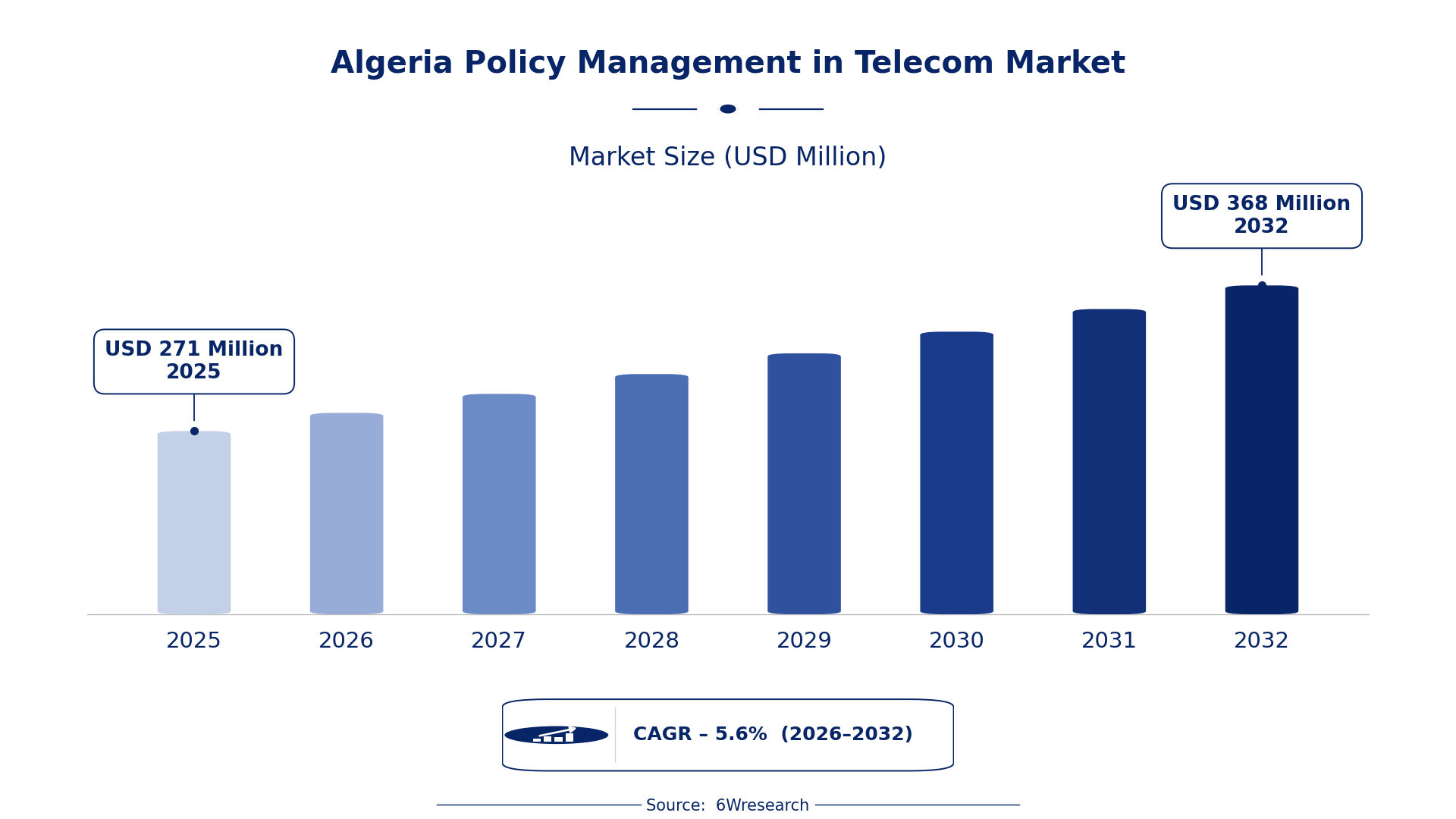
The Algeria Policy Management in Telecom Market was estimated at USD 271 Million in 2025 and is projected to reach USD 368 Million by 2032, growing at a CAGR of 5.6% from 2026 to 2032.
Algeria Policy Management in Telecom Market Synopsis
The most significant force currently driving the Algeria Policy Management in Telecom Market is the government's push towards regulatory reform and infrastructure expansion. This initiative is crucial in supporting the increasing demand for advanced telecom services, which has been compounded by consumer shifts toward more data-intensive applications.
As operators race to implement efficient policy management systems, the emphasis is on integrating advanced technologies like AI and machine learning. These innovations are key to not only maintaining compliance but also enhancing user experiences in an increasingly competitive landscape.
Algeria Policy Management in Telecom Market Year-wise Growth Rate and Key Drivers
This graph illustrates the annual growth rates of the Algeria Policy Management in Telecom Market from 2021 to 2032, highlighting a steady upward trajectory and projected expansion over the forecast period.
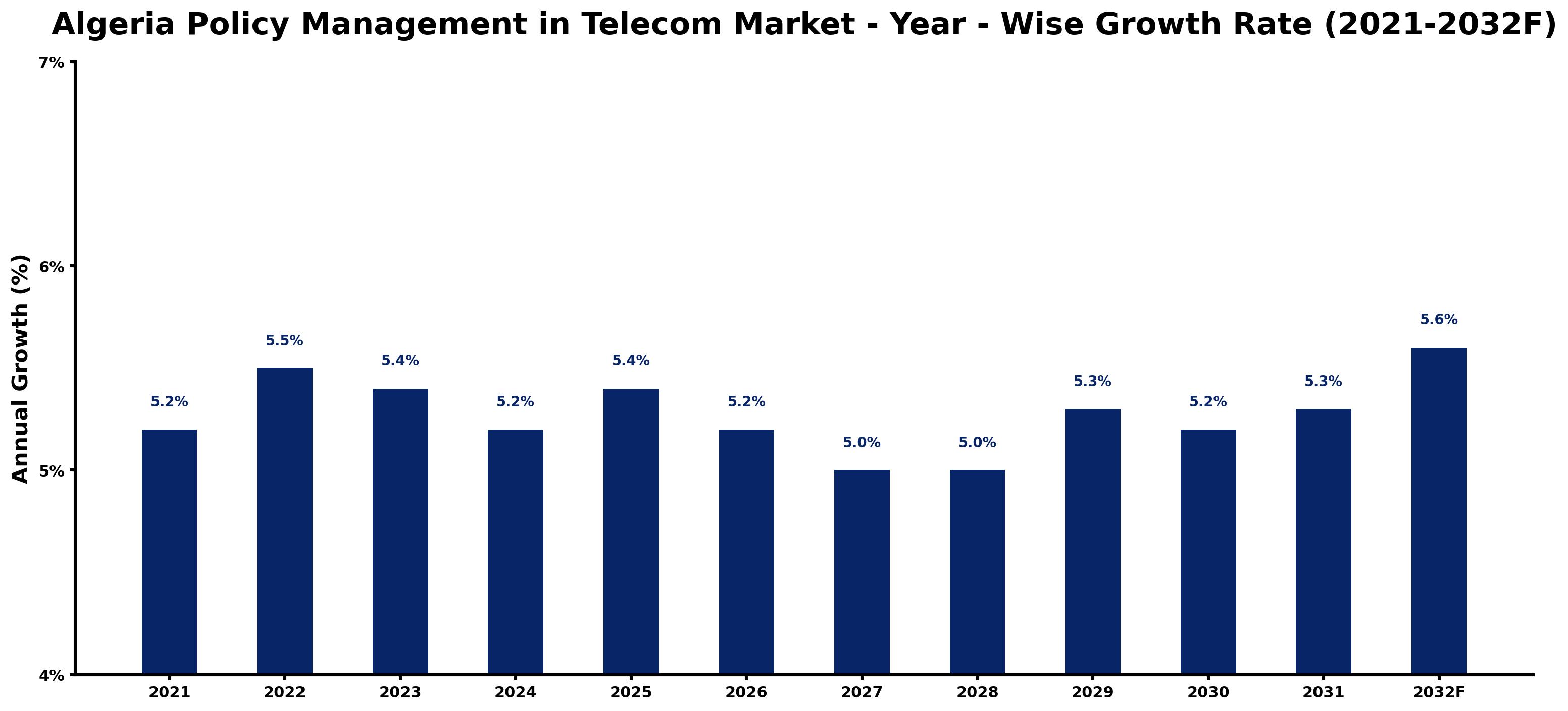
The table below presents the year‑wise growth rates along with the key drivers influencing the market
| Year | Growth Rate | Major Drivers |
| 2021 | 5.2% | Launch of Algeria's digital transformation plan. |
| 2022 | 5.5% | Implementation of new telecommunications regulatory framework. |
| 2023 | 5.4% | Increase in mobile internet affordability across demographics. |
| 2024 | 5.2% | Government incentives for telecom infrastructure investments. |
| 2025 | 5.4% | Rising smartphone penetration fostering communication services. |
| 2026 | 5.2% | Enhanced rural connectivity programs by Ministry of Telecommunications. |
| 2027 | 5.0% | Emerging demand for 5G services among urban population. |
| 2028 | 5.0% | Collaborations with tech firms boosting telecom innovations. |
| 2029 | 5.3% | Growing awareness of digital services driving policy engagement. |
| 2030 | 5.2% | Focus on cybersecurity regulations enhancing service reliability. |
| 2031 | 5.3% | Local startups innovating solutions for telecom efficiency. |
| 2032 | 5.6% | Increased public-private partnerships in telecom sector development. |
Note: Market size estimations and growth projections presented in this report are based on 6Wresearch's proprietary forecasting methodology, utilizing the latest available industry data, government publications, and primary research inputs.
Algeria Policy Management in Telecom Market Key Takeaways
Below are some of the specific key takeaways from the market, including:
- The market is growing steadily, driven by evolving consumer demands and regulatory changes.
- Investment in new technologies is critical for effective policy management and compliance.
- Regulatory complexities pose challenges but also motivate operators to innovate.
- The government's focus on expanding digital infrastructure is enhancing service delivery.
- AI and analytics are becoming integral for real-time policy management solutions.
Evaluation of Restraints in Algeria Policy Management in Telecom Market
Regulatory complexities and evolving compliance requirements pose significant challenges for telecom operators in Algeria. The necessity for constant updates to policy management frameworks translates to increased operational costs and administrative burdens. As technology advances rapidly, operators must adapt quickly to maintain competitive advantages, often straining resources. These factors contribute to a slower adaptation rate in some areas of the market, limiting the full potential of growth and innovation.
Algeria Policy Management in Telecom Market Trends
Several trends are currently shaping the Algeria Policy Management in Telecom Market. A notable shift towards automation is being observed, as telecom operators seek to reduce manual processes and enhance efficiency through AI-driven systems. Furthermore, the introduction of personalized service offerings is on the rise, fueled by data analytics capabilities that allow for tailored customer experiences. Lastly, the growing demand for 5G services is prompting operators to invest in advanced policy management systems capable of handling increased data flow and ensuring regulatory compliance.
Algeria Policy Management in Telecom Market Opportunities
Opportunities in this market largely stem from the government's infrastructure projects aimed at enhancing telecom service availability across the country. As demand for high-speed internet and improved mobile services grows, telecom operators have room to innovate and expand their offerings. The integration of IoT devices presents another avenue for growth, necessitating more sophisticated policy management solutions to handle the influx of connected devices.
Government Initiatives in the Algeria Policy Management in Telecom Market
Government policies are significantly impacting the Algeria Policy Management in Telecom Market, focusing on regulatory frameworks that support competition and innovation. The government is prioritizing the expansion of digital infrastructure and fostering an environment conducive to investment in advanced telecom solutions. These initiatives are critical for addressing the growing demands of consumers and businesses alike.
- A recent initiative aimed at streamlining spectrum allocation was launched, designed to enhance service delivery efficiency.
- Current efforts are underway to implement a regulatory framework mandating billing transparency for telecom services.
- A planned public-private partnership is expected to expand telecom infrastructure access by 2028.
- The government is reviewing its regulations on data privacy to align with international standards, with revisions expected by early 2026.
- In 2025, a policy was introduced encouraging investment in 5G technology, expected to drive market growth.
Future Insights of the Algeria Policy Management in Telecom Market
Looking ahead to 2026-2032, the Algeria Policy Management in Telecom Market is likely to experience a shift towards even greater digital integration. With ongoing government support for infrastructure development and a sustained focus on regulatory compliance, operators will have the opportunity to refine their service offerings. The anticipated rollout of 5G and increased connectivity will demand robust policy management solutions, likely prompting further investments in technology and innovative practices across the sector.
Algeria Policy Management in Telecom Market Latest Developments
In the past 12-14 months, the Algeria Policy Management in Telecom Market has seen several key developments aimed at enhancing operational efficiencies and service delivery. Operators are increasingly adopting advanced technologies to keep pace with changing consumer demands and regulatory requirements.
- A major telecom operator launched a new AI-based policy management platform in early 2025, aiming to improve compliance and operational agility.
- An initiative to upgrade digital infrastructure began in mid-2025 and remains underway, focused on expanding service reach in rural areas.
- A pilot program for an innovative analytics-driven customer experience management tool is expected to roll out by late 2025.
- A collaboration between telecom providers and tech vendors commenced in Q2 2025 to develop interoperability solutions, enhancing service integration.
- Upcoming regulatory changes expected in 2026 will mandate enhanced data protection measures for consumer privacy.
Algeria Policy Management in Telecom Market - Key Attractiveness of the Report
- 10 Years of Market Numbers
- Historical Data Starting from 2022 to 2025
- Base Year: 2025
- Forecast Data until 2032
- Key Performance Indicators Impacting the Market
- Major Upcoming Developments and Projects
Key Highlights of the Report:
- Algeria Policy Management in Telecom Market Outlook
- Market Size of Algeria Policy Management in Telecom Market, 2025
- Forecast of Algeria Policy Management in Telecom Market, 2032
- Historical Data and Forecast of Algeria Policy Management in Telecom Revenues & Volume for the Period 2022-2032F
- Algeria Policy Management in Telecom Market Trend Evolution
- Algeria Policy Management in Telecom Market Drivers and Challenges
- Algeria Policy Management in Telecom Price Trends
- Algeria Policy Management in Telecom Porter's Five Forces
- Algeria Policy Management in Telecom Industry Life Cycle
- Historical Data and Forecast of Algeria Policy Management in Telecom Market Revenues & Volume By Network for the Period 2022-2032F
- Historical Data and Forecast of Algeria Policy Management in Telecom Market Revenues & Volume By Fixed for the Period 2022-2032F
- Historical Data and Forecast of Algeria Policy Management in Telecom Market Revenues & Volume By Wireless for the Period 2022-2032F
- Historical Data and Forecast of Algeria Policy Management in Telecom Market Revenues & Volume By Component for the Period 2022-2032F
- Historical Data and Forecast of Algeria Policy Management in Telecom Market Revenues & Volume By Solutions for the Period 2022-2032F
- Historical Data and Forecast of Algeria Policy Management in Telecom Market Revenues & Volume By Services for the Period 2022-2032F
- Historical Data and Forecast of Algeria Policy Management in Telecom Market Revenues & Volume By Deployment for the Period 2022-2032F
- Historical Data and Forecast of Algeria Policy Management in Telecom Market Revenues & Volume By Cloud for the Period 2022-2032F
- Historical Data and Forecast of Algeria Policy Management in Telecom Market Revenues & Volume By On-Premises for the Period 2022-2032F
- Algeria Policy Management in Telecom Import Export Trade Statistics
- Market Opportunity Assessment By Network
- Market Opportunity Assessment By Component
- Market Opportunity Assessment By Deployment
- Algeria Policy Management in Telecom Top Companies Market Share
- Algeria Policy Management in Telecom Competitive Benchmarking By Technical and Operational Parameters
- Algeria Policy Management in Telecom Company Profiles
- Algeria Policy Management in Telecom Key Strategic Recommendations






































