Nigeria Process Automation And Instrumentation Market Size, Share & Growth Rate
The Nigeria Process Automation And Instrumentation Market was estimated at USD 1308 Million in 2025 and is projected to reach USD 2317 Million by 2032, growing at a CAGR of 8.5% from 2026 to 2032. This growth trajectory is primarily driven by the increased need for operational efficiency across various sectors, including oil and gas, manufacturing, and chemicals. The ongoing adoption of Industry 4.0 technologies is facilitating a shift towards more automated processes, enabling companies to reduce costs and improve product quality significantly.
Nigeria Process Automation And Instrumentation Market Year-wise Growth Rate and Key Drivers
This graph highlights how the Nigeria Process Automation And Instrumentation Market has steadily grown over the years, supported by major growth factors.
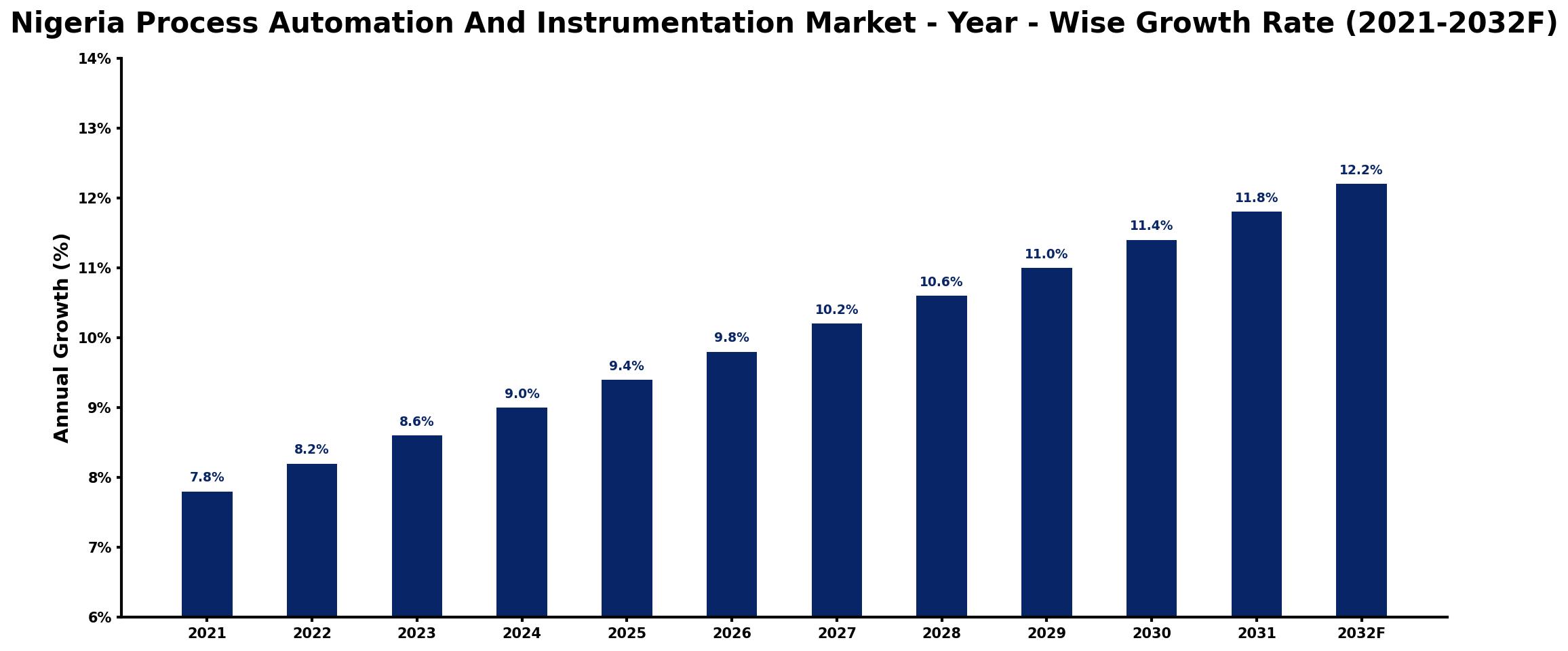
The table below presents the year‑wise growth rates along with the key drivers influencing the market
| Year | Growth Rate | Major Drivers |
| 2021 | 7.8% | rising demand from manufacturing sector |
| 2022 | 8.2% | increased investments in infrastructure projects |
| 2023 | 8.6% | growth in energy sector applications |
| 2024 | 9.0% | expansion of smart city initiatives |
| 2025 | 9.4% | enhanced focus on sustainability practices |
| 2026 | 9.8% | technological advancements in industries |
| 2027 | 10.2% | growing need for efficiency improvements |
| 2028 | 10.6% | increased regulatory compliance requirements |
| 2029 | 11.0% | increased production capacity utilization |
| 2030 | 11.4% | rising adoption of digital solutions |
| 2031 | 11.8% | growing interest in renewable energy |
| 2032 | 12.2% | growing emerging market penetration |
Note: Market size estimations and growth projections presented in this report are based on 6Wresearch's proprietary forecasting methodology, utilizing the latest available industry data, government publications, and primary research inputs.
Nigeria Process Automation And Instrumentation Market Synopsis
In Nigeria, the integration of automation technologies is not just a trend but a necessity for competitiveness. Industries are increasingly investing in sophisticated control systems and field instruments to achieve greater precision and efficiency in their operations. This shift is particularly evident in the oil and gas sector, where real-time data monitoring is critical.
Additionally, software solutions that facilitate streamlined processes are becoming essential as firms seek to optimize resource utilization. The strong governmental support for industrial automation further accelerates this market's evolution, making it a pivotal area for investment and growth.
Nigeria Process Automation And Instrumentation Market Key Takeaways
- The market is driven by the need for improved operational efficiency across various sectors.
- Government initiatives are providing support through incentives and policy frameworks.
- Adoption of Industry 4.0 technologies is accelerating automation across industries.
- Infrastructure development is a critical driver of market expansion in Nigeria.
- High initial investment costs remain a significant barrier for many companies.
Evaluation of Restraints in Nigeria Process Automation And Instrumentation Market
Despite the promising growth prospects, the Nigeria process automation and instrumentation market faces several constraints. Chief among these are infrastructure deficiencies, which hinder the implementation of automation technologies effectively. Many industries also lack standardized communication protocols, complicating integration efforts. Furthermore, a limited understanding of the benefits that automation can bring contributes to slower adoption rates. High initial investment costs create barriers for smaller firms, limiting their ability to compete effectively in an increasingly automated landscape.
Nigeria Process Automation And Instrumentation Market Trends
Current trends in the Nigeria process automation and instrumentation market indicate a rising interest in smart manufacturing solutions. The convergence of IoT and automation technologies is reshaping the way industries operate, with a focus on predictive maintenance and real-time data analytics. Moreover, the integration of artificial intelligence in control systems is providing new opportunities for optimizing performance and reducing downtime, reflecting a global shift towards more intelligent industrial operations.
Nigeria Process Automation And Instrumentation Market Opportunities
The potential for growth in the Nigeria process automation and instrumentation market lies in several key areas. As industries increasingly recognize the value of automation, there is an opportunity to develop tailored solutions that meet specific operational needs. Expanding investment in renewable energy and sustainable practices also presents a unique opportunity for automation firms to innovate and provide solutions that align with global sustainability goals. Additionally, the push for enhanced safety and compliance within industries can further drive demand for advanced instrumentation and automation technologies.
Government Initiatives in the Nigeria Process Automation And Instrumentation Market
The Nigerian government is actively promoting industrial efficiency through various policies aimed at advancing the process automation and instrumentation market. The National Industrial Revolution Plan (NIRP) includes initiatives designed to encourage the adoption of cutting-edge automation technologies. Furthermore, incentives such as tax breaks, grants for technological upgrades, and comprehensive training programs for the workforce are crucial in supporting businesses as they transition towards more automated processes.
Future Insights of the Nigeria Process Automation And Instrumentation Market
Looking ahead to the period from 2026 to 2032, the Nigeria process automation and instrumentation market is poised for significant evolution. As more sectors embrace automation, we can expect advancements in technology to further facilitate increased efficiency and output. The government's continued support and growing awareness of the benefits of automation will likely spur wider adoption, leading to a more competitive industrial landscape. The market is expected to mature, with established players and new entrants alike focusing on innovative solutions that cater to Nigeria's unique industrial challenges.
Nigeria Process Automation And Instrumentation Market Latest Developments (2025 - 2026)
In recent months, the market has seen a notable shift towards the integration of artificial intelligence within automation systems, indicating a growing recognition of the value of smart technologies. Companies are increasingly looking to harness data analytics for better decision-making and process optimization. Additionally, several governmental initiatives aimed at bolstering industrial automation are set to roll out, further enhancing the supportive ecosystem for technology adoption in Nigeria.
Nigeria Process Automation And Instrumentation Market - Key Attractiveness of the Report
- 10 Years of Market Numbers
- Historical Data Starting from 2022 to 2025
- Base Year: 2025
- Forecast Data until 2032
- Key Performance Indicators Impacting the Market
- Major Upcoming Developments and Projects
Key Highlights of the Report:
- Nigeria Process Automation And Instrumentation Market Outlook
- Market Size of Nigeria Process Automation And Instrumentation Market, 2025
- Forecast of Nigeria Process Automation And Instrumentation Market, 2032
- Historical Data and Forecast of Nigeria Process Automation And Instrumentation Revenues & Volume for the Period 2022-2032F
- Nigeria Process Automation And Instrumentation Market Trend Evolution
- Nigeria Process Automation And Instrumentation Market Drivers and Challenges
- Nigeria Process Automation And Instrumentation Price Trends
- Nigeria Process Automation And Instrumentation Porter's Five Forces
- Nigeria Process Automation And Instrumentation Industry Life Cycle
- Historical Data and Forecast of Nigeria Process Automation And Instrumentation Market Revenues & Volume By Instrument for the Period 2022-2032F
- Historical Data and Forecast of Nigeria Process Automation And Instrumentation Market Revenues & Volume By Field Instruments for the Period 2022-2032F
- Historical Data and Forecast of Nigeria Process Automation And Instrumentation Market Revenues & Volume By Control Valve for the Period 2022-2032F
- Historical Data and Forecast of Nigeria Process Automation And Instrumentation Market Revenues & Volume By Analytical Instruments for the Period 2022-2032F
- Historical Data and Forecast of Nigeria Process Automation And Instrumentation Market Revenues & Volume By Solution for the Period 2022-2032F
- Historical Data and Forecast of Nigeria Process Automation And Instrumentation Market Revenues & Volume By Advanced Process Control (APC) for the Period 2022-2032F
- Historical Data and Forecast of Nigeria Process Automation And Instrumentation Market Revenues & Volume By Distributed Control System (DCS) for the Period 2022-2032F
- Historical Data and Forecast of Nigeria Process Automation And Instrumentation Market Revenues & Volume By Human Machine Interaction (HMI) for the Period 2022-2032F
- Historical Data and Forecast of Nigeria Process Automation And Instrumentation Market Revenues & Volume By Manufacturing Execution System (MES) for the Period 2022-2032F
- Historical Data and Forecast of Nigeria Process Automation And Instrumentation Market Revenues & Volume By Programmable Logic Controller (PLC) for the Period 2022-2032F
- Historical Data and Forecast of Nigeria Process Automation And Instrumentation Market Revenues & Volume By Safety Automation for the Period 2022-2032F
- Historical Data and Forecast of Nigeria Process Automation And Instrumentation Market Revenues & Volume By Supervisory Control and Data Acquisition (SCADA) for the Period 2022-2032F
- Historical Data and Forecast of Nigeria Process Automation And Instrumentation Market Revenues & Volume By End-user Industry for the Period 2022-2032F
- Historical Data and Forecast of Nigeria Process Automation And Instrumentation Market Revenues & Volume By Oil and Gas for the Period 2022-2032F
- Historical Data and Forecast of Nigeria Process Automation And Instrumentation Market Revenues & Volume By Food and Beverage for the Period 2022-2032F
- Historical Data and Forecast of Nigeria Process Automation And Instrumentation Market Revenues & Volume By Pharmaceutical and Biopharma for the Period 2022-2032F
- Historical Data and Forecast of Nigeria Process Automation And Instrumentation Market Revenues & Volume By Chemical and Petrochemical for the Period 2022-2032F
- Historical Data and Forecast of Nigeria Process Automation And Instrumentation Market Revenues & Volume By Other End-user Industries for the Period 2022-2032F
- Nigeria Process Automation And Instrumentation Import Export Trade Statistics
- Market Opportunity Assessment By Instrument
- Market Opportunity Assessment By Solution
- Market Opportunity Assessment By End-user Industry
- Nigeria Process Automation And Instrumentation Top Companies Market Share
- Nigeria Process Automation And Instrumentation Competitive Benchmarking By Technical and Operational Parameters
- Nigeria Process Automation And Instrumentation Company Profiles
- Nigeria Process Automation And Instrumentation Key Strategic Recommendations






































