Nigeria Tankless Water Heater Market Top 5 Importing Countries and Market Competition (HHI) Analysis
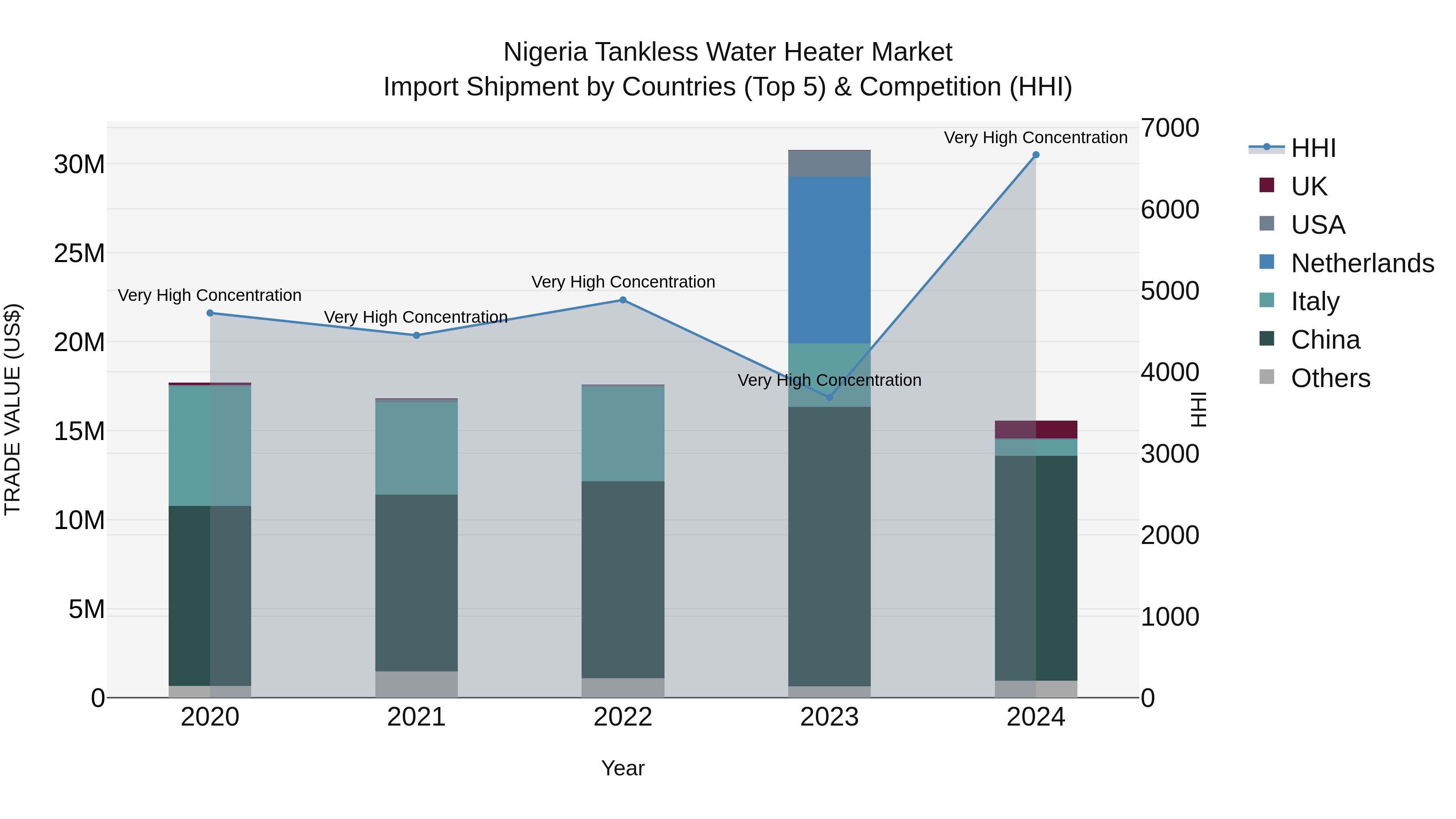
Despite the declining CAGR and significant drop in growth rate from 2023 to 2024, the top countries exporting tankless water heaters to Nigeria in 2024 include China, UK, Italy, Turkey, and India. The high Herfindahl-Hirschman Index (HHI) indicates a concentrated market with these key players dominating the import shipments. This data suggests that while the market may be experiencing challenges, these countries continue to play a crucial role in supplying tankless water heaters to meet the demand in Nigeria.
Nigeria Tankless Water Heater Market Overview
The Nigeria tankless water heater market is experiencing significant growth due to increasing urbanization, rising disposable incomes, and a growing awareness of energy efficiency. Consumers are increasingly opting for tankless water heaters over traditional storage water heaters due to their compact size, energy savings, and on-demand hot water supply. Key market players are focusing on product innovations, such as advanced technology integration for improved efficiency and smart features for user convenience. The market is also witnessing a surge in demand from commercial sectors such as hotels, hospitals, and restaurants due to the high demand for continuous hot water supply. Government initiatives promoting energy-efficient appliances are further driving the adoption of tankless water heaters in Nigeria.
Nigeria Tankless Water Heater Market Trends and Opportunities
The Nigeria Tankless Water Heater Market is experiencing growth due to increasing urbanization, rising disposable income, and a growing awareness of energy efficiency. Consumers are increasingly seeking alternatives to traditional water heaters for their space-saving benefits and on-demand hot water supply. Key opportunities in the market include the introduction of smart and connected tankless water heaters, which offer remote control and monitoring capabilities. Furthermore, the government`s focus on promoting energy-efficient appliances is driving the demand for tankless water heaters as they are known for their lower energy consumption compared to traditional models. Manufacturers have an opportunity to expand their product offerings and distribution channels to cater to the growing demand for tankless water heaters in Nigeria.
Nigeria Tankless Water Heater Market Challenges
In the Nigeria tankless water heater market, several challenges are faced including high initial costs which may deter price-sensitive consumers, unreliable power supply leading to inconsistent performance, lack of awareness and understanding of the benefits of tankless water heaters among consumers, and limited availability of skilled technicians for installation and maintenance. Additionally, issues related to water quality and pressure can impact the efficiency and longevity of tankless water heaters in Nigeria. Market penetration and competition from traditional water heaters also present hurdles for the growth of tankless water heaters in the country. Overcoming these challenges will require targeted marketing campaigns, improved product affordability, investment in infrastructure for stable power supply, and education programs to increase consumer knowledge and confidence in adopting tankless water heater technology.
Nigeria Tankless Water Heater Market Drivers
The Nigeria Tankless Water Heater Market is primarily driven by the growing demand for energy-efficient and space-saving water heating solutions. As urbanization and population growth increase in Nigeria, there is a rising need for more compact and eco-friendly appliances in residential and commercial buildings. Tankless water heaters offer significant advantages over traditional storage water heaters, such as instant hot water supply, lower energy consumption, and longer lifespan. Additionally, the government`s focus on promoting energy efficiency and sustainability is encouraging consumers and businesses to adopt tankless water heaters as a greener alternative. The increasing disposable income and changing consumer preferences towards modern and convenient home appliances are also fueling the growth of the tankless water heater market in Nigeria.
Nigeria Tankless Water Heater Market Government Policies
The Nigerian government has implemented various policies related to the Tankless Water Heater Market to promote energy efficiency and environmental sustainability. These policies include the National Energy Efficiency Action Plan (NEEAP) which aims to reduce energy consumption and greenhouse gas emissions by promoting the use of energy-efficient appliances such as tankless water heaters. Additionally, the government has introduced tax incentives and rebates for consumers and businesses that invest in energy-efficient technologies like tankless water heaters. Furthermore, regulations have been put in place to ensure that only energy-efficient water heaters are imported and sold in the Nigerian market, encouraging manufacturers to produce more eco-friendly products. Overall, these policies are geared towards promoting the adoption of tankless water heaters to reduce energy consumption and mitigate the impact of climate change.
Nigeria Tankless Water Heater Market Future Outlook
The Nigeria Tankless Water Heater Market is expected to witness significant growth in the coming years due to factors such as increasing urbanization, rising disposable income, and growing awareness about energy efficiency. As consumers seek more sustainable and cost-effective solutions for their homes, tankless water heaters offer benefits such as on-demand hot water supply, space-saving design, and lower energy consumption. Additionally, government initiatives promoting the use of energy-efficient appliances are likely to drive the adoption of tankless water heaters in Nigeria. With ongoing advancements in technology and a shift towards eco-friendly practices, the market is poised for expansion, presenting opportunities for manufacturers and suppliers to capitalize on the growing demand for innovative water heating solutions in the country.
Key Highlights of the Report:
- Nigeria Tankless Water Heater Market Outlook
- Market Size of Nigeria Tankless Water Heater Market, 2024
- Forecast of Nigeria Tankless Water Heater Market, 2031
- Historical Data and Forecast of Nigeria Tankless Water Heater Revenues & Volume for the Period 2021- 2031
- Nigeria Tankless Water Heater Market Trend Evolution
- Nigeria Tankless Water Heater Market Drivers and Challenges
- Nigeria Tankless Water Heater Price Trends
- Nigeria Tankless Water Heater Porter's Five Forces
- Nigeria Tankless Water Heater Industry Life Cycle
- Historical Data and Forecast of Nigeria Tankless Water Heater Market Revenues & Volume By Type for the Period 2021- 2031
- Historical Data and Forecast of Nigeria Tankless Water Heater Market Revenues & Volume By Whole-House for the Period 2021- 2031
- Historical Data and Forecast of Nigeria Tankless Water Heater Market Revenues & Volume By Point-of-Use for the Period 2021- 2031
- Historical Data and Forecast of Nigeria Tankless Water Heater Market Revenues & Volume By Application for the Period 2021- 2031
- Historical Data and Forecast of Nigeria Tankless Water Heater Market Revenues & Volume By Residential for the Period 2021- 2031
- Historical Data and Forecast of Nigeria Tankless Water Heater Market Revenues & Volume By Commercial for the Period 2021- 2031
- Nigeria Tankless Water Heater Import Export Trade Statistics
- Market Opportunity Assessment By Type
- Market Opportunity Assessment By Application
- Nigeria Tankless Water Heater Top Companies Market Share
- Nigeria Tankless Water Heater Competitive Benchmarking By Technical and Operational Parameters
- Nigeria Tankless Water Heater Company Profiles
- Nigeria Tankless Water Heater Key Strategic Recommendations






































