Nigeria Three Wheeler Market Size, Share & Growth Rate
The Nigeria Three Wheeler Market was estimated at USD 458 Million in 2025 and is projected to reach USD 629 Million by 2032, growing at a CAGR of 4.6% from 2026 to 2032. This growth is largely driven by the increasing urbanization of Nigerian cities, which has created a demand for efficient and cost-effective transportation options. Additionally, the rise of e-commerce and last-mile delivery services is contributing significantly to the market dynamics, as three-wheelers offer an agile solution for navigating through crowded urban environments.
Nigeria Three Wheeler Market Year-wise Growth Rate and Key Drivers
This graph highlights how the Nigeria Three Wheeler Market has steadily grown over the years, supported by major growth factors.
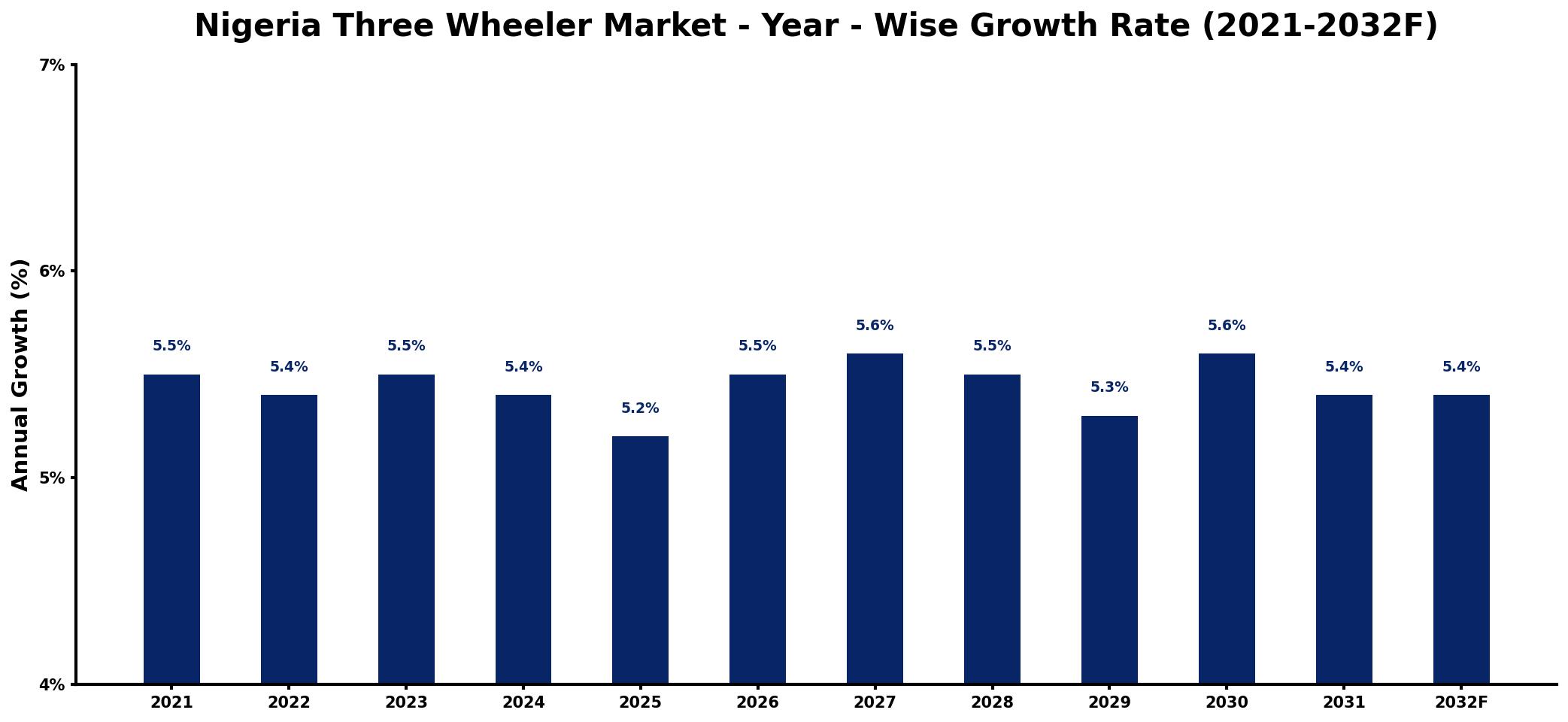
The table below presents the year‑wise growth rates along with the key drivers influencing the market
| Year | Growth Rate | Major Drivers |
| 2021 | 5.5% | Urban mobility solutions gaining traction |
| 2022 | 5.4% | Increased investment in infrastructure |
| 2023 | 5.5% | Growth in ride-hailing services |
| 2024 | 5.4% | Expansion of logistics delivery networks |
| 2025 | 5.2% | Rising demand for affordable transport |
| 2026 | 5.5% | Surge in tourism and travel |
| 2027 | 5.6% | Technological advancements in transportation |
| 2028 | 5.5% | Government support for local manufacturing |
| 2029 | 5.3% | Emerging markets driving demand |
| 2030 | 5.6% | Sustainability initiatives boosting adoption |
| 2031 | 5.4% | improved raw material availability |
| 2032 | 5.4% | Enhanced financing options available |
Note: Market size estimations and growth projections presented in this report are based on 6Wresearch's proprietary forecasting methodology, utilizing the latest available industry data, government publications, and primary research inputs.
Nigeria Three Wheeler Market Synopsis
In recent years, the Nigeria Three Wheeler Market has gained momentum, fueled by a rising population and a need for affordable transport options. However, as the market matures, it is facing a paradigm shift towards electrification and sustainable mobility solutions, which are becoming increasingly critical in the wake of environmental concerns.
Looking ahead, the market is poised for continuous expansion, as government initiatives and consumer preferences increasingly align with the benefits offered by three-wheelers. This landscape creates an enticing environment for investment, particularly in the manufacturing and innovation of electric models that cater to local needs.
Nigeria Three Wheeler Market Key Takeaways
- Market growth driven by urbanization and the demand for last-mile delivery services.
- Three-wheelers are increasingly preferred for their versatility and fuel efficiency.
- Shift towards electric three-wheelers is in line with global sustainability trends.
- Government initiatives are boosting the adoption of cleaner transportation options.
- Investment opportunities are emerging in manufacturing and distribution tailored to local preferences.
Evaluation of Restraints in Nigeria Three Wheeler Market
Despite the overall positive trajectory, the Nigeria Three Wheeler Market faces several restraints that hinder its growth potential. One of the primary challenges is the limited infrastructure, characterized by poor road conditions and inadequate maintenance, which affect operational efficiency. Furthermore, competition from alternative modes of transport, such as motorcycles and traditional taxis, complicates market penetration efforts. Regulatory hurdles, including licensing requirements and restrictions on operational zones, further challenge operators within the three-wheeler segment. Additionally, economic factors such as fluctuating fuel prices and inflation can impact consumer affordability, necessitating targeted interventions to mitigate these effects.
Nigeria Three Wheeler Market Trends
Key trends shaping the Nigeria Three Wheeler Market include a growing preference for electric vehicles, influenced by global sustainability initiatives. As environmental concerns gain prominence, both consumers and businesses are recognizing the advantages of electric three-wheelers over traditional combustion engines. Additionally, innovations in technology are enhancing the operational capabilities of three-wheelers, with manufacturers focusing on fuel efficiency and durability. The rise of digital platforms for e-hailing and delivery services is also creating new avenues for three-wheeler utilization, solidifying their role in urban transportation.
Nigeria Three Wheeler Market Opportunities
The Nigeria Three Wheeler Market is ripe for investment opportunities, particularly as the demand for affordable transportation solutions expands in urban and rural landscapes. The ongoing government focus on improving infrastructure and transportation networks signals a growing need for effective last-mile connectivity, creating openings for manufacturers and suppliers. Investors can explore avenues in the financing and customization of three-wheelers to better align with local preferences and operational requirements, thus contributing to sustainable urban mobility while potentially reaping considerable returns.
Government Initiatives in the Nigeria Three Wheeler Market
The Nigerian government has implemented various policies aimed at regulating and promoting the Three Wheeler Market. These include import tariffs designed to protect local manufacturers, alongside measures ensuring compliance with safety standards and emissions regulations. The government has introduced incentives such as tax breaks and subsidies aimed at encouraging the adoption of environmentally friendly three-wheelers, reinforcing its commitment to sustainable transportation solutions while fostering domestic production and innovation within the sector.
Future Insights of the Nigeria Three Wheeler Market
The Nigeria Three Wheeler Market is anticipated to continue its steady growth trajectory through 2026-2032, underpinned by urbanization, a booming e-commerce sector, and the persistent need for affordable transport options. The increasing adoption of electric three-wheelers as a viable alternative to traditional vehicles will likely enhance market dynamics further. However, addressing existing infrastructure challenges and regulatory barriers will be pivotal in unlocking the market's full potential. Stakeholders must remain agile to capitalize on emerging trends and shifts in consumer behavior as the market evolves.
Nigeria Three Wheeler Market Latest Developments (2025 - 2026)
Recent developments in the Nigeria Three Wheeler Market have centered on advancements in electric vehicle technology, with several initiatives aimed at integrating electric three-wheelers into public transport systems. Additionally, there has been a marked increase in partnerships between local manufacturers and technology firms to enhance operational efficiencies. Regulatory bodies are also actively revising policies to streamline licensing and operational requirements, aimed at promoting a more favorable environment for three-wheeler operators.
Nigeria Three Wheeler Market - Key Attractiveness of the Report
- 10 Years of Market Numbers
- Historical Data Starting from 2022 to 2025
- Base Year: 2025
- Forecast Data until 2032
- Key Performance Indicators Impacting the Market
- Major Upcoming Developments and Projects
Key Highlights of the Report:
- Nigeria Three Wheeler Market Outlook
- Market Size of Nigeria Three Wheeler Market, 2025
- Forecast of Nigeria Three Wheeler Market, 2032
- Historical Data and Forecast of Nigeria Three Wheeler Revenues & Volume for the Period 2022-2032F
- Nigeria Three Wheeler Market Trend Evolution
- Nigeria Three Wheeler Market Drivers and Challenges
- Nigeria Three Wheeler Price Trends
- Nigeria Three Wheeler Porter's Five Forces
- Nigeria Three Wheeler Industry Life Cycle
- Historical Data and Forecast of Nigeria Three Wheeler Market Revenues & Volume By Fuel Type for the Period 2022-2032F
- Historical Data and Forecast of Nigeria Three Wheeler Market Revenues & Volume By Petrol/CNG for the Period 2022-2032F
- Historical Data and Forecast of Nigeria Three Wheeler Market Revenues & Volume By Diesel for the Period 2022-2032F
- Historical Data and Forecast of Nigeria Three Wheeler Market Revenues & Volume By Electric for the Period 2022-2032F
- Historical Data and Forecast of Nigeria Three Wheeler Market Revenues & Volume By Vehicle Type for the Period 2022-2032F
- Historical Data and Forecast of Nigeria Three Wheeler Market Revenues & Volume By Passenger Carrier for the Period 2022-2032F
- Historical Data and Forecast of Nigeria Three Wheeler Market Revenues & Volume By Load Carrier for the Period 2022-2032F
- Nigeria Three Wheeler Import Export Trade Statistics
- Market Opportunity Assessment By Fuel Type
- Market Opportunity Assessment By Vehicle Type
- Nigeria Three Wheeler Top Companies Market Share
- Nigeria Three Wheeler Competitive Benchmarking By Technical and Operational Parameters
- Nigeria Three Wheeler Company Profiles
- Nigeria Three Wheeler Key Strategic Recommendations






































