Nigeria Trolley Market Size, Share & Growth Rate
The Nigeria Trolley Market was estimated at USD 189 Million in 2025 and is projected to reach USD 251 Million by 2032, growing at a CAGR of 4.1% from 2026 to 2032. This growth trajectory is primarily driven by the burgeoning retail and e-commerce sectors, which demand efficient material handling solutions to streamline operations. Additionally, the rising air travel industry has amplified the need for effective baggage handling systems, further propelling trolley utilization across airports and logistics networks.
Nigeria Trolley Market Year-wise Growth Rate and Key Drivers
This graph highlights how the Nigeria Trolley Market has steadily grown over the years, supported by major growth factors.
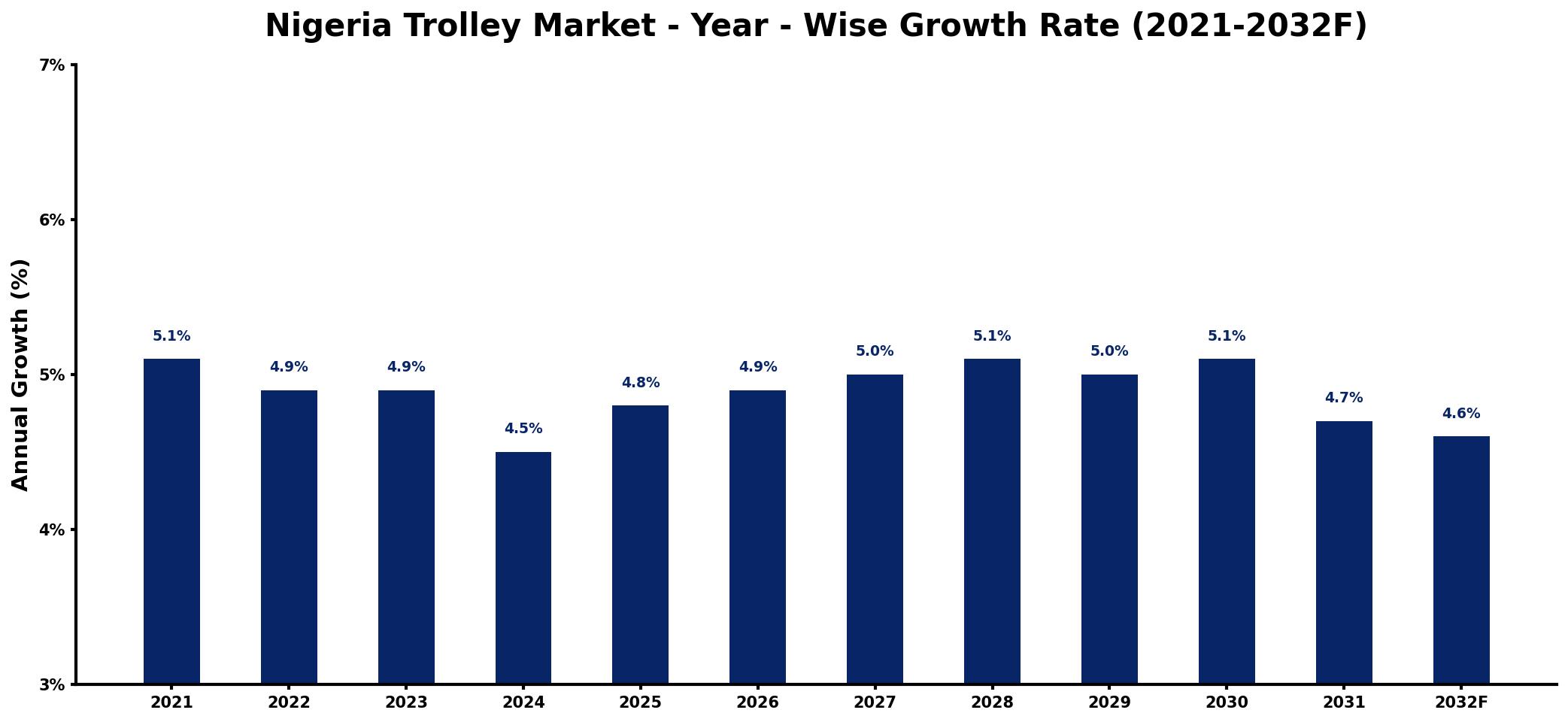
The table below presents the year‑wise growth rates along with the key drivers influencing the market
| Year | Growth Rate | Major Drivers |
| 2021 | 5.1% | Rising consumer demand for convenience |
| 2022 | 4.9% | Increased urbanization and infrastructure development |
| 2023 | 4.9% | Growth in e-commerce and logistics |
| 2024 | 4.5% | Expansion of retail sector operations |
| 2025 | 4.8% | Surge in online grocery shopping |
| 2026 | 4.9% | Higher investments in supply chains |
| 2027 | 5.0% | improved raw material availability |
| 2028 | 5.1% | Growing focus on sustainable solutions |
| 2029 | 5.0% | Enhanced distribution network efficiency |
| 2030 | 5.1% | Technological advancements in logistics |
| 2031 | 4.7% | Strengthening of local manufacturing capabilities |
| 2032 | 4.6% | Rising demand for organized retail |
Note: Market size estimations and growth projections presented in this report are based on 6Wresearch's proprietary forecasting methodology, utilizing the latest available industry data, government publications, and primary research inputs.
Nigeria Trolley Market Synopsis
In Nigeria, the demand for trolleys is particularly pronounced in urban retail spaces where ease of goods transportation is essential for customer satisfaction and operational efficiency. Furthermore, the increasing number of logistics companies is leading to higher adoption of advanced trolley designs, such as foldable and lightweight models that cater to diverse needs.
Trolleys are not merely tools but pivotal assets in improving labor productivity and enhancing workflow efficiency in warehouses and production environments. As industries in Nigeria continue to evolve, there is a clear shift toward adopting innovative solutions in material handling, making trolleys an integral part of operational strategies.
Nigeria Trolley Market Key Takeaways
- The market is expanding primarily due to the surge in retail and logistics sectors.
- Innovative designs are shaping consumer preferences and driving sales.
- Government policies favoring local manufacturing are enhancing domestic supply chains.
- Challenges such as infrastructural deficits impact market efficiency.
- The demand for trolleys in airports is on the rise due to increasing traveler numbers.
Evaluation of Restraints in Nigeria Trolley Market
Despite its growth potential, the Nigeria trolley market faces significant challenges that hinder its progress. Poor infrastructure remains a major barrier, complicating the distribution process and inflating costs for manufacturers and retailers alike. Additionally, the market grapples with competition from imported trolleys, which, while often cheaper, do not always meet the quality standards that local consumers expect. Furthermore, a lack of innovation in local manufacturing and fluctuating economic conditions contribute to market volatility, affecting overall demand and consumer confidence.
Nigeria Trolley Market Trends
The Nigeria trolley market is increasingly influenced by technological advancements, with a notable trend towards integrating smart features into trolley designs. Features such as weight sensors and mobile app connectivity are gaining traction, allowing for more efficient tracking and management of goods. Additionally, there is a growing preference for sustainable materials in trolley production, driven by heightened awareness of environmental impact among both consumers and businesses. This dual focus on technology and sustainability is poised to reshape the market landscape in the coming years.
Nigeria Trolley Market Opportunities
There are significant opportunities for growth in the Nigeria trolley market, particularly for local manufacturers who can innovate and cater to specific industry needs. The ongoing urban development projects present a chance to tap into new sectors such as construction and hospitality, where specialized trolleys are required. Moreover, as e-commerce continues to expand, there's an urgent need for customized solutions that enhance last-mile delivery logistics, presenting an opening for businesses to develop tailored trolley solutions.
Government Initiatives in the Nigeria Trolley Market
The Nigerian government has initiated several policies aimed at improving urban infrastructure and public transportation systems, indirectly boosting the trolley market. Investments in airport modernization and public transit upgrades have led to increased demand for trolleys for both passenger and freight handling. Additionally, there are incentives in place for local manufacturers, promoting the production of high-quality trolleys, which helps reduce reliance on imports and strengthens the domestic economy.
Future Insights of the Nigeria Trolley Market
Looking ahead, the Nigeria trolley market is positioned for robust growth between 2026 and 2032. Innovations in design and functionality will drive consumer interest, particularly as sectors like retail and logistics evolve. The emphasis on efficiency and automation will necessitate the continual adaptation of trolley designs to meet emerging demands. By capitalizing on government initiatives and embracing technological advancements, the local industry could significantly enhance its competitive edge in the market.
Nigeria Trolley Market Latest Developments (2025 - 2026)
In recent months, the Nigeria trolley market has seen a shift towards more ergonomic designs that prioritize user comfort and efficiency. Industry stakeholders are increasingly participating in workshops and expos focusing on material handling solutions, fostering collaboration and innovation. Additionally, ongoing discussions about strengthening local supply chains have gained momentum, aiming to mitigate the effects of import dependency and enhance product availability in the domestic market.
Nigeria Trolley Market - Key Attractiveness of the Report
- 10 Years of Market Numbers
- Historical Data Starting from 2022 to 2025
- Base Year: 2025
- Forecast Data until 2032
- Key Performance Indicators Impacting the Market
- Major Upcoming Developments and Projects
Key Highlights of the Report:
- Nigeria Trolley Market Outlook
- Market Size of Nigeria Trolley Market, 2025
- Forecast of Nigeria Trolley Market, 2032
- Historical Data and Forecast of Nigeria Trolley Revenues & Volume for the Period 2022-2032F
- Nigeria Trolley Market Trend Evolution
- Nigeria Trolley Market Drivers and Challenges
- Nigeria Trolley Price Trends
- Nigeria Trolley Porter's Five Forces
- Nigeria Trolley Industry Life Cycle
- Historical Data and Forecast of Nigeria Trolley Market Revenues & Volume By Product for the Period 2022-2032F
- Historical Data and Forecast of Nigeria Trolley Market Revenues & Volume By Manual for the Period 2022-2032F
- Historical Data and Forecast of Nigeria Trolley Market Revenues & Volume By Electric for the Period 2022-2032F
- Historical Data and Forecast of Nigeria Trolley Market Revenues & Volume By Application for the Period 2022-2032F
- Historical Data and Forecast of Nigeria Trolley Market Revenues & Volume By Commercial for the Period 2022-2032F
- Historical Data and Forecast of Nigeria Trolley Market Revenues & Volume By Non-commercial for the Period 2022-2032F
- Historical Data and Forecast of Nigeria Trolley Market Revenues & Volume By Distribution for the Period 2022-2032F
- Historical Data and Forecast of Nigeria Trolley Market Revenues & Volume By Offline for the Period 2022-2032F
- Historical Data and Forecast of Nigeria Trolley Market Revenues & Volume By Online for the Period 2022-2032F
- Nigeria Trolley Import Export Trade Statistics
- Market Opportunity Assessment By Product
- Market Opportunity Assessment By Application
- Market Opportunity Assessment By Distribution
- Nigeria Trolley Top Companies Market Share
- Nigeria Trolley Competitive Benchmarking By Technical and Operational Parameters
- Nigeria Trolley Company Profiles
- Nigeria Trolley Key Strategic Recommendations






































