Nigeria Warehousing and Storage Market Size, Share & Growth Rate
The Nigeria Warehousing and Storage Market was estimated at USD 84 Million in 2025 and is projected to reach USD 91 Million by 2032, growing at a CAGR of 1.2% from 2026 to 2032. This steady growth trajectory is primarily fueled by the burgeoning retail and manufacturing sectors, alongside the increasing complexity of logistics driven by e-commerce. As urbanization accelerates and the middle class expands, the demand for efficient warehousing solutions is expected to rise significantly.
Nigeria Warehousing and Storage Market Year-wise Growth Rate and Key Drivers
This graph highlights how the Nigeria Warehousing and Storage Market has steadily grown over the years, supported by major growth factors.
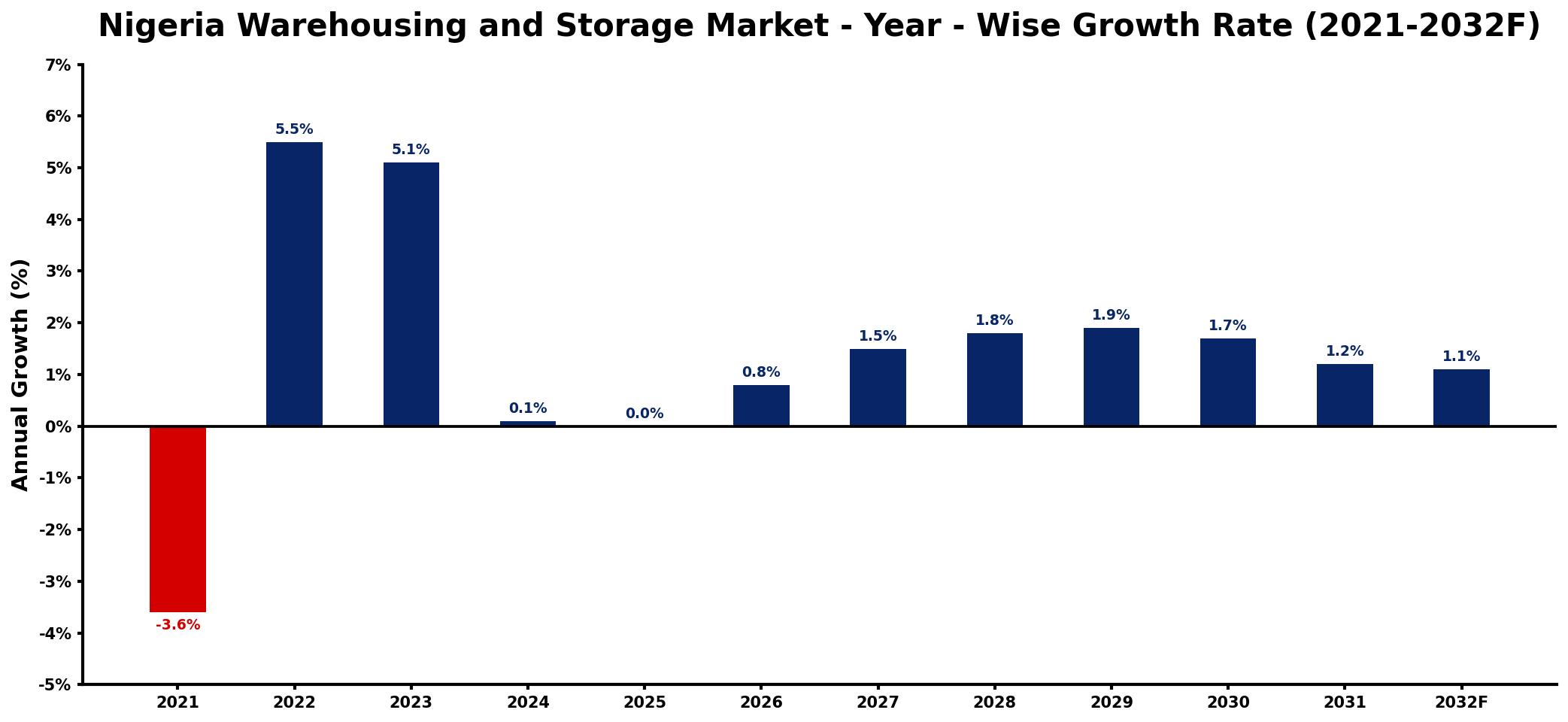
The table below presents the year‑wise growth rates along with the key drivers influencing the market
| Year | Growth Rate | Major Drivers |
| 2021 | -3.6% | decreased logistics infrastructure investment |
| 2022 | 5.5% | rising e-commerce market demand |
| 2023 | 5.1% | increased foreign direct investment |
| 2024 | 0.1% | growing retail sector expansion |
| 2025 | 0.0% | strengthened supply chain networks |
| 2026 | 0.8% | enhanced technological adoption rates |
| 2027 | 1.5% | expansion of manufacturing operations |
| 2028 | 1.8% | increased agricultural product distribution |
| 2029 | 1.9% | growing demand for cold chain |
| 2030 | 1.7% | rising urbanization trends accelerating |
| 2031 | 1.2% | increased focus on sustainability practices |
| 2032 | 1.1% | expanding regional trade agreements |
Note: Market size estimations and growth projections presented in this report are based on 6Wresearch's proprietary forecasting methodology, utilizing the latest available industry data, government publications, and primary research inputs.
Nigeria Warehousing and Storage Market Synopsis
Recent momentum in the Nigeria warehousing and storage market reflects a robust response to the nations expanding trade activities. As industries ramp up their operations, facilities are under pressure to modernize and adapt, moving from traditional practices to innovative solutions that enhance efficiency.
Looking ahead, the market is poised for evolution, driven by improvements in infrastructure and technology. The anticipated influx of investments into warehousing facilities is likely to bolster operational capacities and address ongoing challenges, such as those associated with cold storage and logistics.
Nigeria Warehousing and Storage Market Key Takeaways
- The market is projected to grow from USD 84 Million in 2025 to USD 91 Million by 2032.
- Urbanization and a growing middle class are increasing demand for logistics and warehousing solutions.
- Investments in infrastructure and modern warehousing practices are essential for enhancing efficiency.
- Challenges remain due to inadequate facilities and high operational costs affecting profitability.
- Government policies aimed at improving trade infrastructure are instrumental in market development.
Evaluation of Restraints in Nigeria Warehousing and Storage Market
The Nigeria warehousing and storage market faces several significant restraints that hinder its growth potential. Inadequate infrastructure remains a pressing issue, as many existing facilities lack the modern technologies essential for efficient operations. This limitation is further compounded by high operational costs, which deter potential investors from establishing new warehouses. Additionally, logistical inefficiencies in transportation and distribution networks create hurdles that can disrupt supply chain processes, ultimately impacting the effectiveness of warehousing solutions.
Nigeria Warehousing and Storage Market Trends
A number of trends are shaping the landscape of the Nigeria warehousing and storage market. Automation technologies, including robotics and advanced inventory management systems, are gaining traction among modern facilities. Furthermore, the rise of e-commerce has intensified the demand for flexible and scalable warehousing solutions that can swiftly respond to market fluctuations. Cold storage facilities are also on the rise, driven by the growing need for perishable goods handling, particularly in the food and pharmaceutical sectors.
Nigeria Warehousing and Storage Market Opportunities
Significant growth opportunities lie in expanding the countrys logistics infrastructure to accommodate the increasing volume of goods. Investments in cold storage solutions could also yield high returns as consumer preferences shift toward fresh and frozen products. The development of Special Economic Zones (SEZs) provides a strategic avenue for enhancing warehousing capabilities while attracting foreign direct investment. By capitalizing on these trends, investors can tap into a vibrant and evolving market.
Government Initiatives in the Nigeria Warehousing and Storage Market
The Nigerian government has instituted several initiatives aimed at bolstering the warehousing and storage market. Policies focused on infrastructure development, such as the Nigeria Industrial Revolution Plan (NIRP), are designed to enhance logistics capabilities. Additionally, the establishment of Special Economic Zones (SEZs) is a strategic move to promote economic activity through improved storage facilities and reduced logistical bottlenecks. Such government efforts are crucial in creating a more conducive environment for investment in the warehousing sector.
Future Insights of the Nigeria Warehousing and Storage Market
As we look towards the period from 2026 to 2032, the Nigeria warehousing and storage market is expected to undergo a transformative phase. With continuous advancements in technology and infrastructure, operational efficiencies will likely improve significantly. Enhanced government policies and increased investments will also support the market's growth trajectory, paving the way for a more sophisticated warehousing ecosystem that can meet the evolving demands of both local and international trade.
Nigeria Warehousing and Storage Market Latest Developments (2025 - 2026)
Recent developments within the Nigeria warehousing and storage market indicate a trend toward modernization and increased capacity. Many facilities are undertaking upgrades to implement state-of-the-art technologies that support automation and better inventory management. Additionally, several projects focusing on cold storage capabilities are emerging, reflecting a response to the growing need for perishable goods storage, especially amid the expanding e-commerce landscape.
Nigeria Warehousing and Storage Market - Key Attractiveness of the Report
- 10 Years of Market Numbers
- Historical Data Starting from 2022 to 2025
- Base Year: 2025
- Forecast Data until 2032
- Key Performance Indicators Impacting the Market
- Major Upcoming Developments and Projects
Key Highlights of the Report:
- Nigeria Warehousing and Storage Market Outlook
- Market Size of Nigeria Warehousing and Storage Market, 2025
- Forecast of Nigeria Warehousing and Storage Market, 2032
- Historical Data and Forecast of Nigeria Warehousing and Storage Revenues & Volume for the Period 2022-2032F
- Nigeria Warehousing and Storage Market Trend Evolution
- Nigeria Warehousing and Storage Market Drivers and Challenges
- Nigeria Warehousing and Storage Price Trends
- Nigeria Warehousing and Storage Porter's Five Forces
- Nigeria Warehousing and Storage Industry Life Cycle
- Historical Data and Forecast of Nigeria Warehousing and Storage Market Revenues & Volume By Type for the Period 2022-2032F
- Historical Data and Forecast of Nigeria Warehousing and Storage Market Revenues & Volume By General Warehousing and Storage for the Period 2022-2032F
- Historical Data and Forecast of Nigeria Warehousing and Storage Market Revenues & Volume By Refrigerated Warehousing and Storage for the Period 2022-2032F
- Historical Data and Forecast of Nigeria Warehousing and Storage Market Revenues & Volume By Farm Product Warehousing and Storage for the Period 2022-2032F
- Historical Data and Forecast of Nigeria Warehousing and Storage Market Revenues & Volume By Ownership for the Period 2022-2032F
- Historical Data and Forecast of Nigeria Warehousing and Storage Market Revenues & Volume By Private Warehouses for the Period 2022-2032F
- Historical Data and Forecast of Nigeria Warehousing and Storage Market Revenues & Volume By Public Warehouses for the Period 2022-2032F
- Historical Data and Forecast of Nigeria Warehousing and Storage Market Revenues & Volume By Bonded Warehouses for the Period 2022-2032F
- Historical Data and Forecast of Nigeria Warehousing and Storage Market Revenues & Volume By End-Use for the Period 2022-2032F
- Historical Data and Forecast of Nigeria Warehousing and Storage Market Revenues & Volume By Manufacturing for the Period 2022-2032F
- Historical Data and Forecast of Nigeria Warehousing and Storage Market Revenues & Volume By Consumer Goods for the Period 2022-2032F
- Historical Data and Forecast of Nigeria Warehousing and Storage Market Revenues & Volume By Retail for the Period 2022-2032F
- Historical Data and Forecast of Nigeria Warehousing and Storage Market Revenues & Volume By Food and Beverage for the Period 2022-2032F
- Historical Data and Forecast of Nigeria Warehousing and Storage Market Revenues & Volume By IT Hardware for the Period 2022-2032F
- Historical Data and Forecast of Nigeria Warehousing and Storage Market Revenues & Volume By Healthcare for the Period 2022-2032F
- Historical Data and Forecast of Nigeria Warehousing and Storage Market Revenues & Volume By Chemicals for the Period 2022-2032F
- Historical Data and Forecast of Nigeria Warehousing and Storage Market Revenues & Volume By Others for the Period 2022-2032F
- Nigeria Warehousing and Storage Import Export Trade Statistics
- Market Opportunity Assessment By Type
- Market Opportunity Assessment By Ownership
- Market Opportunity Assessment By End-Use
- Nigeria Warehousing and Storage Top Companies Market Share
- Nigeria Warehousing and Storage Competitive Benchmarking By Technical and Operational Parameters
- Nigeria Warehousing and Storage Company Profiles
- Nigeria Warehousing and Storage Key Strategic Recommendations






































