Nigeria Wheel Loader Market Size, Share & Growth Rate
The Nigeria Wheel Loader Market was estimated at USD 302 Million in 2025 and is projected to reach USD 425 Million by 2032, growing at a CAGR of 5.0% from 2026 to 2032. This promising growth trajectory is primarily fueled by substantial government investment in infrastructure, especially in road construction and housing projects, which demand advanced machinery for efficient execution. Moreover, the rapid urbanization and expansion of the construction sector are driving the need for reliable material handling solutions, making wheel loaders indispensable for various industrial applications.
Nigeria Wheel Loader Market Year-wise Growth Rate and Key Drivers
This graph highlights how the Nigeria Wheel Loader Market has steadily grown over the years, supported by major growth factors.
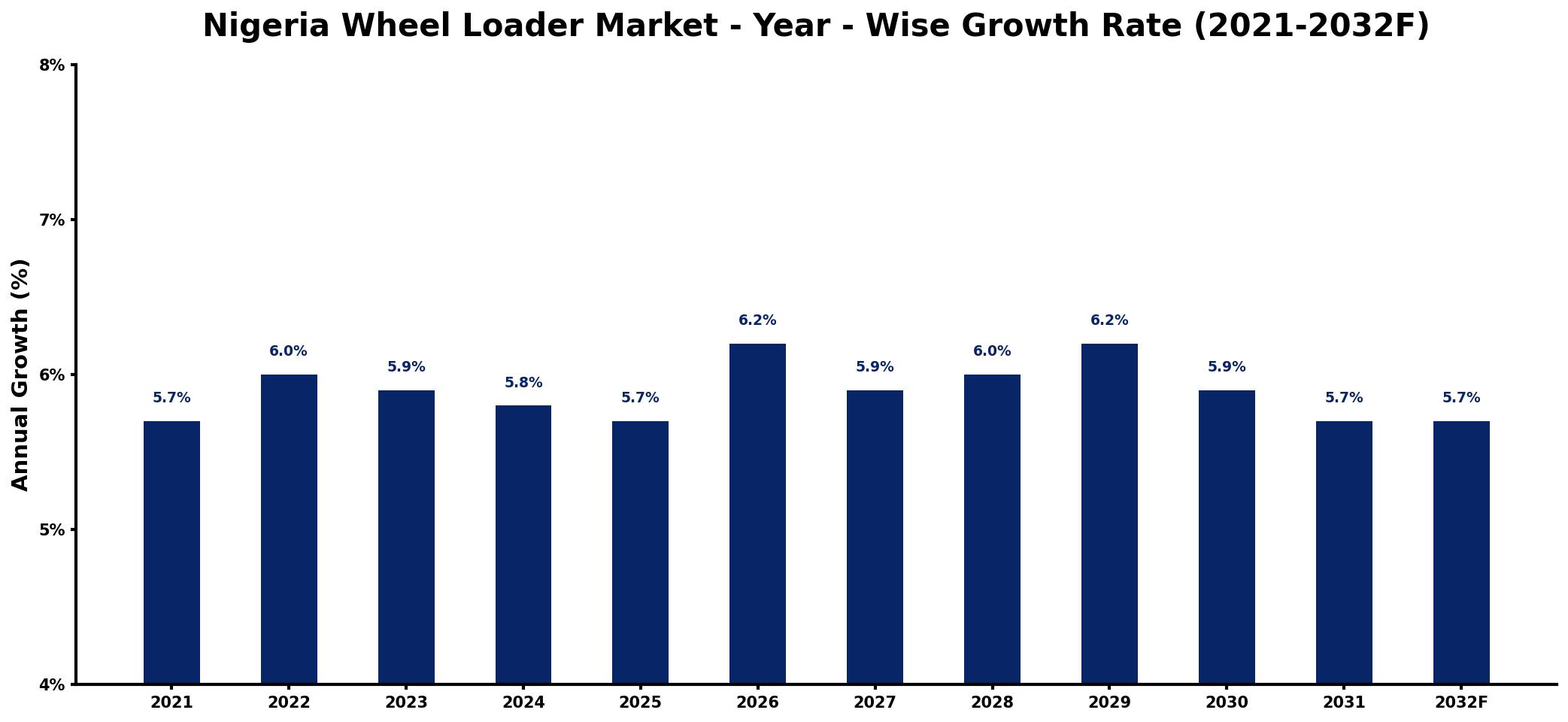
The table below presents the year‑wise growth rates along with the key drivers influencing the market
| Year | Growth Rate | Major Drivers |
| 2021 | 5.7% | Rising construction sector investments |
| 2022 | 6.0% | Infrastructure development initiatives increase |
| 2023 | 5.9% | Mining sector expansion initiatives |
| 2024 | 5.8% | Agricultural mechanization trends grow |
| 2025 | 5.7% | Urbanization driving equipment demand |
| 2026 | 6.2% | Government projects boost procurement |
| 2027 | 5.9% | Increased demand in logistics sector |
| 2028 | 6.0% | Real estate projects gain momentum |
| 2029 | 6.2% | Technological advancements attract investments |
| 2030 | 5.9% | Renewable energy projects on rise |
| 2031 | 5.7% | Public-private partnerships enhance projects |
| 2032 | 5.7% | Export opportunities for machinery increase |
Note: Market size estimations and growth projections presented in this report are based on 6Wresearch's proprietary forecasting methodology, utilizing the latest available industry data, government publications, and primary research inputs.
Nigeria Wheel Loader Market Synopsis
In Nigeria, the demand for wheel loaders is significantly influenced by the flourishing construction and mining sectors. As urban areas expand and infrastructure projects multiply, the need for efficient earthmoving and material handling equipment is escalating. Wheel loaders are integral to these operations, providing speed and versatility across various applications.
Despite the robust demand, the market faces hurdles such as limited access to financing for purchasing heavy machinery. Coupled with high import duties, these financial constraints pose significant challenges for companies looking to invest in wheel loaders. Nevertheless, the potential for growth remains strong, driven by continued infrastructure development and a shift towards technologically advanced machinery.
Nigeria Wheel Loader Market Key Takeaways
- The market is driven by rapid urbanization and significant investments in infrastructure development.
- Technological advancements in wheel loaders are enhancing productivity and reducing operational costs.
- Government policies are focusing on promoting local manufacturing of construction equipment.
- Electric and hybrid wheel loaders are gaining traction amid a growing emphasis on sustainability.
- Investment in distribution and service networks is crucial for success in this evolving market.
Evaluation of Restraints in Nigeria Wheel Loader Market
The Nigeria Wheel Loader Market is hampered by several significant restraints. Chief among these is the infrastructural inadequacies that impact the operational efficiency of construction projects. Poor roads and unreliable power supplies complicate the logistics of transporting and utilizing heavy machinery. Additionally, high tariffs and import restrictions on equipment inflate the costs, deterring potential buyers. The prevalence of counterfeit products undermines confidence in the market, as does a general lack of awareness among potential users about the benefits of investing in quality equipment. Fluctuating exchange rates and economic uncertainties further complicate financial planning, creating a less favorable environment for investment.
Nigeria Wheel Loader Market Trends
Current trends in the Nigeria Wheel Loader Market indicate a shift towards the adoption of advanced technologies. Customers are increasingly seeking wheel loaders equipped with telematics and GPS tracking to improve operational efficiency and minimize costs. Moreover, the focus on sustainability is pushing manufacturers to innovate electric and hybrid models that cater to environmentally conscious buyers. This growing demand for versatile, reliable, and comfortable machinery is shaping product offerings and driving manufacturers to enhance performance and safety features.
Nigeria Wheel Loader Market Opportunities
The Nigeria Wheel Loader Market is ripe with investment opportunities, particularly in manufacturing and rental services. As the construction and mining sectors continue to expand, the necessity for reliable wheel loaders will increase, providing avenues for businesses to enter the market. Innovative technologies, such as telematics and improved fuel efficiency, present additional growth prospects, appealing to a customer base eager for efficiency and cost-effectiveness. Collaborating with local dealers and enhancing service networks can also bolster market presence and customer trust, further amplifying growth opportunities in this dynamic landscape.
Government Initiatives in the Nigeria Wheel Loader Market
The Nigerian government has enacted several initiatives that positively influence the wheel loader market. A strong emphasis is placed on local manufacturing, with policies aimed at reducing reliance on imported machinery. Public spending on infrastructure development is also substantial, driving demand for construction equipment like wheel loaders. However, inconsistencies in policy implementation and bureaucratic challenges remain, posing obstacles to seamless market growth. The government's approach underscores the potential for significant advancements in the local manufacturing sector.
Future Insights of the Nigeria Wheel Loader Market
Looking ahead to 2026-2032, the Nigeria Wheel Loader Market is set to expand due to ongoing governmental infrastructure initiatives and a burgeoning economy. Increased investments in urban infrastructure, housing, and industrial projects will continue to drive demand for efficient machinery. Technological advancements aimed at improving fuel efficiency and operator comfort are expected to further fuel market growth. The combination of economic development and the rising necessity for modernized construction equipment signals a positive outlook for the market in the coming years.
Nigeria Wheel Loader Market Latest Developments (2025 - 2026)
Recent developments in the Nigeria Wheel Loader Market indicate a growing inclination toward hybrid and electric wheel loader models, in response to environmental concerns. Companies are increasingly investing in research and development to enhance the technological features of their products. Initiatives aimed at strengthening local dealer networks and improving customer service are gaining traction. These efforts are complemented by rising awareness among construction firms about the operational advantages of utilizing advanced machinery in their projects.
Nigeria Wheel Loader Market - Key Attractiveness of the Report
- 10 Years of Market Numbers
- Historical Data Starting from 2022 to 2025
- Base Year: 2025
- Forecast Data until 2032
- Key Performance Indicators Impacting the Market
- Major Upcoming Developments and Projects
Key Highlights of the Report:
- Nigeria Wheel Loader Market Outlook
- Market Size of Nigeria Wheel Loader Market, 2025
- Forecast of Nigeria Wheel Loader Market, 2032
- Historical Data and Forecast of Nigeria Wheel Loader Revenues & Volume for the Period 2022-2032F
- Nigeria Wheel Loader Market Trend Evolution
- Nigeria Wheel Loader Market Drivers and Challenges
- Nigeria Wheel Loader Price Trends
- Nigeria Wheel Loader Porter's Five Forces
- Nigeria Wheel Loader Industry Life Cycle
- Historical Data and Forecast of Nigeria Wheel Loader Market Revenues & Volume By Types for the Period 2022-2032F
- Historical Data and Forecast of Nigeria Wheel Loader Market Revenues & Volume By Armored Wheel Loaders for the Period 2022-2032F
- Historical Data and Forecast of Nigeria Wheel Loader Market Revenues & Volume By Tractor Front Loaders for the Period 2022-2032F
- Historical Data and Forecast of Nigeria Wheel Loader Market Revenues & Volume By Compact Front End Loaders for the Period 2022-2032F
- Historical Data and Forecast of Nigeria Wheel Loader Market Revenues & Volume By Skid Loaders & Track Loaders for the Period 2022-2032F
- Historical Data and Forecast of Nigeria Wheel Loader Market Revenues & Volume By Operating Power for the Period 2022-2032F
- Historical Data and Forecast of Nigeria Wheel Loader Market Revenues & Volume By 20 ?? 40 Hp for the Period 2022-2032F
- Historical Data and Forecast of Nigeria Wheel Loader Market Revenues & Volume By 40 ?? 80 Hp for the Period 2022-2032F
- Historical Data and Forecast of Nigeria Wheel Loader Market Revenues & Volume By 80 ?? 120 Hp for the Period 2022-2032F
- Historical Data and Forecast of Nigeria Wheel Loader Market Revenues & Volume By 120 ?? 160 Hp for the Period 2022-2032F
- Historical Data and Forecast of Nigeria Wheel Loader Market Revenues & Volume By 160 Hp for the Period 2022-2032F
- Historical Data and Forecast of Nigeria Wheel Loader Market Revenues & Volume By Above for the Period 2022-2032F
- Historical Data and Forecast of Nigeria Wheel Loader Market Revenues & Volume By Types Of Bucket for the Period 2022-2032F
- Historical Data and Forecast of Nigeria Wheel Loader Market Revenues & Volume By Bottom Bucket for the Period 2022-2032F
- Historical Data and Forecast of Nigeria Wheel Loader Market Revenues & Volume By Flat Bottom Bucket for the Period 2022-2032F
- Historical Data and Forecast of Nigeria Wheel Loader Market Revenues & Volume By Backhoe Bucket for the Period 2022-2032F
- Historical Data and Forecast of Nigeria Wheel Loader Market Revenues & Volume By Demolition Bucket for the Period 2022-2032F
- Historical Data and Forecast of Nigeria Wheel Loader Market Revenues & Volume By Excavating Buckets for the Period 2022-2032F
- Historical Data and Forecast of Nigeria Wheel Loader Market Revenues & Volume By Others for the Period 2022-2032F
- Historical Data and Forecast of Nigeria Wheel Loader Market Revenues & Volume By End-use Application for the Period 2022-2032F
- Historical Data and Forecast of Nigeria Wheel Loader Market Revenues & Volume By Stone Quarries for the Period 2022-2032F
- Historical Data and Forecast of Nigeria Wheel Loader Market Revenues & Volume By Mining Zones for the Period 2022-2032F
- Historical Data and Forecast of Nigeria Wheel Loader Market Revenues & Volume By Construction Sites for the Period 2022-2032F
- Historical Data and Forecast of Nigeria Wheel Loader Market Revenues & Volume By Military & Defense for the Period 2022-2032F
- Historical Data and Forecast of Nigeria Wheel Loader Market Revenues & Volume By Public Sectors for the Period 2022-2032F
- Nigeria Wheel Loader Import Export Trade Statistics
- Market Opportunity Assessment By Types
- Market Opportunity Assessment By Operating Power
- Market Opportunity Assessment By Types Of Bucket
- Market Opportunity Assessment By End-use Application
- Nigeria Wheel Loader Top Companies Market Share
- Nigeria Wheel Loader Competitive Benchmarking By Technical and Operational Parameters
- Nigeria Wheel Loader Company Profiles
- Nigeria Wheel Loader Key Strategic Recommendations






































