Nigeria Work Order Management Systems Market Size & Growth Rate (2026-2032)
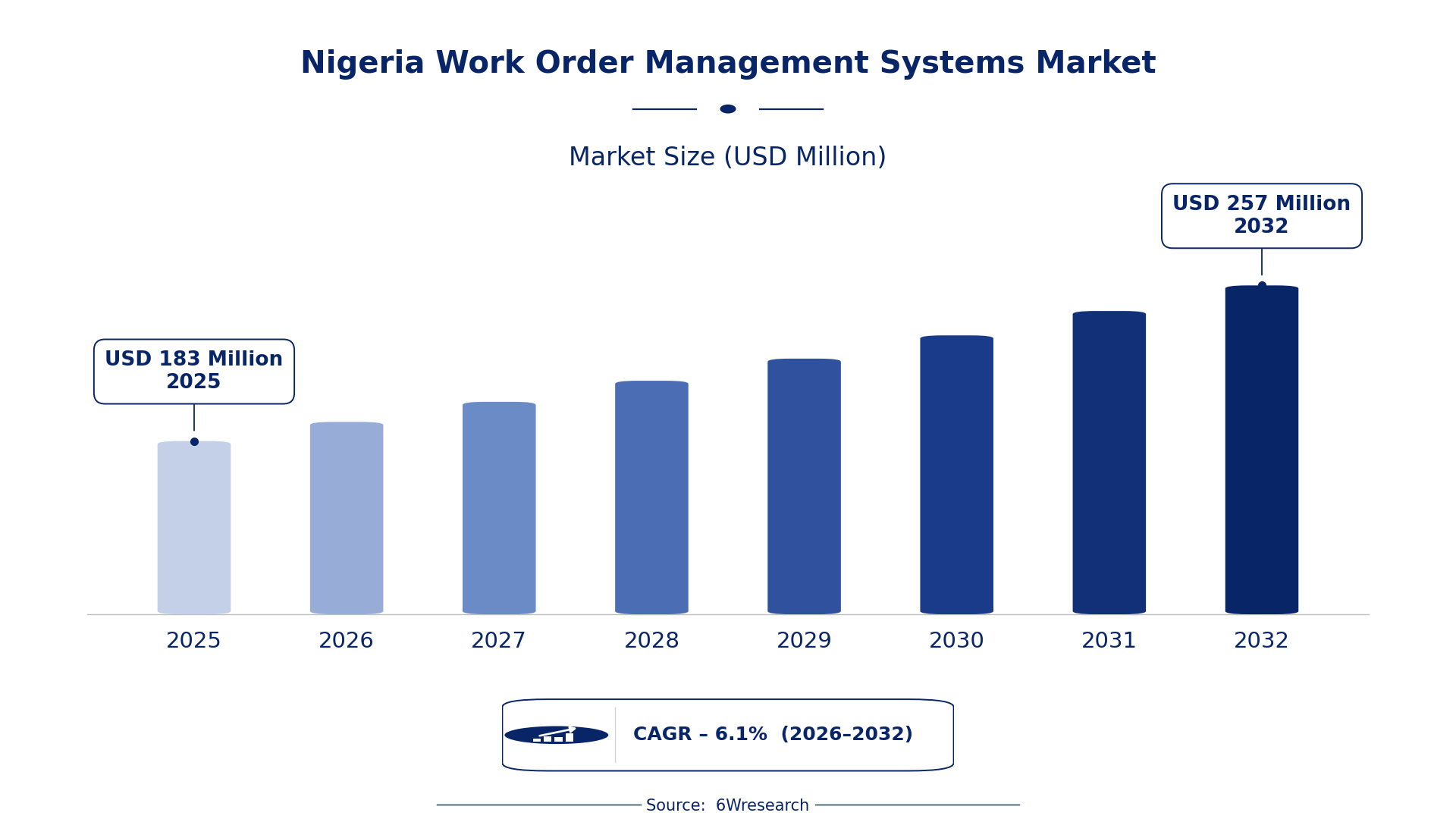
The Nigeria Work Order Management Systems Market was estimated at USD 183 Million in 2025 and is projected to reach USD 257 Million by 2032, growing at a CAGR of 6.1% from 2026 to 2032.
Nigeria Work Order Management Systems Market Synopsis
In recent years, the Nigeria Work Order Management Systems market has gained momentum as organizations recognize the need for improved efficiency in task management. With industries such as construction and logistics emphasizing operational excellence, the demand for these systems is expected to continue its upward trajectory.
Looking forward, the market is set to evolve further, driven by technological advancements and an increasing focus on customer satisfaction. As businesses strive to optimize resources and streamline workflows, the investment in work order management systems will likely intensify across various sectors.
Nigeria Work Order Management Systems Market Year-wise Growth Rate and Key Drivers
This graph illustrates the annual growth rates of the Nigeria Work Order Management Systems Market from 2021 to 2032, highlighting a steady upward trajectory and projected expansion over the forecast period.
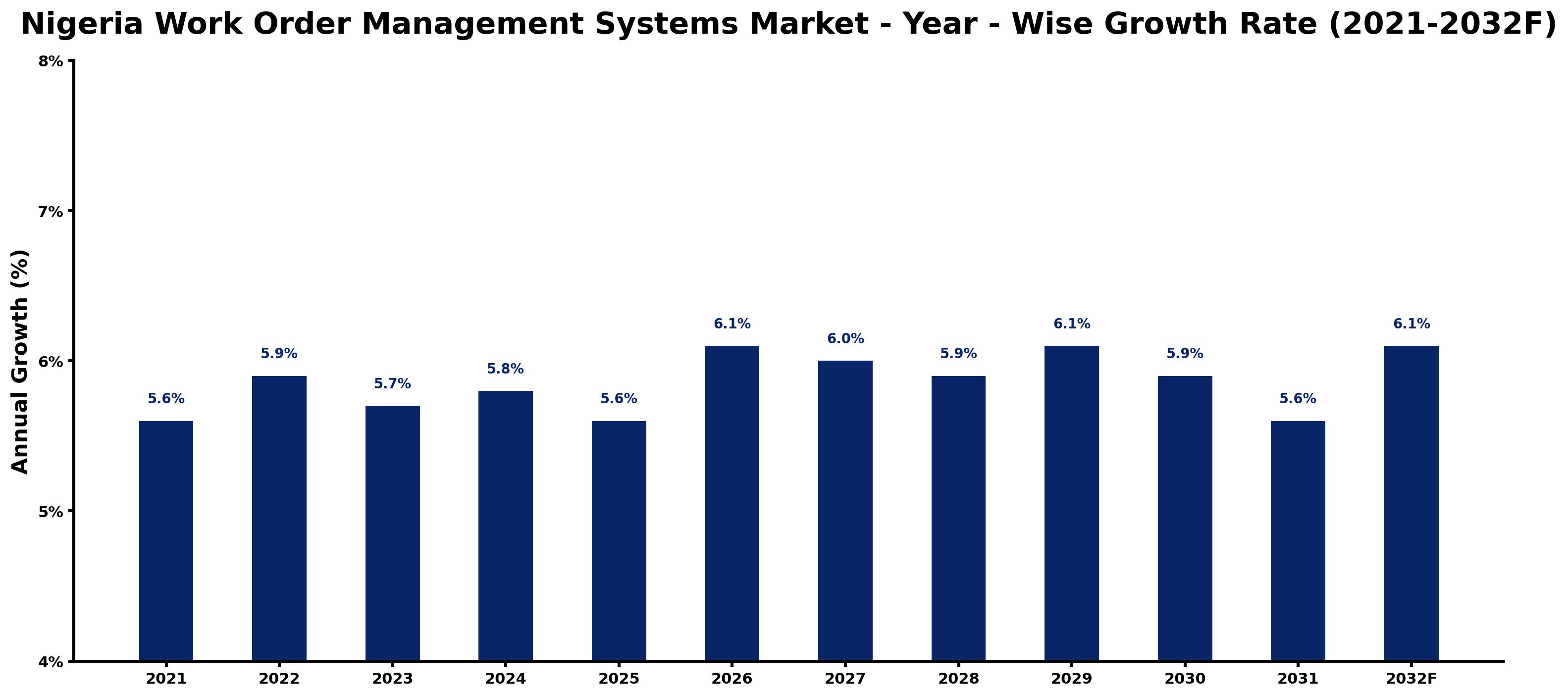
The table below presents the year‑wise growth rates along with the key drivers influencing the market
| Year | Growth Rate | Major Drivers |
| 2021 | 5.6% | Increased investments in local manufacturing efficiency initiatives. |
| 2022 | 5.9% | Government subsidies promoting digital transformation in enterprises. |
| 2023 | 5.7% | Growing adoption of mobile technology for operational management. |
| 2024 | 5.8% | Strengthened local supply chains leading to improved resource allocation. |
| 2025 | 5.6% | Emergence of tech hubs enhancing innovation in work processes. |
| 2026 | 6.1% | Private sector partnerships accelerating deployment of management solutions. |
| 2027 | 6.0% | Rising youth workforce driving demand for management efficiency. |
| 2028 | 5.9% | Enhanced training programs boosting skilled labor in industries. |
| 2029 | 6.1% | Increased focus on sustainable practices within operational workflows. |
| 2030 | 5.9% | National policy promoting digitization in small business operations. |
| 2031 | 5.6% | Improved internet accessibility enhancing system adoption rates. |
| 2032 | 6.1% | Local startups advocating for integrated work order solutions. |
Note: Market size estimations and growth projections presented in this report are based on 6Wresearch's proprietary forecasting methodology, utilizing the latest available industry data, government publications, and primary research inputs.
Nigeria Work Order Management Systems Market Key Takeaways
Below are some of the specific key takeaways from the market, including:
- The demand for work order management systems is rising sharply in sectors like construction, utilities, and maintenance.
- Companies are increasingly prioritizing digitization to enhance task tracking and resource allocation.
- Customization of solutions is essential to cater to the diverse needs of different industries.
- Government initiatives are creating a favorable environment for the adoption of digital systems.
- Concerns about data security and integration challenges remain critical for many organizations.
Evaluation of Restraints in Nigeria Work Order Management Systems Market
Resistance to adopting new technologies is a notable obstacle for the Nigeria Work Order Management Systems market. Smaller enterprises often hesitate to invest in systems that may require extensive training and adaptation. Additionally, the need for tailored solutions to meet industry-specific requirements complicates the decision-making process. Concerns around data security and the integration of new systems with legacy software further contribute to hesitance in market adoption.
Nigeria Work Order Management Systems Market Trends
A shift towards mobile and cloud-based solutions is reshaping the demand for work order management systems in Nigeria. Companies are increasingly looking for platforms that allow real-time updates and access from various devices. This trend is complemented by the rising importance of data analytics to optimize service delivery and improve decision-making. As organizations seek competitive advantages, the integration of AI and machine learning into work order systems is becoming more prevalent.
Nigeria Work Order Management Systems Market Opportunities
There are substantial growth opportunities for work order management systems in Nigeria, particularly in sectors like utilities and logistics. As businesses aim to improve operational efficiency, investments in customized solutions that address specific industry challenges can yield significant returns. on top of that, the ongoing digital transformation across the public sector presents avenues for private-sector partnerships, fostering innovation and enhancing service delivery.
Government Initiatives in the Nigeria Work Order Management Systems Market
Government policies are playing an integral role in shaping the Nigeria Work Order Management Systems market. By investing in digital infrastructure and e-government platforms, the government aims to improve efficiency and transparency in public service delivery. These initiatives focus on enhancing user experience, promoting data security, and ensuring interoperability among systems, which is vital for the effective functioning of work order management solutions.
- A national digital infrastructure upgrade programme launched in 2023 aims to enhance connectivity for service providers.
- Ongoing initiatives include the development of e-government platforms designed to streamline work order processes across public services.
- Recent policies emphasize data security measures to protect sensitive information within work order management systems.
- A planned public-private initiative expected to begin by 2026 aims to enhance the availability of digital solutions for small and medium enterprises.
- The government is implementing a framework to promote interoperability between different work order management systems across sectors.
Future Insights of the Nigeria Work Order Management Systems Market
From 2026 to 2032, the Nigeria Work Order Management Systems market is expected to see significant advancements driven by technological integration and increased demand for efficiency. As organizations prioritize customer satisfaction, the focus on real-time data access and analytics will grow stronger. Investments in innovative solutions tailored to specific industry needs will be crucial for companies looking to stay competitive. The market is likely to mature, with increased collaboration between public and private sectors fostering a conducive environment for growth.
Nigeria Work Order Management Systems Market Latest Developments
Recent months have seen a flurry of activity in the Nigeria Work Order Management Systems market, reflecting a growing commitment to technology and efficiency. Organizations are increasingly adopting new platforms that offer advanced features to enhance service delivery and task management. The trend towards digital solutions is evident as companies seek to stay ahead in a competitive environment.
- A major technology vendor completed the rollout of a cloud-based work order management system in early 2025, aiming to improve service efficiency for utilities.
- In mid-2025, a leading regional operator announced a partnership to integrate AI capabilities into existing work order management solutions.
- An initiative aimed at training employees in using new digital tools began in late 2025 and remains underway across several sectors.
- Upcoming plans for 2026 include the launch of a new platform that focuses on mobile access for field workers, expected to enhance task allocation.
- A service upgrade for existing systems is planned for Q3 2026, incorporating user feedback to improve functionality and user experience.
Nigeria Work Order Management Systems Market - Key Attractiveness of the Report
- 10 Years of Market Numbers
- Historical Data Starting from 2022 to 2025
- Base Year: 2025
- Forecast Data until 2032
- Key Performance Indicators Impacting the Market
- Major Upcoming Developments and Projects
Key Highlights of the Report:
- Nigeria Work Order Management Systems Market Outlook
- Market Size of Nigeria Work Order Management Systems Market, 2025
- Forecast of Nigeria Work Order Management Systems Market, 2032
- Historical Data and Forecast of Nigeria Work Order Management Systems Revenues & Volume for the Period 2022-2032F
- Nigeria Work Order Management Systems Market Trend Evolution
- Nigeria Work Order Management Systems Market Drivers and Challenges
- Nigeria Work Order Management Systems Price Trends
- Nigeria Work Order Management Systems Porter's Five Forces
- Nigeria Work Order Management Systems Industry Life Cycle
- Historical Data and Forecast of Nigeria Work Order Management Systems Market Revenues & Volume By Component for the Period 2022-2032F
- Historical Data and Forecast of Nigeria Work Order Management Systems Market Revenues & Volume By Solution for the Period 2022-2032F
- Historical Data and Forecast of Nigeria Work Order Management Systems Market Revenues & Volume By Services for the Period 2022-2032F
- Historical Data and Forecast of Nigeria Work Order Management Systems Market Revenues & Volume By Deployment Type for the Period 2022-2032F
- Historical Data and Forecast of Nigeria Work Order Management Systems Market Revenues & Volume By Cloud for the Period 2022-2032F
- Historical Data and Forecast of Nigeria Work Order Management Systems Market Revenues & Volume By On-premises for the Period 2022-2032F
- Historical Data and Forecast of Nigeria Work Order Management Systems Market Revenues & Volume By Industry Vertical for the Period 2022-2032F
- Historical Data and Forecast of Nigeria Work Order Management Systems Market Revenues & Volume By Manufacturing for the Period 2022-2032F
- Historical Data and Forecast of Nigeria Work Order Management Systems Market Revenues & Volume By Energy and Utilities for the Period 2022-2032F
- Historical Data and Forecast of Nigeria Work Order Management Systems Market Revenues & Volume By Transportation and Logistics for the Period 2022-2032F
- Historical Data and Forecast of Nigeria Work Order Management Systems Market Revenues & Volume By Construction and Real Estate for the Period 2022-2032F
- Historical Data and Forecast of Nigeria Work Order Management Systems Market Revenues & Volume By Consumer Goods and Retail for the Period 2022-2032F
- Historical Data and Forecast of Nigeria Work Order Management Systems Market Revenues & Volume By Healthcare and Life Sciences for the Period 2022-2032F
- Historical Data and Forecast of Nigeria Work Order Management Systems Market Revenues & Volume By Banking, Financial Services, and Insurance (BFSI) for the Period 2022-2032F
- Historical Data and Forecast of Nigeria Work Order Management Systems Market Revenues & Volume By Telecom and IT for the Period 2022-2032F
- Historical Data and Forecast of Nigeria Work Order Management Systems Market Revenues & Volume By Organization Size for the Period 2022-2032F
- Historical Data and Forecast of Nigeria Work Order Management Systems Market Revenues & Volume By Small and Medium-sized Enterprises for the Period 2022-2032F
- Historical Data and Forecast of Nigeria Work Order Management Systems Market Revenues & Volume By Large Enterprises for the Period 2022-2032F
- Nigeria Work Order Management Systems Import Export Trade Statistics
- Market Opportunity Assessment By Component
- Market Opportunity Assessment By Deployment Type
- Market Opportunity Assessment By Industry Vertical
- Market Opportunity Assessment By Organization Size
- Nigeria Work Order Management Systems Top Companies Market Share
- Nigeria Work Order Management Systems Competitive Benchmarking By Technical and Operational Parameters
- Nigeria Work Order Management Systems Company Profiles
- Nigeria Work Order Management Systems Key Strategic Recommendations































