Norway Asbestos Market Growth Rate Analysis (2025 - 2031)
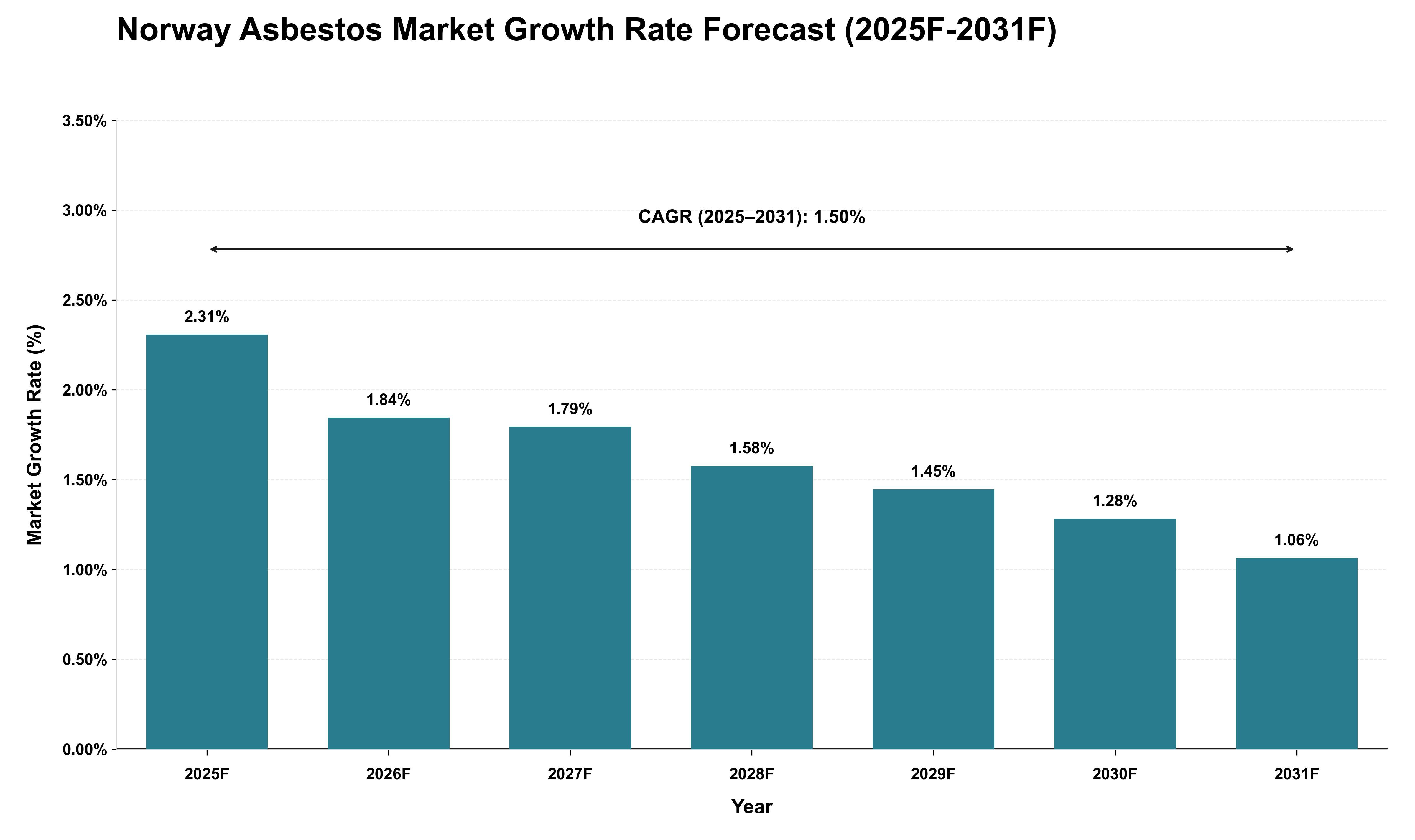
The Norway asbestos market will experience a gradual growth trajectory from 2025 to 2031, driven by evolving regulatory frameworks and trade policy dynamics. As the country continues to navigate stringent environmental regulations, the demand for asbestos-related products will be influenced by compliance costs and potential import tariffs on alternative materials. The projected CAGR of 1.50% reflects a deceleration in annual growth rates, with initial years showing stronger performance (2.31% in 2025) before tapering off to 1.06% by 2031. This trend suggests that while there may be short-term spikes in demand due to construction and renovation activities, long-term reliance on asbestos will face challenges from increasing public health awareness and international trade agreements favoring safer alternatives. Consequently, import dependencies will likely shift as Norway seeks to balance domestic production with sustainable sourcing practices, impacting overall market dynamics throughout the forecast period.
Key Highlights of the Report:
- Norway Asbestos Market Outlook
- Market Size of Norway Asbestos Market, 2024
- Forecast of Norway Asbestos Market, 2031
- Historical Data and Forecast of Norway Asbestos Revenues & Volume for the Period 2021- 2031
- Norway Asbestos Market Trend Evolution
- Norway Asbestos Market Drivers and Challenges
- Norway Asbestos Price Trends
- Norway Asbestos Porter's Five Forces
- Norway Asbestos Industry Life Cycle
- Historical Data and Forecast of Norway Asbestos Market Revenues & Volume By Type for the Period 2021- 2031
- Historical Data and Forecast of Norway Asbestos Market Revenues & Volume By Chrysotile for the Period 2021- 2031
- Historical Data and Forecast of Norway Asbestos Market Revenues & Volume By Amosite for the Period 2021- 2031
- Historical Data and Forecast of Norway Asbestos Market Revenues & Volume By Crocidolite for the Period 2021- 2031
- Historical Data and Forecast of Norway Asbestos Market Revenues & Volume By Anthophyllite for the Period 2021- 2031
- Historical Data and Forecast of Norway Asbestos Market Revenues & Volume By Tremolite for the Period 2021- 2031
- Historical Data and Forecast of Norway Asbestos Market Revenues & Volume By Actinolite for the Period 2021- 2031
- Historical Data and Forecast of Norway Asbestos Market Revenues & Volume By Application for the Period 2021- 2031
- Historical Data and Forecast of Norway Asbestos Market Revenues & Volume By Building materials for the Period 2021- 2031
- Historical Data and Forecast of Norway Asbestos Market Revenues & Volume By Electrical insulation for the Period 2021- 2031
- Historical Data and Forecast of Norway Asbestos Market Revenues & Volume By Friction products for the Period 2021- 2031
- Historical Data and Forecast of Norway Asbestos Market Revenues & Volume By Packaging for the Period 2021- 2031
- Historical Data and Forecast of Norway Asbestos Market Revenues & Volume By Gaskets for the Period 2021- 2031
- Historical Data and Forecast of Norway Asbestos Market Revenues & Volume By Other applications for the Period 2021- 2031
- Norway Asbestos Import Export Trade Statistics
- Market Opportunity Assessment By Type
- Market Opportunity Assessment By Application
- Norway Asbestos Top Companies Market Share
- Norway Asbestos Competitive Benchmarking By Technical and Operational Parameters
- Norway Asbestos Company Profiles
- Norway Asbestos Key Strategic Recommendations






































