Norway Calcined Petroleum Coke Market Top 5 Importing Countries and Market Competition (HHI) Analysis
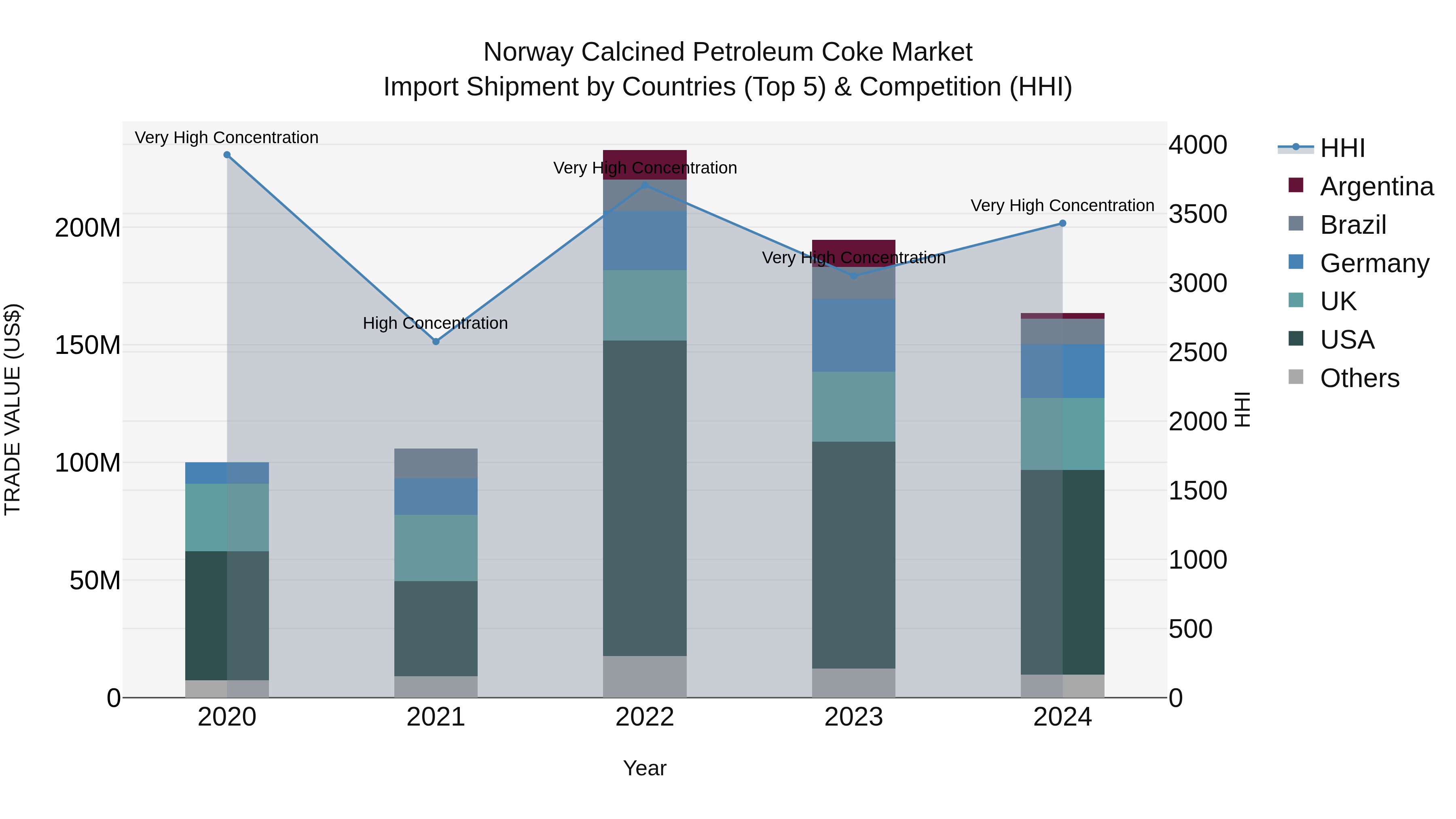
Norway`s calcined petroleum coke import market saw significant growth with a CAGR of 13.05% from 2020 to 2024, despite a slight decline in growth rate from 2023 to 2024 at -15.98%. The top exporting countries to Norway in 2024 were the USA, UK, Germany, Brazil, and Poland, indicating a diverse import source base. However, the market remained highly concentrated with a high Herfindahl-Hirschman Index (HHI) in 2024, suggesting potential market dominance by key players.
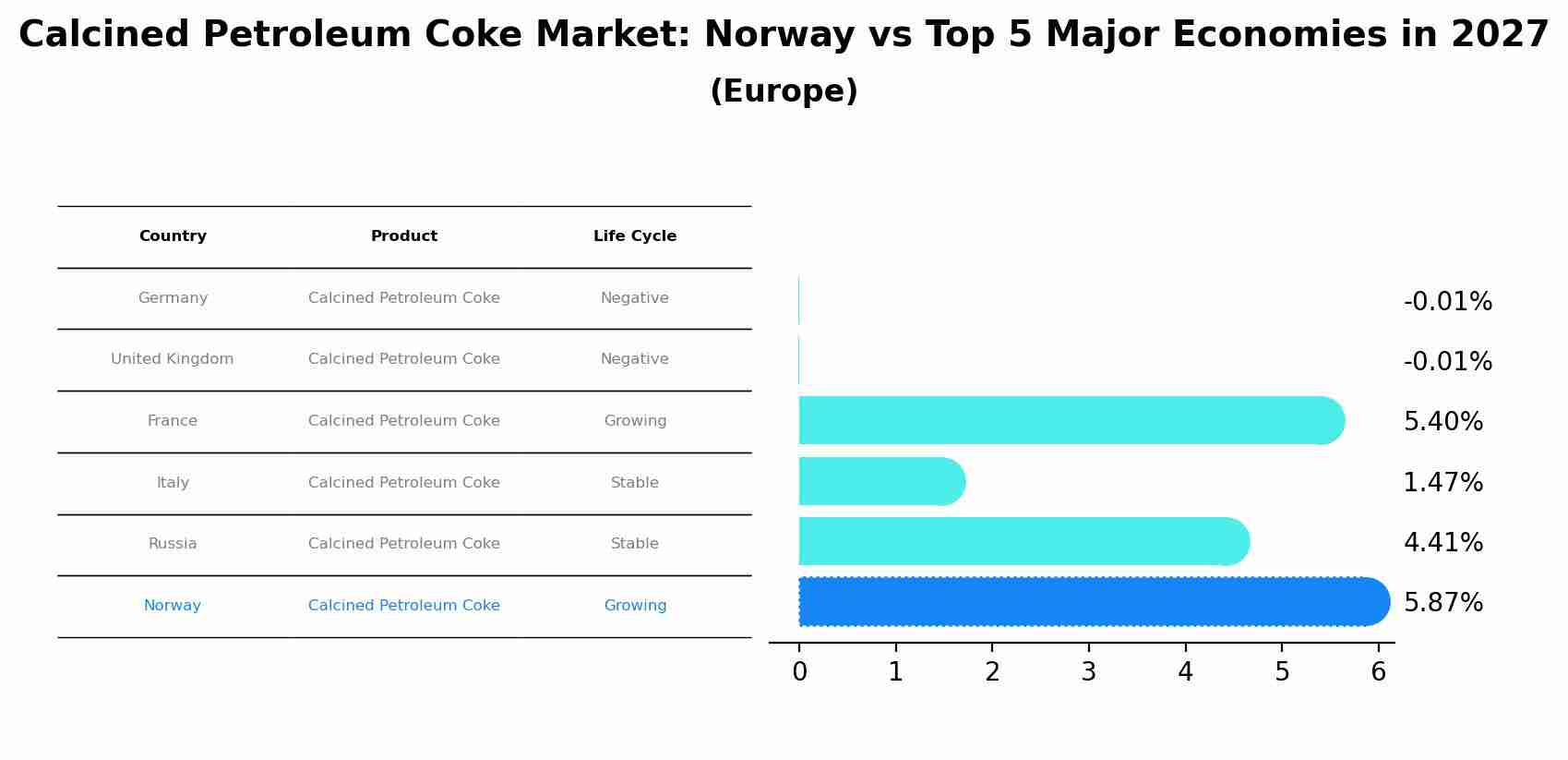
Calcined Petroleum Coke Market: Norway vs Top 5 Major Economies in 2027 (Europe)
Norway's Calcined Petroleum Coke market is anticipated to experience a growing growth rate of 5.87% by 2027, reflecting trends observed in the largest economy Germany, followed by United Kingdom, France, Italy and Russia.
Norway Calcined Petroleum Coke Market Overview
The calcined petroleum coke market in Norway is growing due to its use as a key raw material in the production of aluminum, steel, and other industrial products. Calcined petroleum coke is produced by heating petroleum coke to high temperatures, enhancing its properties for use in industrial processes. The market is influenced by demand from the aluminum and steel industries, fluctuations in petroleum coke prices, and advancements in production technology.
Drivers of the market
The Calcined Petroleum Coke Market in Norway is driven by its use in aluminum smelting and steel manufacturing. The growing demand for calcined coke as a key component in industrial processes, particularly in the metallurgical industry, supports market expansion.
Challenges of the market
Challenges in the Norway Calcined Petroleum Coke Market include the high cost of production and fluctuations in global oil prices. The market is influenced by demand from the aluminum and steel industries, but competition from alternative materials and the need for compliance with environmental regulations add to market complexity.
Government Policy of the market
Norwegian environmental policies related to carbon emissions and industrial waste management influence the calcined petroleum coke market. The government promotes sustainable practices in the refining and use of petroleum products, which impacts demand and regulatory compliance in this sector.
Key Highlights of the Report:
- Norway Calcined Petroleum Coke Market Outlook
- Market Size of Norway Calcined Petroleum Coke Market, 2024
- Forecast of Norway Calcined Petroleum Coke Market, 2031
- Historical Data and Forecast of Norway Calcined Petroleum Coke Revenues & Volume for the Period 2021-2031
- Norway Calcined Petroleum Coke Market Trend Evolution
- Norway Calcined Petroleum Coke Market Drivers and Challenges
- Norway Calcined Petroleum Coke Price Trends
- Norway Calcined Petroleum Coke Porter`s Five Forces
- Norway Calcined Petroleum Coke Industry Life Cycle
- Historical Data and Forecast of Norway Calcined Petroleum Coke Market Revenues & Volume By Type for the Period 2021-2031
- Historical Data and Forecast of Norway Calcined Petroleum Coke Market Revenues & Volume By Anode Grade for the Period 2021-2031
- Historical Data and Forecast of Norway Calcined Petroleum Coke Market Revenues & Volume By Needle Grade for the Period 2021-2031
- Historical Data and Forecast of Norway Calcined Petroleum Coke Market Revenues & Volume By for the Period 2021-2031
- Historical Data and Forecast of Norway Calcined Petroleum Coke Market Revenues & Volume By End-user for the Period 2021-2031
- Historical Data and Forecast of Norway Calcined Petroleum Coke Market Revenues & Volume By Carburizing & Recarburizing for the Period 2021-2031
- Historical Data and Forecast of Norway Calcined Petroleum Coke Market Revenues & Volume By Electric Arc & Induction Furnaces for the Period 2021-2031
- Historical Data and Forecast of Norway Calcined Petroleum Coke Market Revenues & Volume By Others for the Period 2021-2031
- Norway Calcined Petroleum Coke Import Export Trade Statistics
- Market Opportunity Assessment By Type
- Market Opportunity Assessment By End-user
- Norway Calcined Petroleum Coke Top Companies Market Share
- Norway Calcined Petroleum Coke Competitive Benchmarking By Technical and Operational Parameters
- Norway Calcined Petroleum Coke Company Profiles
- Norway Calcined Petroleum Coke Key Strategic Recommendations






































