Norway Ceiling Tiles Market Top 5 Importing Countries and Market Competition (HHI) Analysis
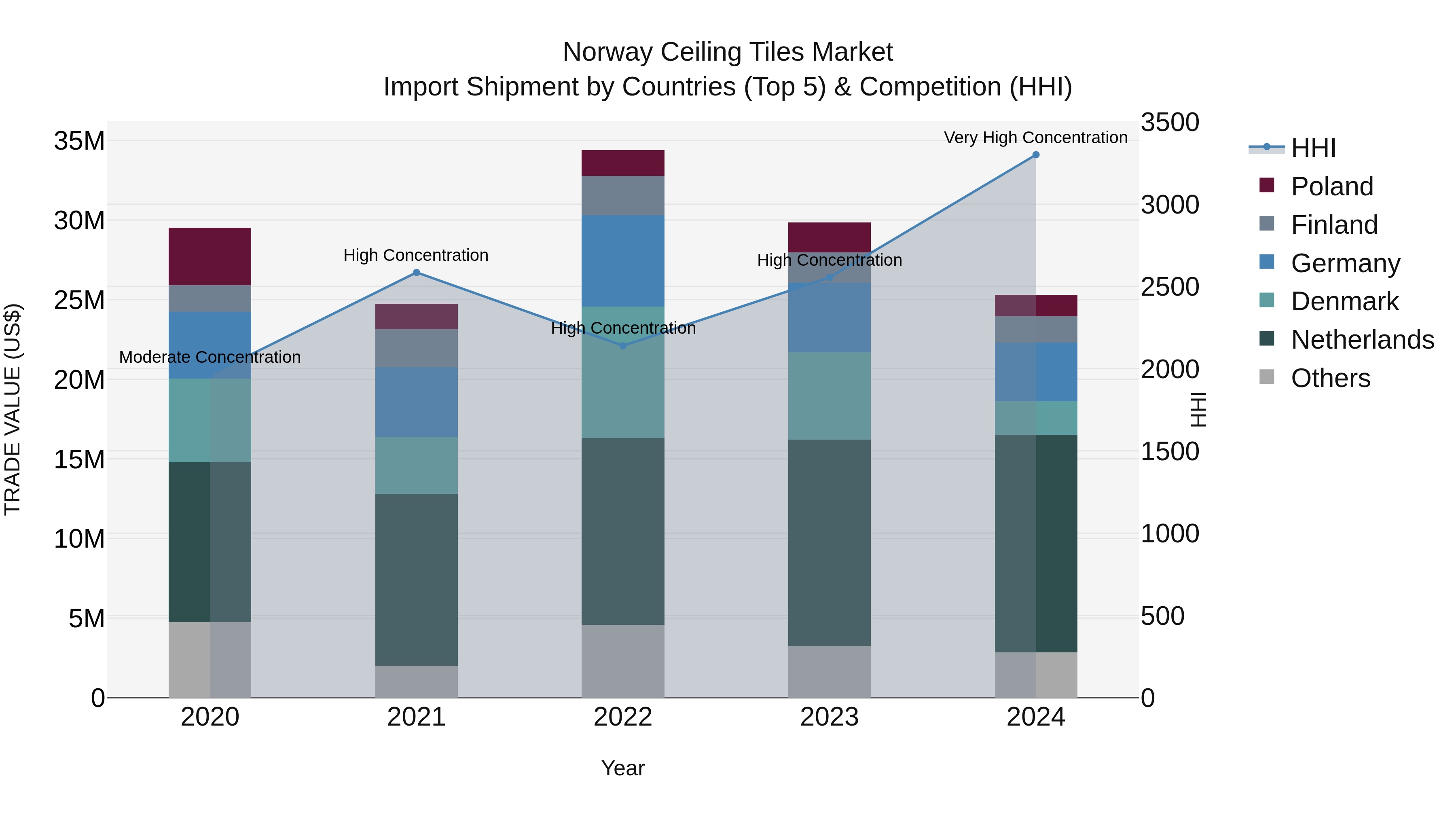
Norway`s ceiling tiles import market saw a significant increase in concentration in 2024, with top exporting countries being Netherlands, Germany, Denmark, Finland, and Poland. The high Herfindahl-Hirschman Index (HHI) indicates a very high level of market concentration. Despite a negative Compound Annual Growth Rate (CAGR) of -3.8% from 2020 to 2024, the market experienced a sharp decline in growth rate of -15.3% from 2023 to 2024. This suggests a challenging environment for ceiling tiles importers in Norway, possibly impacted by various economic factors and competitive dynamics within the market.
Norway Ceiling Tiles Market Overview
The Ceiling Tiles market in Norway is growing due to the use of ceiling tiles in improving acoustics, aesthetics, and energy efficiency in buildings. Ceiling tiles are used in various applications, including offices, commercial spaces, and residential properties. Market growth is driven by advancements in tile materials and designs, increasing demand for noise control solutions, and the expansion of the construction and renovation industries.
Drivers of the market
The Norway Ceiling Tiles Market is experiencing growth due to the demand for aesthetically pleasing and acoustically efficient ceiling solutions in commercial and residential buildings. The rise in construction activities supports market expansion.
Challenges of the market
In the Norway ceiling tiles market, environmental sustainability and compliance with stringent building regulations present challenges. The high cost of raw materials for eco-friendly tiles and fluctuations in construction activity also impact demand.
Government Policy of the market
In the building materials sector, the Norwegian government enforces strict standards on materials like ceiling tiles for fire safety, sustainability, and energy efficiency. The regulations ensure that ceiling tiles meet stringent environmental and safety standards, especially in commercial and public buildings. Norway also encourages the use of recycled materials in construction products, aligning with the country`s sustainability goals.
Key Highlights of the Report:
- Norway Ceiling Tiles Market Outlook
- Market Size of Norway Ceiling Tiles Market, 2024
- Forecast of Norway Ceiling Tiles Market, 2031
- Historical Data and Forecast of Norway Ceiling Tiles Revenues & Volume for the Period 2021-2031
- Norway Ceiling Tiles Market Trend Evolution
- Norway Ceiling Tiles Market Drivers and Challenges
- Norway Ceiling Tiles Price Trends
- Norway Ceiling Tiles Porter`s Five Forces
- Norway Ceiling Tiles Industry Life Cycle
- Historical Data and Forecast of Norway Ceiling Tiles Market Revenues & Volume By Material Type for the Period 2021-2031
- Historical Data and Forecast of Norway Ceiling Tiles Market Revenues & Volume By Mineral Wool for the Period 2021-2031
- Historical Data and Forecast of Norway Ceiling Tiles Market Revenues & Volume By Metal for the Period 2021-2031
- Historical Data and Forecast of Norway Ceiling Tiles Market Revenues & Volume By Gypsum for the Period 2021-2031
- Historical Data and Forecast of Norway Ceiling Tiles Market Revenues & Volume By Others for the Period 2021-2031
- Historical Data and Forecast of Norway Ceiling Tiles Market Revenues & Volume By Application for the Period 2021-2031
- Historical Data and Forecast of Norway Ceiling Tiles Market Revenues & Volume By Residential for the Period 2021-2031
- Historical Data and Forecast of Norway Ceiling Tiles Market Revenues & Volume By Non-residential for the Period 2021-2031
- Norway Ceiling Tiles Import Export Trade Statistics
- Market Opportunity Assessment By Material Type
- Market Opportunity Assessment By Application
- Norway Ceiling Tiles Top Companies Market Share
- Norway Ceiling Tiles Competitive Benchmarking By Technical and Operational Parameters
- Norway Ceiling Tiles Company Profiles
- Norway Ceiling Tiles Key Strategic Recommendations






































