Norway Chlorine Market Top 5 Importing Countries and Market Competition (HHI) Analysis
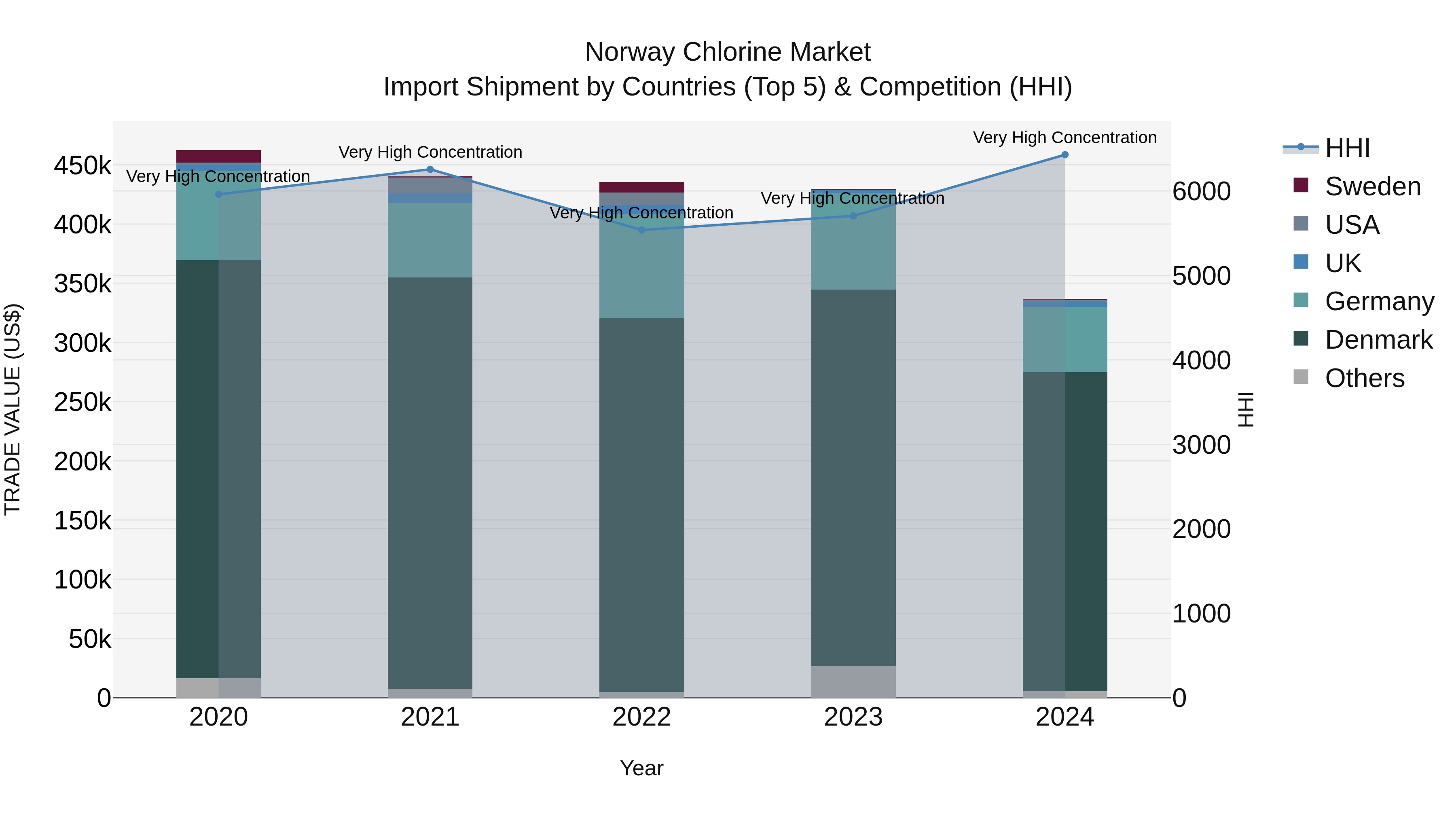
Norway`s chlorine import market in 2024 continued to be dominated by key suppliers including Denmark, Germany, UK, Belgium, and Poland. Despite a high concentration with a high Herfindahl-Hirschman Index (HHI), the market experienced a negative compound annual growth rate (CAGR) of -7.62% from 2020 to 2024. The growth rate in 2024 declined even further by -21.66% compared to the previous year, indicating a challenging environment for chlorine imports in Norway.
Norway Chlorine Market Overview
The chlorine market in Norway is characterized by its widespread use in water treatment, paper production, and the manufacture of various chemicals. The demand for chlorine is propelled by Norways commitment to maintaining clean water standards and its robust chemical production industry. Regulatory frameworks on environmental impact also play a significant role in shaping the market dynamics.
Drivers of the market
The Norway Chlorine Market is driven by its widespread application in industries such as water treatment, chemicals, and pharmaceuticals. The increasing demand for chlorine in sanitation and disinfectant production supports the market`s expansion.
Challenges of the market
Norways chlorine market encounters multiple challenges, including environmental regulations that restrict the use of chlorine in water treatment and other industries due to concerns over its potential harmful effects. Furthermore, the rising cost of energy required for chlorine production adds pressure to manufacturers, impacting profit margins.
Government Policy of the market
The chlorine market in Norway is subject to government policies that prioritize environmental protection and chemical safety. As chlorine is a key industrial chemical used in water treatment, sanitation, and various manufacturing processes, the Norwegian government enforces strict controls on chlorine production and use to mitigate environmental impacts, such as the release of harmful gases and chemicals. Additionally, regulations are in place to ensure safe handling and distribution, with an emphasis on minimizing risks to workers and the public.
Key Highlights of the Report:
- Norway Chlorine Market Outlook
- Market Size of Norway Chlorine Market, 2024
- Forecast of Norway Chlorine Market, 2031
- Historical Data and Forecast of Norway Chlorine Revenues & Volume for the Period 2021-2031
- Norway Chlorine Market Trend Evolution
- Norway Chlorine Market Drivers and Challenges
- Norway Chlorine Price Trends
- Norway Chlorine Porter`s Five Forces
- Norway Chlorine Industry Life Cycle
- Historical Data and Forecast of Norway Chlorine Market Revenues & Volume By Application for the Period 2021-2031
- Historical Data and Forecast of Norway Chlorine Market Revenues & Volume By EDC/PVC for the Period 2021-2031
- Historical Data and Forecast of Norway Chlorine Market Revenues & Volume By Isocyanates and Oxygenates for the Period 2021-2031
- Historical Data and Forecast of Norway Chlorine Market Revenues & Volume By Chloromethanes for the Period 2021-2031
- Historical Data and Forecast of Norway Chlorine Market Revenues & Volume By Solvents and Epichlorohydrin for the Period 2021-2031
- Historical Data and Forecast of Norway Chlorine Market Revenues & Volume By Inorganic Chemicals for the Period 2021-2031
- Historical Data and Forecast of Norway Chlorine Market Revenues & Volume By Other Applications for the Period 2021-2031
- Historical Data and Forecast of Norway Chlorine Market Revenues & Volume By End-user for the Period 2021-2031
- Historical Data and Forecast of Norway Chlorine Market Revenues & Volume By Water Treatment for the Period 2021-2031
- Historical Data and Forecast of Norway Chlorine Market Revenues & Volume By Pharmaceutical for the Period 2021-2031
- Historical Data and Forecast of Norway Chlorine Market Revenues & Volume By Chemicals for the Period 2021-2031
- Historical Data and Forecast of Norway Chlorine Market Revenues & Volume By Paper and Pulp for the Period 2021-2031
- Historical Data and Forecast of Norway Chlorine Market Revenues & Volume By Plastic for the Period 2021-2031
- Historical Data and Forecast of Norway Chlorine Market Revenues & Volume By Pesticides for the Period 2021-2031
- Historical Data and Forecast of Norway Chlorine Market Revenues & Volume By Other for the Period 2021-2031
- Norway Chlorine Import Export Trade Statistics
- Market Opportunity Assessment By Application
- Market Opportunity Assessment By End-user
- Norway Chlorine Top Companies Market Share
- Norway Chlorine Competitive Benchmarking By Technical and Operational Parameters
- Norway Chlorine Company Profiles
- Norway Chlorine Key Strategic Recommendations






































