United States (US) Chlorine Market Top 5 Importing Countries and Market Competition (HHI) Analysis
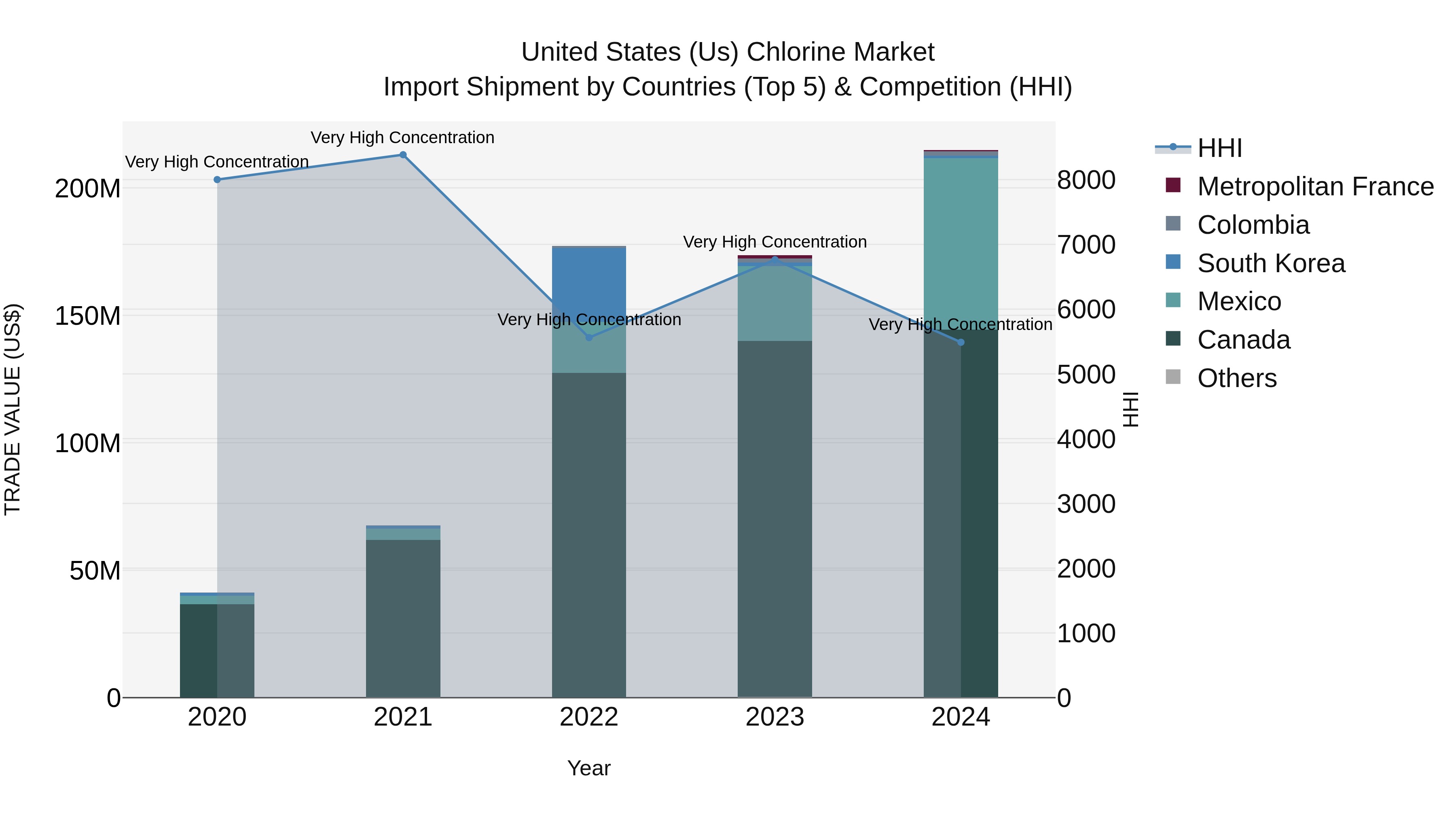
The United States continued to be a significant importer of chlorine in 2024, with top exporting countries including Canada, Mexico, Colombia, South Korea, and Metropolitan France. The market concentration, measured by the Herfindahl-Hirschman Index (HHI), remained very high, indicating dominance by a few key suppliers. The compound annual growth rate (CAGR) from 2020 to 2024 was an impressive 51.11%, with a notable growth rate of 23.79% from 2023 to 2024. This data suggests a strong demand for chlorine in the U.S., driven by various industries and applications.
USA Export Potential Assessment For Chlorine Market (Values in USD Thousand)
United States (US) Chlorine Market Overview
The United States Chlorine Market is a prominent sector within the chemical industry, driven by its wide range of applications across various sectors such as water treatment, pharmaceuticals, agriculture, and manufacturing. The market is primarily dominated by key players like Occidental Petroleum Corporation, Olin Corporation, and Westlake Chemical Corporation. The demand for chlorine is projected to witness steady growth due to its critical role in disinfection, sanitation, and the production of various chemicals. However, environmental concerns regarding the use of chlorine and stringent regulations regarding its disposal and handling pose challenges to market growth. Technological advancements in chlorine production and increasing investments in sustainable practices are expected to shape the future of the US Chlorine Market.
United States (US) Chlorine Market Trends
The US Chlorine Market is currently experiencing a trend towards sustainable and eco-friendly chlorine production methods. With increasing awareness of environmental concerns, companies are focusing on adopting cleaner production processes such as membrane cell technology and electrolysis, which reduce the carbon footprint of chlorine production. Additionally, there is a growing demand for chlorine-based products in various industries including water treatment, pharmaceuticals, and agriculture. As the economy continues to recover post-pandemic, the construction sector is also driving demand for chlorine as a key component in PVC production. Overall, the US Chlorine Market is witnessing a shift towards sustainability and innovation in production methods to meet the increasing demand while minimizing environmental impact.
United States (US) Chlorine Market Challenges
In the United States Chlorine Market, there are several challenges that industry players face. One significant challenge is the increasing regulations and scrutiny regarding the environmental impact of chlorine production and its byproducts. This includes stricter emissions standards and waste disposal regulations, which can require costly upgrades to facilities to comply. Another challenge is the volatility of raw material prices, as chlorine production relies heavily on feedstocks such as salt and electricity. Fluctuations in these input costs can impact profit margins and overall competitiveness in the market. Additionally, competition from alternative water treatment methods and disinfectants poses a threat to the demand for chlorine products. Adapting to these challenges through innovation, sustainable practices, and strategic market positioning is crucial for companies operating in the US Chlorine Market.
United States (US) Chlorine Market Investment Opportunities
The United States Chlorine Market offers lucrative investment opportunities in the production and distribution of chlorine-based products such as PVC, water treatment chemicals, and bleach. With the increasing demand for clean water supply, the water treatment segment is poised for significant growth, creating opportunities for companies involved in chlorine production. Additionally, the construction industry`s reliance on PVC for various applications like piping and construction materials further drives the demand for chlorine. Investing in innovative technologies for chlorine production, sustainable manufacturing practices, and expanding product portfolios to cater to diverse industries can be strategic moves in capitalizing on the growth potential of the US Chlorine Market. However, investors should closely monitor regulatory developments, environmental concerns, and fluctuations in raw material prices to make informed investment decisions in this sector.
United States (US) Chlorine Market Government Policy
In the United States, the chlorine market is regulated by several government policies aimed at ensuring public health and environmental protection. The Environmental Protection Agency (EPA) sets limits and guidelines for chlorine emissions and discharge into water bodies to prevent harmful effects on aquatic life and human health. Additionally, the Occupational Safety and Health Administration (OSHA) enforces regulations to protect workers handling chlorine in industrial settings. The Clean Water Act and Safe Drinking Water Act also play key roles in regulating chlorine use and disposal to safeguard water quality across the country. Overall, these government policies are crucial in maintaining safe and sustainable practices within the US chlorine market.
United States (US) Chlorine Market Future Outlook
The United States Chlorine Market is expected to witness steady growth in the coming years, driven by the increasing demand from various end-use industries such as water treatment, chemical manufacturing, and pharmaceuticals. The market is likely to benefit from the growth in infrastructure development and urbanization, leading to a rising need for clean water and sanitation systems. Additionally, the expanding industrial sector and a growing emphasis on maintaining hygiene standards are expected to further boost the demand for chlorine products. However, environmental regulations regarding the use and disposal of chlorine may pose challenges for market growth, driving the need for sustainable and eco-friendly alternatives. Overall, technological advancements and strategic collaborations within the industry are projected to drive innovation and support the continued growth of the US Chlorine Market.
Key Highlights of the Report:
- United States (US) Chlorine Market Outlook
- Market Size of United States (US) Chlorine Market, 2021
- Forecast of United States (US) Chlorine Market, 2031
- Historical Data and Forecast of United States (US) Chlorine Revenues & Volume for the Period 2018 - 2031
- United States (US) Chlorine Market Trend Evolution
- United States (US) Chlorine Market Drivers and Challenges
- United States (US) Chlorine Price Trends
- United States (US) Chlorine Porter's Five Forces
- United States (US) Chlorine Industry Life Cycle
- Historical Data and Forecast of United States (US) Chlorine Market Revenues & Volume By Application for the Period 2018 - 2031
- Historical Data and Forecast of United States (US) Chlorine Market Revenues & Volume By EDC/PVC for the Period 2018 - 2031
- Historical Data and Forecast of United States (US) Chlorine Market Revenues & Volume By Isocyanates and Oxygenates for the Period 2018 - 2031
- Historical Data and Forecast of United States (US) Chlorine Market Revenues & Volume By Chloromethanes for the Period 2018 - 2031
- Historical Data and Forecast of United States (US) Chlorine Market Revenues & Volume By Solvents and Epichlorohydrin for the Period 2018 - 2031
- Historical Data and Forecast of United States (US) Chlorine Market Revenues & Volume By Inorganic Chemicals for the Period 2018 - 2031
- Historical Data and Forecast of United States (US) Chlorine Market Revenues & Volume By Other Applications for the Period 2018 - 2031
- Historical Data and Forecast of United States (US) Chlorine Market Revenues & Volume By End-user Industry for the Period 2018 - 2031
- Historical Data and Forecast of United States (US) Chlorine Market Revenues & Volume By Water Treatment for the Period 2018 - 2031
- Historical Data and Forecast of United States (US) Chlorine Market Revenues & Volume By Pharmaceutical for the Period 2018 - 2031
- Historical Data and Forecast of United States (US) Chlorine Market Revenues & Volume By Chemicals for the Period 2018 - 2031
- Historical Data and Forecast of United States (US) Chlorine Market Revenues & Volume By Paper and Pulp for the Period 2018 - 2031
- Historical Data and Forecast of United States (US) Chlorine Market Revenues & Volume By Plastic for the Period 2018 - 2031
- Historical Data and Forecast of United States (US) Chlorine Market Revenues & Volume By Pesticides for the Period 2018 - 2031
- Historical Data and Forecast of United States (US) Chlorine Market Revenues & Volume By Other End-user Industries for the Period 2018 - 2031
- United States (US) Chlorine Import Export Trade Statistics
- Market Opportunity Assessment By Application
- Market Opportunity Assessment By End-user Industry
- United States (US) Chlorine Top Companies Market Share
- United States (US) Chlorine Competitive Benchmarking By Technical and Operational Parameters
- United States (US) Chlorine Company Profiles
- United States (US) Chlorine Key Strategic Recommendations






































