Philippines Chlorine Market Top 5 Importing Countries and Market Competition (HHI) Analysis
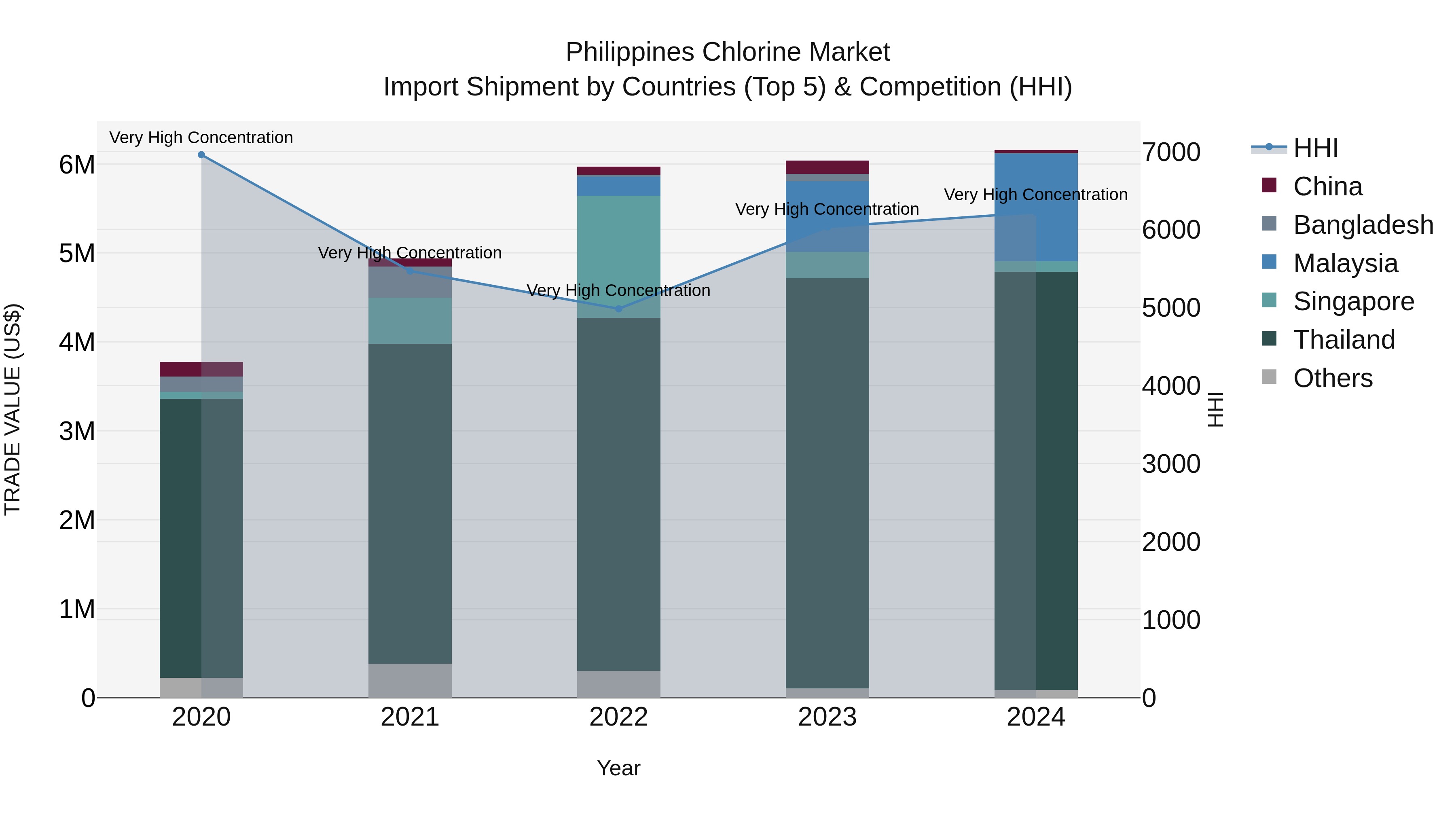
In 2024, Philippines continued to rely on chlorine imports, with key suppliers including Thailand, Malaysia, Singapore, India, and China. The high Herfindahl-Hirschman Index (HHI) indicates a concentrated market. The impressive compound annual growth rate (CAGR) of 13.01% from 2020-24 demonstrates sustained demand. Although the growth rate slightly slowed to 1.94% in 2024, the overall trend suggests a steady market for chlorine imports in the Philippines, with potential opportunities for suppliers to explore.
Chlorine Market: Philippines vs Top 5 Major Economies in 2027 (Asia)
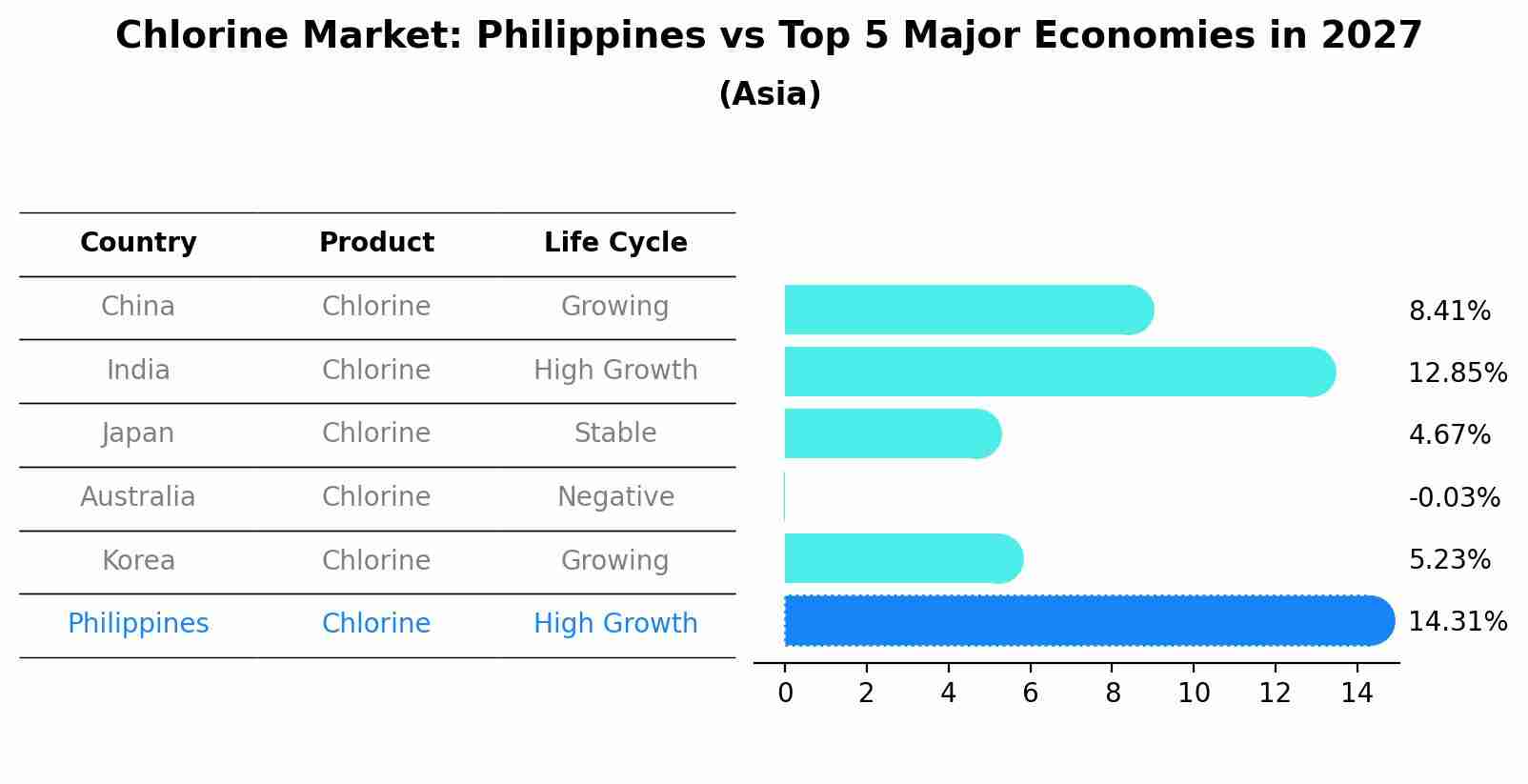
Philippines's Chlorine market is anticipated to experience a high growth rate of 14.31% by 2027, reflecting trends observed in the largest economy China, followed by India, Japan, Australia and South Korea.
Philippines Chlorine Market Synopsis
The market for chlorine in Philippines is estimated to be worth around US$66 million annually. Chlorine finds use primarily as a disinfectant or bleaching agent across numerous industry sectors including chemicals manufacturing, plastic products manufacturing, papermaking/printing etc. Major applications are wastewater treatment plants (WWTPs), oil refineries & petrochemical complexes etc.
Drivers of the market
The Philippines Chlorine market is witnessing growth due to various drivers. One of the key factors is the water treatment industry, where chlorine is extensively used for disinfection of drinking water and wastewater treatment. As the Philippines focuses on improving its water infrastructure, the demand for chlorine is expected to rise. The chemical industry also plays a role as chlorine is a crucial raw material for the production of various chemicals. Furthermore, the paper and pulp industry contributes to the market`s growth as chlorine is used in the bleaching process.
Challenges of the market
The chlorine market confronts issues related to safety and environmental impact. Chlorine handling requires stringent safety protocols, and the market must adapt to greener alternatives due to increasing concerns about its potential environmental harm.
Covid-19 Impact of the market
The Philippines Chlorine Market encountered significant disruptions due to the COVID-19 pandemic. With its essential role in water treatment and disinfection, the demand for chlorine remained consistent in sectors like utilities and healthcare. However, industries such as textiles, paper, and manufacturing, which also rely on chlorine, faced challenges due to reduced operations. The market`s resilience in fulfilling critical needs underscored its importance during the pandemic.
Key Players of the market
Chlorine and caustic soda are closely related markets, with both being essential for various industries including water treatment and chemicals manufacturing. Local companies like ChloroChem Philippines Inc. and Caustic Solutions Corp. are prominent players, alongside multinational corporations such as Dow Chemical Philippines.
Key Highlights of the Report:
- Philippines Chlorine Market Outlook
- Market Size of Philippines Chlorine Market, 2024
- Forecast of Philippines Chlorine Market, 2031
- Historical Data and Forecast of Philippines Chlorine Revenues & Volume for the Period 2021-2031
- Philippines Chlorine Market Trend Evolution
- Philippines Chlorine Market Drivers and Challenges
- Philippines Chlorine Price Trends
- Philippines Chlorine Porter's Five Forces
- Philippines Chlorine Industry Life Cycle
- Historical Data and Forecast of Philippines Chlorine Market Revenues & Volume By Application for the Period 2021-2031
- Historical Data and Forecast of Philippines Chlorine Market Revenues & Volume By EDC/PVC for the Period 2021-2031
- Historical Data and Forecast of Philippines Chlorine Market Revenues & Volume By Isocyanates and Oxygenates for the Period 2021-2031
- Historical Data and Forecast of Philippines Chlorine Market Revenues & Volume By Chloromethanes for the Period 2021-2031
- Historical Data and Forecast of Philippines Chlorine Market Revenues & Volume By Solvents and Epichlorohydrin for the Period 2021-2031
- Historical Data and Forecast of Philippines Chlorine Market Revenues & Volume By Inorganic Chemicals for the Period 2021-2031
- Historical Data and Forecast of Philippines Chlorine Market Revenues & Volume By Other Applications for the Period 2021-2031
- Historical Data and Forecast of Philippines Chlorine Market Revenues & Volume By End-user Industry for the Period 2021-2031
- Historical Data and Forecast of Philippines Chlorine Market Revenues & Volume By Water Treatment for the Period 2021-2031
- Historical Data and Forecast of Philippines Chlorine Market Revenues & Volume By Pharmaceutical for the Period 2021-2031
- Historical Data and Forecast of Philippines Chlorine Market Revenues & Volume By Chemicals for the Period 2021-2031
- Historical Data and Forecast of Philippines Chlorine Market Revenues & Volume By Paper and Pulp for the Period 2021-2031
- Historical Data and Forecast of Philippines Chlorine Market Revenues & Volume By Plastic for the Period 2021-2031
- Historical Data and Forecast of Philippines Chlorine Market Revenues & Volume By Pesticides for the Period 2021-2031
- Historical Data and Forecast of Philippines Chlorine Market Revenues & Volume By Other End-user Industries for the Period 2021-2031
- Philippines Chlorine Import Export Trade Statistics
- Market Opportunity Assessment By Application
- Market Opportunity Assessment By End-user Industry
- Philippines Chlorine Top Companies Market Share
- Philippines Chlorine Competitive Benchmarking By Technical and Operational Parameters
- Philippines Chlorine Company Profiles
- Philippines Chlorine Key Strategic Recommendations






































