Norway Cyclohexane Market Top 5 Importing Countries and Market Competition (HHI) Analysis
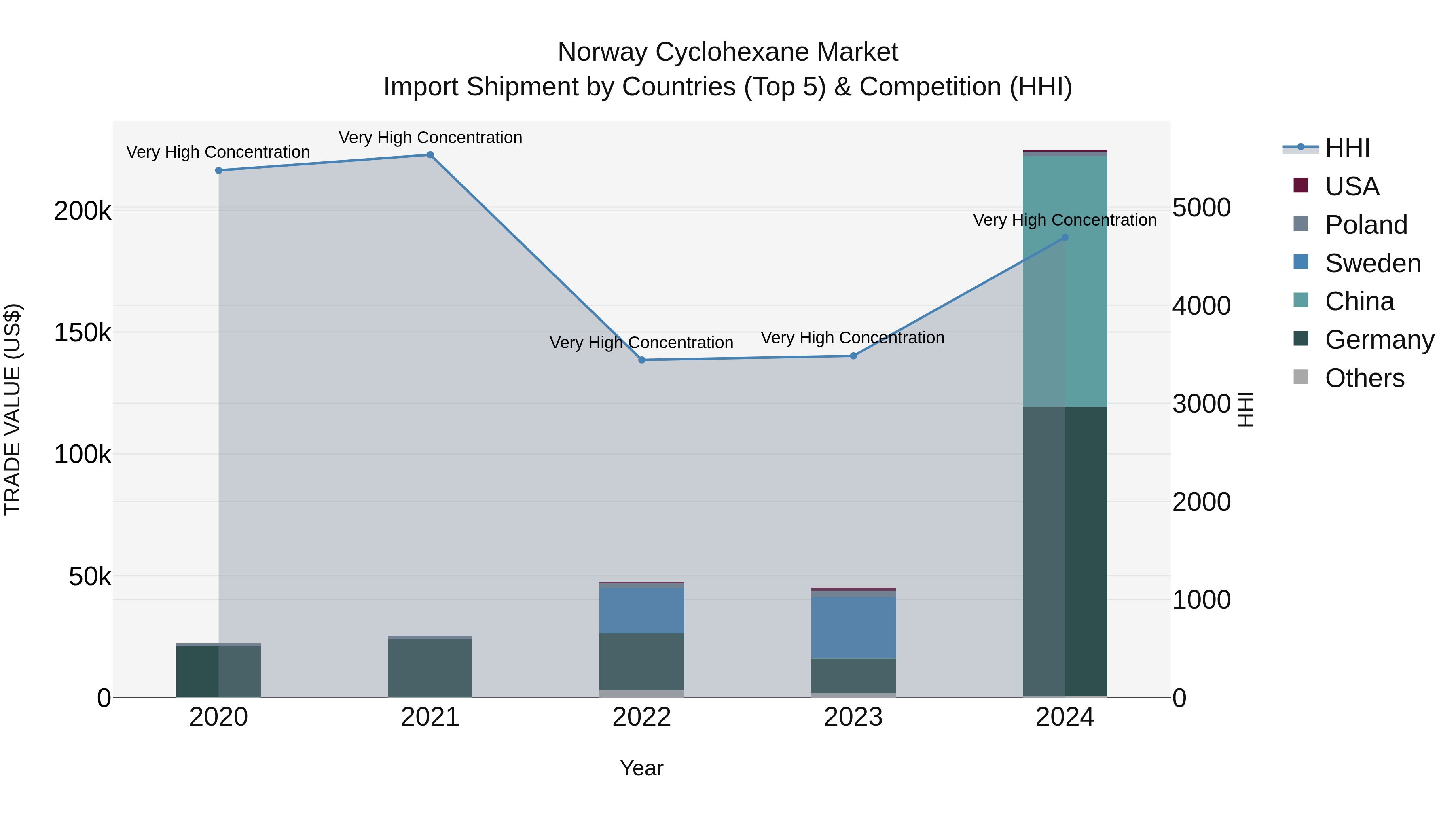
Norway`s cyclohexane import market in 2024 continued to show high concentration, with top exporters being Germany, China, Poland, USA, and Israel. The Herfindahl-Hirschman Index (HHI) remained at significant levels, indicating a concentrated market structure. The impressive compound annual growth rate (CAGR) of 78.38% over the period 2020-2024 reflects strong demand dynamics. Moreover, the remarkable growth rate of 398.09% from 2023 to 2024 demonstrates a rapid acceleration in import activities, pointing towards a potentially lucrative market for cyclohexane in Norway.
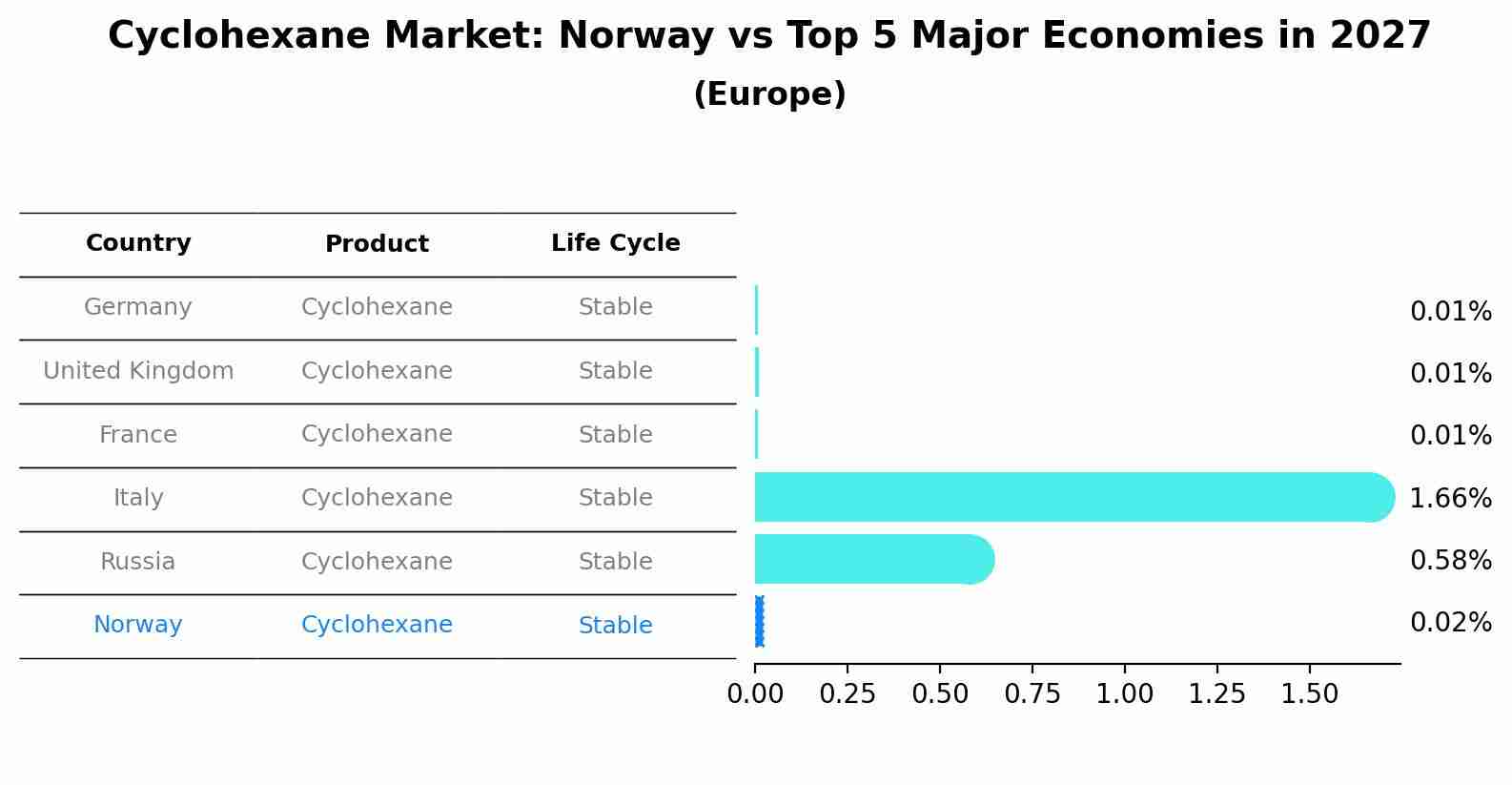
Cyclohexane Market: Norway vs Top 5 Major Economies in 2027 (Europe)
The Cyclohexane market in Norway is projected to grow at a stable growth rate of 0.02% by 2027, highlighting the country's increasing focus on advanced technologies within the Europe region, where Germany holds the dominant position, followed closely by United Kingdom, France, Italy and Russia, shaping overall regional demand.
Norway Cyclohexane Market Overview
The cyclohexane market in Norway involves the production and use of cyclohexane, a solvent and intermediate chemical used in the manufacture of nylon, resins, and other chemicals. The market is influenced by industrial demand for cyclohexane in the chemical and textile industries and the need for high-quality chemical products.
Drivers of the market
The Norway Cyclohexane Market experiences growth due to its use as a solvent and intermediate in the production of chemicals such as nylon and adipic acid. The demand for cyclohexane in various industrial applications supports market expansion. Innovations in production processes and increasing industrial activities contribute to market growth.
Challenges of the market
The cyclohexane market in Norway encounters difficulties such as the high cost of raw materials and the need for efficient production processes. Demand for cyclohexane is influenced by fluctuations in industries such as chemicals and pharmaceuticals. Additionally, competition from alternative chemicals and the need to comply with environmental regulations add to the market complexities.
Government Policy of the market
Government policies in Norway for the Cyclohexane market emphasize safety and environmental impact. Regulations ensure that cyclohexane products meet high standards for quality and safety. The government supports research into safer and more sustainable production methods and provides incentives for innovations that reduce environmental impact and improve the efficiency of cyclohexane production.
Key Highlights of the Report:
- Norway Cyclohexane Market Outlook
- Market Size of Norway Cyclohexane Market, 2024
- Forecast of Norway Cyclohexane Market, 2031
- Historical Data and Forecast of Norway Cyclohexane Revenues & Volume for the Period 2021-2031
- Norway Cyclohexane Market Trend Evolution
- Norway Cyclohexane Market Drivers and Challenges
- Norway Cyclohexane Price Trends
- Norway Cyclohexane Porter`s Five Forces
- Norway Cyclohexane Industry Life Cycle
- Historical Data and Forecast of Norway Cyclohexane Market Revenues & Volume By Application for the Period 2021-2031
- Historical Data and Forecast of Norway Cyclohexane Market Revenues & Volume By Adipic acid for the Period 2021-2031
- Historical Data and Forecast of Norway Cyclohexane Market Revenues & Volume By Caprolactam for the Period 2021-2031
- Historical Data and Forecast of Norway Cyclohexane Market Revenues & Volume By Others for the Period 2021-2031
- Historical Data and Forecast of Norway Cyclohexane Market Revenues & Volume By End-use for the Period 2021-2031
- Historical Data and Forecast of Norway Cyclohexane Market Revenues & Volume By Nylon 6 for the Period 2021-2031
- Historical Data and Forecast of Norway Cyclohexane Market Revenues & Volume By Nylon 66 for the Period 2021-2031
- Historical Data and Forecast of Norway Cyclohexane Market Revenues & Volume By Others for the Period 2021-2031
- Norway Cyclohexane Import Export Trade Statistics
- Market Opportunity Assessment By Application
- Market Opportunity Assessment By End-use
- Norway Cyclohexane Top Companies Market Share
- Norway Cyclohexane Competitive Benchmarking By Technical and Operational Parameters
- Norway Cyclohexane Company Profiles
- Norway Cyclohexane Key Strategic Recommendations






































