Norway Electric Motor Market Growth Rate Analysis (2025 - 2031)
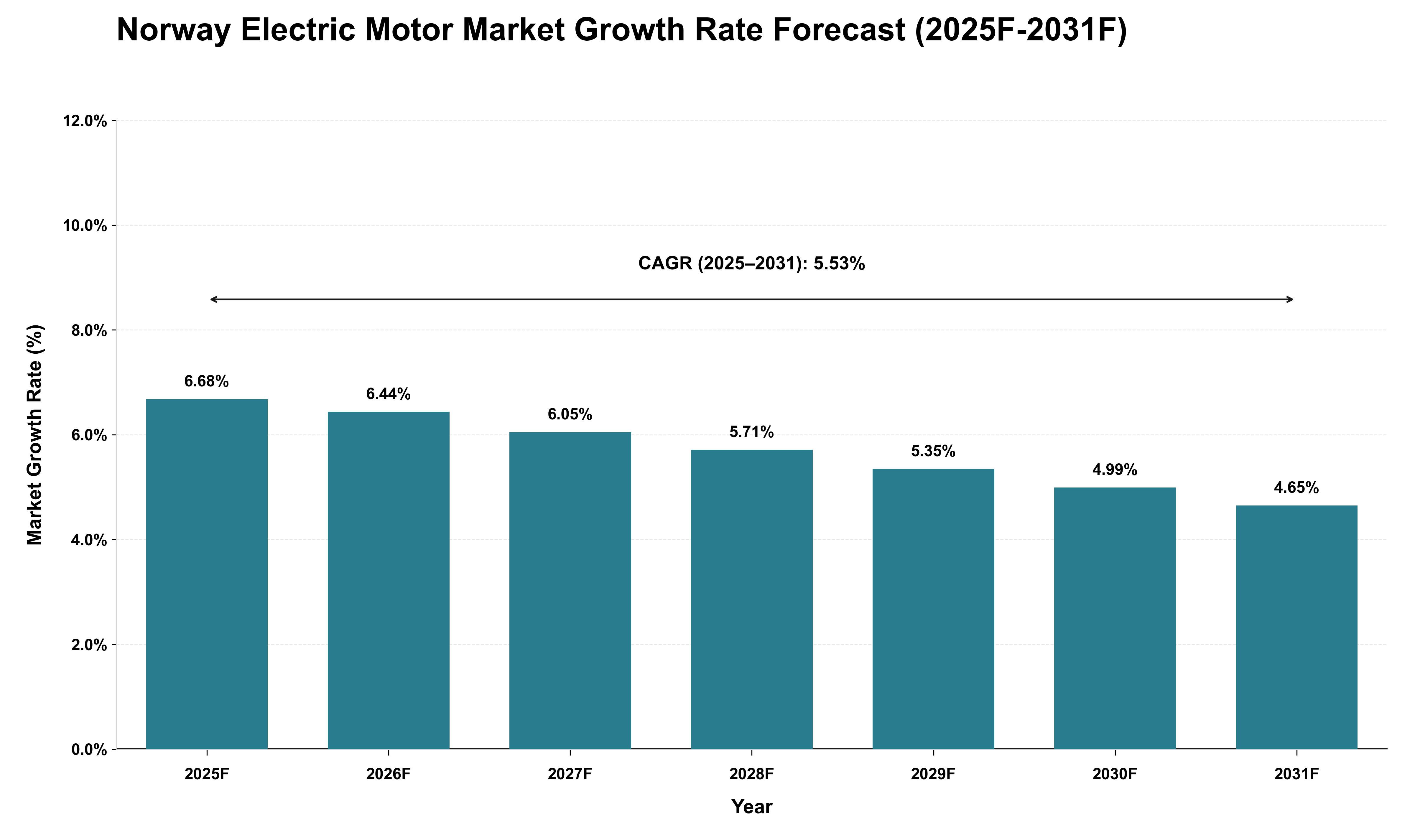
The Norway electric motor market will experience a notable transition driven by technological advancements and product substitution dynamics from 2025 to 2031. As the demand for energy-efficient solutions escalates, manufacturers will increasingly adopt innovative designs and materials, enhancing performance while reducing environmental impact. The projected CAGR of 5.53% reflects a robust growth trajectory, with annual increases peaking at 6.68% in 2025 before gradually tapering off. This trend will be influenced by Norway's commitment to sustainability and electrification across various sectors, including transportation and industrial applications. Additionally, import dependencies on advanced motor technologies may create cyclical fluctuations in supply chains, impacting pricing strategies and market accessibility. As electric motors evolve to meet stricter regulatory standards and consumer preferences shift towards greener alternatives, the sector will likely witness significant transformations that redefine competitive landscapes throughout the forecast period.
Key Highlights of the Report:
- Norway Electric Motor Market Outlook
- Market Size of Norway Electric Motor Market, 2024
- Forecast of Norway Electric Motor Market, 2031
- Historical Data and Forecast of Norway Electric Motor Revenues & Volume for the Period 2021-2031
- Norway Electric Motor Market Trend Evolution
- Norway Electric Motor Market Drivers and Challenges
- Norway Electric Motor Price Trends
- Norway Electric Motor Porter`s Five Forces
- Norway Electric Motor Industry Life Cycle
- Historical Data and Forecast of Norway Electric Motor Market Revenues & Volume By Motor Type for the Period 2021-2031
- Historical Data and Forecast of Norway Electric Motor Market Revenues & Volume By Alternate Current (AC) Motor for the Period 2021-2031
- Historical Data and Forecast of Norway Electric Motor Market Revenues & Volume By Direct Current (DC) Motor for the Period 2021-2031
- Historical Data and Forecast of Norway Electric Motor Market Revenues & Volume By Hermetic Motor for the Period 2021-2031
- Historical Data and Forecast of Norway Electric Motor Market Revenues & Volume By Output Power for the Period 2021-2031
- Historical Data and Forecast of Norway Electric Motor Market Revenues & Volume By Voltage Range for the Period 2021-2031
- Historical Data and Forecast of Norway Electric Motor Market Revenues & Volume By 9 V & Below for the Period 2021-2031
- Historical Data and Forecast of Norway Electric Motor Market Revenues & Volume By 10-20 V for the Period 2021-2031
- Historical Data and Forecast of Norway Electric Motor Market Revenues & Volume By 21-60 V for the Period 2021-2031
- Historical Data and Forecast of Norway Electric Motor Market Revenues & Volume By 60 V & Above for the Period 2021-2031
- Historical Data and Forecast of Norway Electric Motor Market Revenues & Volume By Application for the Period 2021-2031
- Historical Data and Forecast of Norway Electric Motor Market Revenues & Volume By Industrial machinery for the Period 2021-2031
- Historical Data and Forecast of Norway Electric Motor Market Revenues & Volume By Motor vehicles for the Period 2021-2031
- Historical Data and Forecast of Norway Electric Motor Market Revenues & Volume By Heating, ventilating, and cooling (HVAC) equipment for the Period 2021-2031
- Historical Data and Forecast of Norway Electric Motor Market Revenues & Volume By Aerospace & transportation for the Period 2021-2031
- Historical Data and Forecast of Norway Electric Motor Market Revenues & Volume By Household appliances for the Period 2021-2031
- Historical Data and Forecast of Norway Electric Motor Market Revenues & Volume By Other for the Period 2021-2031
- Historical Data and Forecast of Norway Electric Motor Market Revenues & Volume By Speed (RPM) for the Period 2021-2031
- Historical Data and Forecast of Norway Electric Motor Market Revenues & Volume By Low-Speed Electric Motors (Less Than 1,000 RPM) for the Period 2021-2031
- Historical Data and Forecast of Norway Electric Motor Market Revenues & Volume By Medium-Speed Electric Motors (1,001-25,000 RPM) for the Period 2021-2031
- Historical Data and Forecast of Norway Electric Motor Market Revenues & Volume By High-Speed Electric Motors (25,001-75,000 RPM) for the Period 2021-2031
- Historical Data and Forecast of Norway Electric Motor Market Revenues & Volume By Ultrahigh-Speed Electric Motors (Greater Than 75,001 RPM) for the Period 2021-2031
- Norway Electric Motor Import Export Trade Statistics
- Market Opportunity Assessment By Motor Type
- Market Opportunity Assessment By Output Power
- Market Opportunity Assessment By Voltage Range
- Market Opportunity Assessment By Application
- Market Opportunity Assessment By Speed (RPM)
- Norway Electric Motor Top Companies Market Share
- Norway Electric Motor Competitive Benchmarking By Technical and Operational Parameters
- Norway Electric Motor Company Profiles
- Norway Electric Motor Key Strategic Recommendations






































