Norway Forklift Market Growth Rate Analysis (2021-2031)
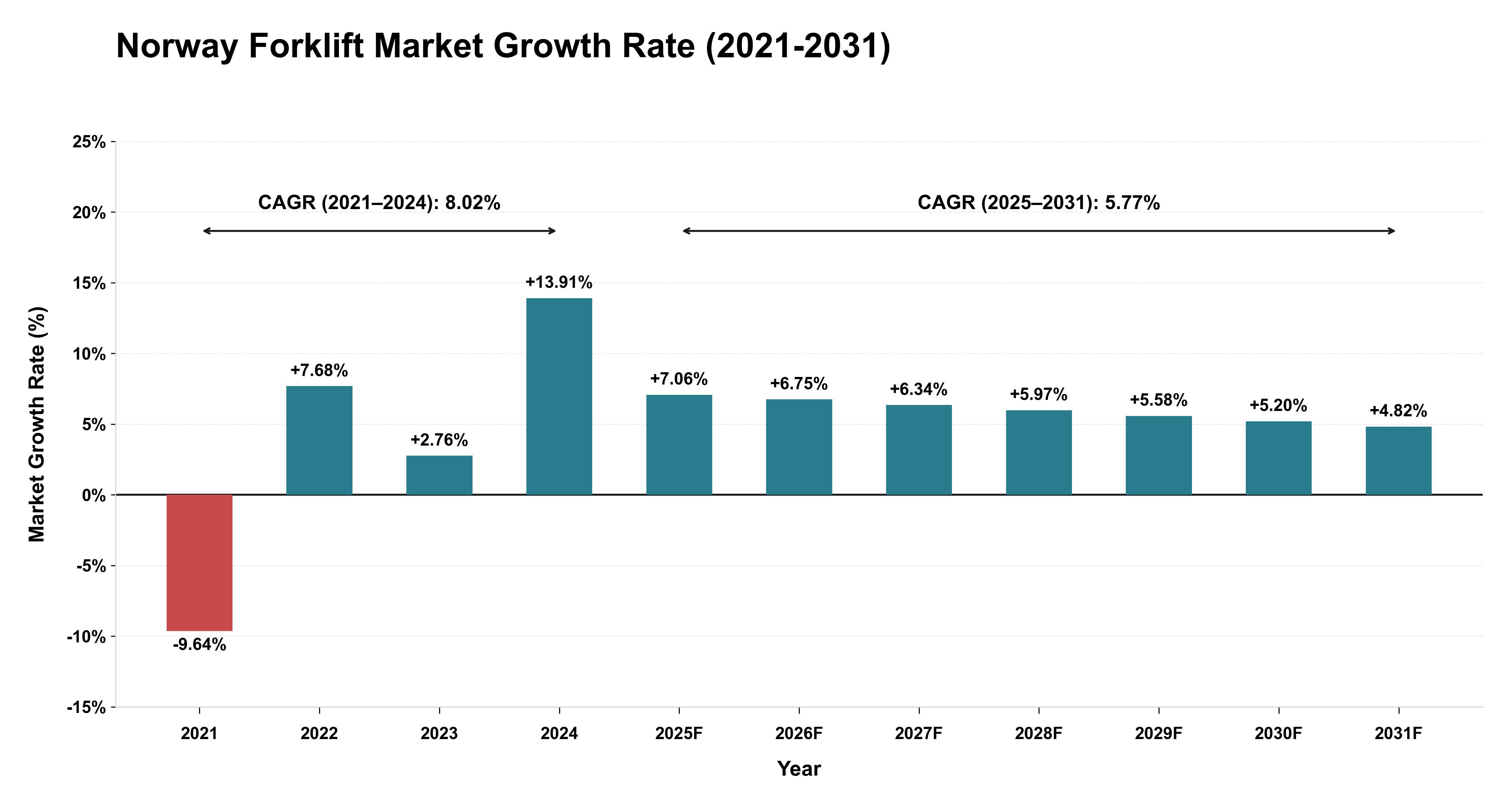
The Norway Forklift Market experienced a turbulent period in 2021, marked by a significant contraction of -9.64%, reflecting structural adjustments and market corrections. However, the subsequent years showcased a resilient recovery, with growth rates of 7.68% in 2022 and 2.76% in 2023, indicating stabilization following the initial downturn. The market then displayed robust expansion in 2024, with a substantial growth rate of 13.91%, highlighting a strong rebound and increasing demand for forklifts. Looking ahead to the forecast period from 2025 to 2031, the market is expected to continue growing at a more moderate pace, with a CAGR of 5.77%. This trajectory suggests a phase of stabilizing expansion and maturity in the Norway Forklift Market, as it adjusts to post-recovery dynamics and settles into a more sustainable growth pattern.
Key Highlights of the Report:
- Norway Forklift Market Outlook
- Market Size of Norway Forklift Market, 2024
- Forecast of Norway Forklift Market, 2031
- Historical Data and Forecast of Norway Forklift Revenues & Volume for the Period 2021-2031
- Norway Forklift Market Trend Evolution
- Norway Forklift Market Drivers and Challenges
- Norway Forklift Price Trends
- Norway Forklift Porter`s Five Forces
- Norway Forklift Industry Life Cycle
- Historical Data and Forecast of Norway Forklift Market Revenues & Volume By Class for the Period 2021-2031
- Historical Data and Forecast of Norway Forklift Market Revenues & Volume By Class 1 for the Period 2021-2031
- Historical Data and Forecast of Norway Forklift Market Revenues & Volume By 2 for the Period 2021-2031
- Historical Data and Forecast of Norway Forklift Market Revenues & Volume By 3 for the Period 2021-2031
- Historical Data and Forecast of Norway Forklift Market Revenues & Volume By 4/5 for the Period 2021-2031
- Historical Data and Forecast of Norway Forklift Market Revenues & Volume By Propulsion for the Period 2021-2031
- Historical Data and Forecast of Norway Forklift Market Revenues & Volume By Electric for the Period 2021-2031
- Historical Data and Forecast of Norway Forklift Market Revenues & Volume By ICE for the Period 2021-2031
- Historical Data and Forecast of Norway Forklift Market Revenues & Volume By Battery Type for the Period 2021-2031
- Historical Data and Forecast of Norway Forklift Market Revenues & Volume By Li-Ion for the Period 2021-2031
- Historical Data and Forecast of Norway Forklift Market Revenues & Volume By Lead Acid for the Period 2021-2031
- Norway Forklift Import Export Trade Statistics
- Market Opportunity Assessment By Class
- Market Opportunity Assessment By Propulsion
- Market Opportunity Assessment By Battery Type
- Norway Forklift Top Companies Market Share
- Norway Forklift Competitive Benchmarking By Technical and Operational Parameters
- Norway Forklift Company Profiles
- Norway Forklift Key Strategic Recommendations






































