Norway Halal Meat Market Top 5 Importing Countries and Market Competition (HHI) Analysis
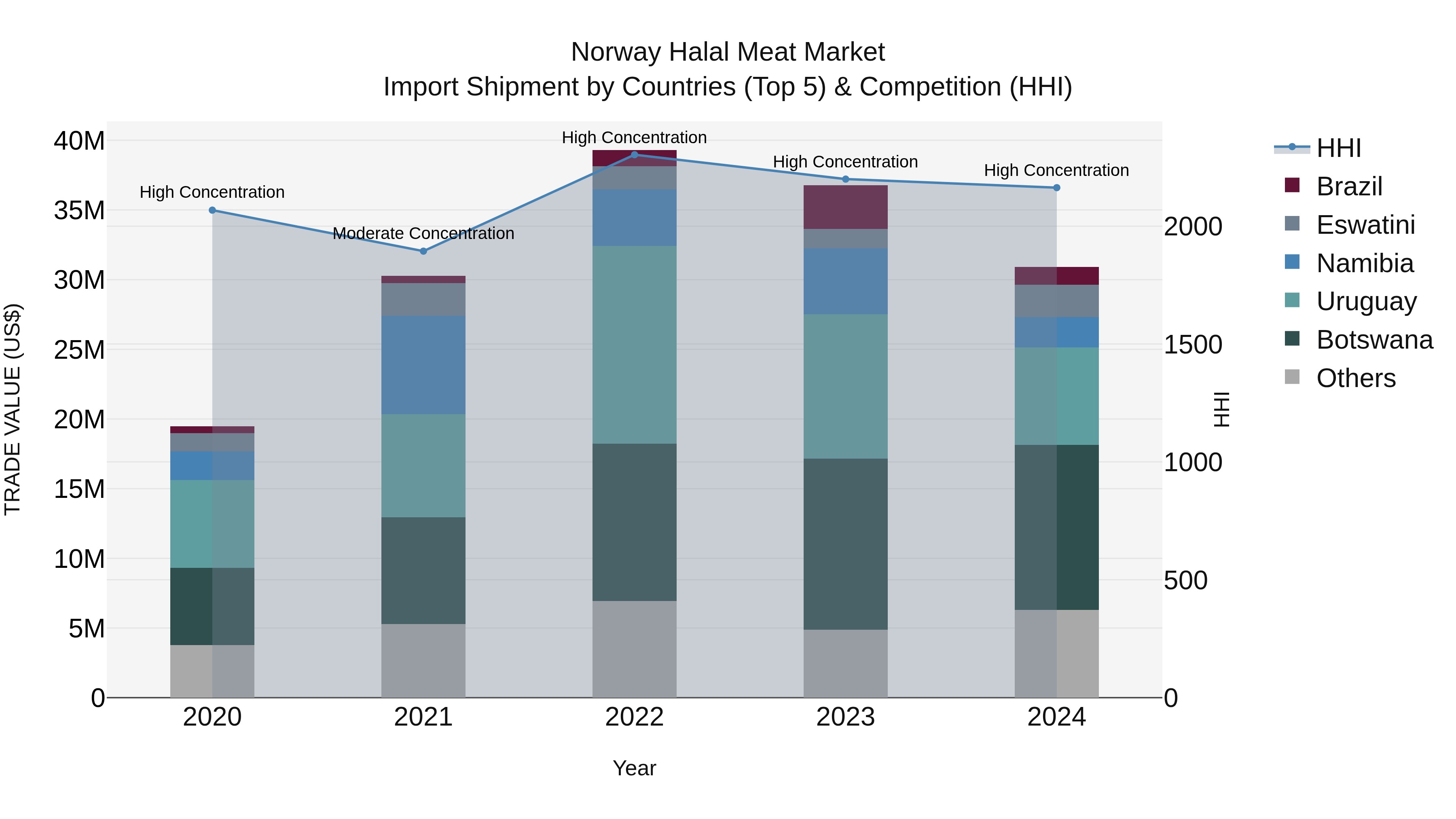
Norway`s halal meat import market in 2024 continued to be dominated by suppliers from Botswana, Uruguay, Eswatini, Namibia, and Argentina. Despite a slight decline in growth rate from the previous year, the industry maintained high concentration levels, indicating a competitive landscape. With a strong compound annual growth rate (CAGR) of 12.26% over the period of 2020-2024, the market is showing steady expansion and potential for further development. The negative growth rate in 2024 may be a short-term fluctuation, and overall, the outlook for halal meat imports in Norway remains positive.
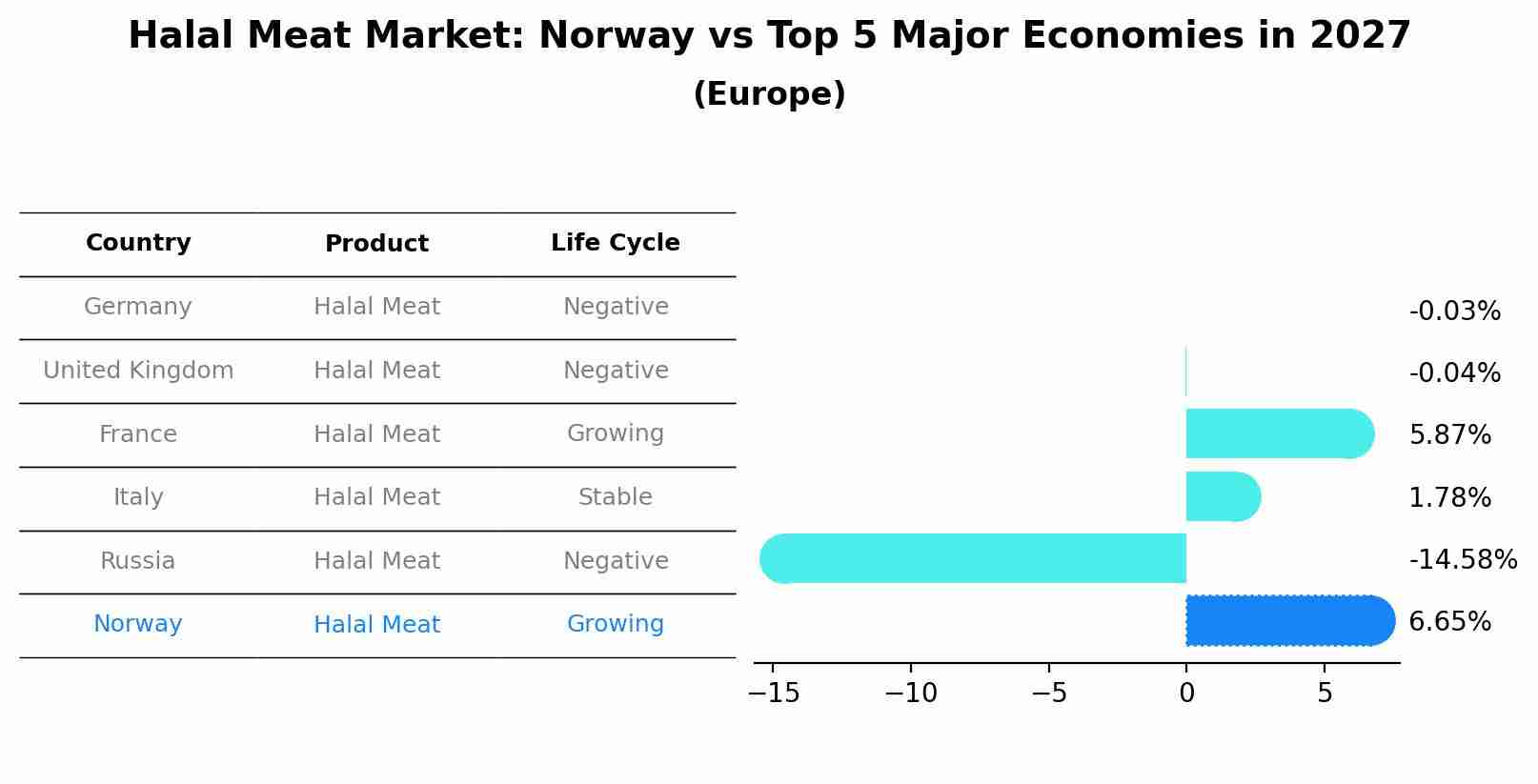
Halal Meat Market: Norway vs Top 5 Major Economies in 2027 (Europe)
Norway's Halal Meat market is anticipated to experience a growing growth rate of 6.65% by 2027, reflecting trends observed in the largest economy Germany, followed by United Kingdom, France, Italy and Russia.
Norway Halal Meat Market Highlights
| Report Name | Norway Halal Meat Market |
| Forecast Period | 2025-2029 |
| CAGR | 5.75% |
| Growing Sector | Retail and Foodservice |
Topics Covered in the Norway Halal Meat Market Report
The Norway Halal Meat Market report thoroughly covers the market by product type. The market report provides an unbiased and detailed analysis of ongoing market trends, opportunities/high growth areas, and market drivers, which would help stakeholders to devise and align their market strategies according to the current and future market dynamics.
Norway Halal Meat Market Synopsis
Norway Halal Meat Market is projected to experience enormous growth over the coming years as demand for halal meat upsurges due to the growing Muslim population and the expanding acceptance of halal dietary practices among non-Muslim consumers. In general, halal meat is being increasingly sought after due to its cultural significance and health-conscious attributes. Alongside, the market is also experiencing robust growth in retail outlets, foodservice, and online platforms.
Evaluation of Growth Drivers in the Norway Halal Meat Market
Below mentioned are some major drivers and their impacts on the market dynamics:
| Drivers | Primary Segments Affected | Why it Matters (Evidence) |
| Increase in Muslim Population | Fresh and Processed Halal Meat | The growing Muslim population in Norway is driving the demand for halal-certified meat products. |
| Rising Consumer Health Consciousness | Fresh and Processed Halal Meat | Halal meat, being free from prohibited ingredients, appeals to health-conscious consumers, indorsing demand. |
| Increase in Halal Certification | Processed Halal Meat | Retailers and food brands are procuring halal certifications, which has increased the availability and market presence of halal products. |
| Growing Convenience of Online Retail | Retail | Development of online grocery stores and food delivery services is enabling greater access to halal meat products for consumers. |
| Expansion of Halal Restaurants | Foodservice | The expansion of halal restaurants and eateries is contributing to the higher consumption of halal meat in the foodservice sector. |
Norway Halal Meat Market is anticipated to gain traction, growing at a CAGR of 5.75% during the forecast period of 2025-2029. The main reasons for this growth are the growing number of Muslims in the country, the growing acceptance of Halal food among non-Muslims, and the growing demand for healthier and more ethically sourced food. More people in Norway, both Muslim and non-Muslim, are becoming interested in Halal meat. This includes people who care about the environment and their health. Halal meat is also becoming more popular in restaurants and stores, which is helping Norway Halal Meat Market grow even faster.
Evaluation of Restraints in the Norway Halal Meat Market
Below mentioned are some major restraints and their influence on the market dynamics:
| Restraints | Primary Segments Affected | What this Means (Evidence) |
| High Price of Halal Meat | Fresh and Processed Halal Meat | Halal meat products often come at a premium due to the certification process and limited supply, which may deter some consumers. |
| Supply Chain Challenges | All Segments | The supply chain for halal meat is often complicated, and any problems can make it harder to get the products. |
| Limited Knowledge of Halal Practices | Retail | Not many people know about halal standards and certification, which can slow growth in non-Muslim groups. |
| Regulatory Complexity | All Segments | Navigating the regulatory framework for halal certification and ensuring adherence to the guidelines can be time-consuming and costly. |
| Cultural Resistance in Rural Areas | Retail | In rural areas, where people may not eat halal meat as often, there is a cultural resistance that could stop the market from growing. |
Norway Halal Meat Market Challenges
The outlook for the Norway Halal Meat Industry is expected to remain positive market. However, there are some challenges such as the limited number of Halal-certified slaughterhouses and the high costs associated with Halal certification. Also, relying on imported Halal meat can make the supply chain weaker and costs go up. Lastly, non-Muslim consumers may not know much about Halal certification, could make it harder for the market to accept it.
Norway Halal Meat Market Trends
Below listed are some emerging trends in the Norway Halal Meat Market:
- More meat sales online: The demand for halal meat is growing on online shopping sites. People are choosing the ease of ordering online increasingly, especially in big cities.
- Health-Conscious Consumption—As more people choose organic and chemical-free products, halal meat is becoming more popular because it is thought to be healthier, especially in processed foods.
- Halal Certification for Non-Muslim Consumers: Halal certification is not only popular with Muslims, but it is also popular with non-Muslims for moral and health reasons. A leading trend is the rise of halal-certified goods in stores and supermarkets.
- Ethical and Sustainable Sourcing – People are concerned about from where their meat comes from. Halal meat is linked to more ethical ways of killing animals, which is appealing to people who want to eat food that is better for the environment and people.
Investment Opportunities in the Norway Halal Meat Industry
There are some potential opportunities in the Norway Halal Meat Industry include:
- Halal Certification for Food Products: There is a growing opportunity to expand halal certification to more types of food, such as frozen foods, ready-to-eat meals, and snacks.
- Halal Catering and Event Services: Halal catering services for events like weddings and business meetings are becoming more popular.
- More places to buy halal meat—supermarkets, hypermarkets, and online grocery stores could all sell more halal meat.
- Health-Conscious Processed Foods: A move toward organic, preservative-free, and high-protein processed halal foods is likely to draw in more people than just Muslims.
- Halal Meat in Tourism—As more people from Muslim-majority visit countries, there is a growing need for halal meat in hotels, airports, and tourist centers.
Top 5 Leading Players in the Norway Halal Meat Market
Below is the comprehensive list of prominent companies dominating the Norway Halal Meat Market Share:
Al Salam Meat AS
| Company Name | Al Salam Meat AS |
| Established Year | 2004 |
| Headquarters | Oslo, Norway |
| Official Website | - |
AS is a trusted supplier of halal-certified meat products in Norway, offering a wide range of beef, lamb, and poultry sourced from certified farms and slaughterhouses.
Norhalal AS
| Company Name | Norhalal AS |
| Established Year | 2008 |
| Headquarters | Drammen, Norway |
| Official Website | - |
Norhalal AS specializes in distributing halal-certified fresh and frozen meat products across Norway, maintaining strict quality standards aligned with Islamic requirements.
Grilstad AS
| Company Name | Grilstad AS |
| Established Year | 1957 |
| Headquarters | Trondheim, Norway |
| Official Website | Click Here |
Grilstad AS is one of Norway’s prominent meat producers offering a range of processed and halal-certified meat products tailored to multicultural consumers.
Fatland AS
| Company Name | Fatland AS |
| Established Year | 1892 |
| Headquarters | Sandnes, Norway |
| Official Website | Click Here |
Fatland AS is one of Norway’s oldest and largest meat processing companies, producing certified halal meat lines to cater to both domestic and export markets.
Nortura SA
| Company Name | Nortura SA |
| Established Year | 2006 |
| Headquarters | Oslo, Norway |
| Official Website | Click Here |
Nortura SA, a leading agricultural cooperative, has expanded its portfolio to include halal-certified meat brands, ensuring ethical production and reliable sourcing for Muslim consumers.
Government Regulations Introduced in the Norway Halal Meat Market
According to Norwegian government data, there have been various initiatives enforced to regulate the Norway Halal Meat Market Growth:
- Haal Certification Standards: The Norwegian government has set official rules for halal meat certification. These rules make sure that meat products meet the strict requirements of Islamic dietary laws.
- Animal Welfare Laws: Norwegian laws on animal welfare say that animals must be treated kindly during slaughter, which is in line with the principles of halal slaughter.
- Health and Safety Regulations: The government makes sure that halal meat products meet safety standards, which means that they are high-quality meat that follows both local and Islamic health laws.
Future Insights of the Norway Halal Meat Market
The Norway Halal Meat Market is expected to continue its growth trajectory, supported by rising consumer demand, increasing halal certifications, and the growing trend toward ethical consumption. The future will see a significant rise in the diversification of halal products across both retail and foodservice sectors.
Market Segmentation Analysis
The report offers a comprehensive study of the following market segments and their leading categories:
By Product Type- Fresh Food to Dominate the Market
According to Mohit, Senior Research Analyst, 6Wresearch, Fresh halal meat is the dominant category, as consumers prefer fresh cuts for home preparation. The demand is particularly high for chicken and lamb. However, processed halal food products, such as ready-to-eat meals and frozen foods, are growing rapidly, driven by convenience.
Key Attractiveness of the Report
- 10 Years of Market Numbers.
- Historical Data Starting from 2021 to 2024.
- Base Year: 2024.
- Forecast Data until 2029.
- Key Performance Indicators Impacting the Market.
- Major Upcoming Developments and Projects.
Key Highlights of the Report:
- Norway Halal Meat Market Outlook
- Market Size of Norway Halal Meat Market, 2024
- Forecast of Norway Halal Meat Market, 2029
- Historical Data and Forecast of Norway Halal Meat Revenues & Volume for the Period 2019 -2029
- Norway Halal Meat Market Trend Evolution
- Norway Halal Meat Market Drivers and Challenges
- Norway Halal Meat Price Trends
- Norway Halal Meat Porter`s Five Forces
- Norway Halal Meat Industry Life Cycle
- Historical Data and Forecast of Norway Halal Meat Market Revenues & Volume By Product Type for the Period 2019 -2029
- Historical Data and Forecast of Norway Halal Meat Market Revenues & Volume By Fresh Food for the Period 2019 -2029
- Historical Data and Forecast of Norway Halal Meat Market Revenues & Volume By Processed Food for the Period 2019 -2029
- Norway Halal Meat Import Export Trade Statistics
- Market Opportunity Assessment By Product Type
- Norway Halal Meat Top Companies Market Share
- Norway Halal Meat Competitive Benchmarking By Technical and Operational Parameters
- Norway Halal Meat Company Profiles
- Norway Halal Meat Key Strategic Recommendations
Market Covered
The report offers a comprehensive study of the subsequent market segments:
By Product Type
- Fresh Food
- Processed Food






































