Norway Packaged Water Market Top 5 Importing Countries and Market Competition (HHI) Analysis
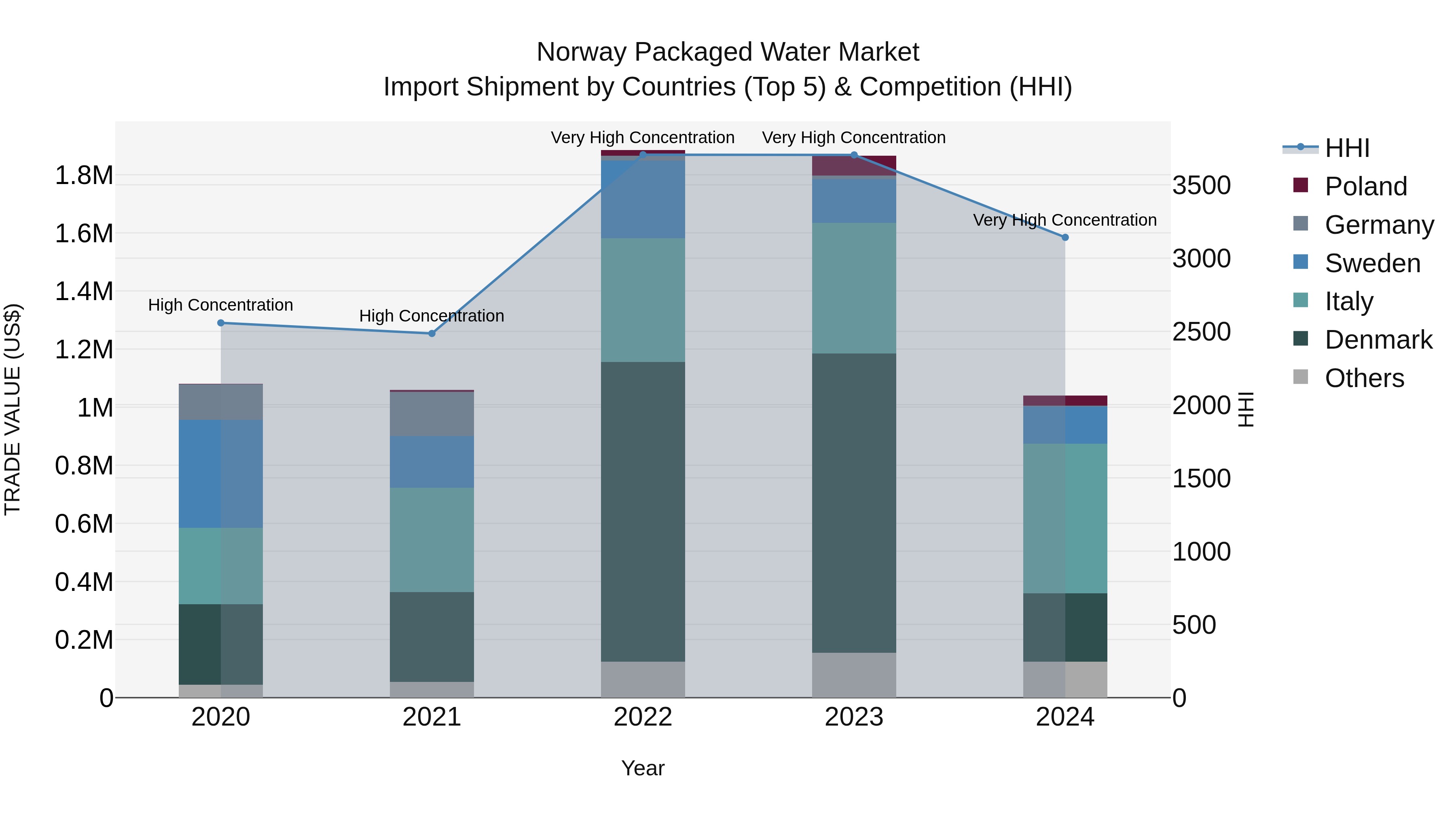
Norway continues to import packaged water mainly from Italy, Denmark, Sweden, Poland, and the Netherlands, with high concentration levels indicated by the Herfindahl-Hirschman Index (HHI) in 2024. Despite a negative Compound Annual Growth Rate (CAGR) from 2020 to 2024, the drastic decline in growth rate from 2023 to 2024 highlights challenges faced by the industry. It will be crucial for stakeholders to assess market dynamics and consumer preferences to adapt and strategize effectively in this competitive landscape.
Norway Packaged water Market Overview
The Norway packaged water market is witnessing steady growth driven by factors such as increasing health consciousness among consumers, rising concerns about water quality, and convenience of on-the-go hydration. The market is characterized by a wide range of offerings including still, sparkling, flavored, and functional waters to cater to diverse consumer preferences. Sustainable packaging options, such as recyclable materials and reduced plastic usage, are gaining traction in response to environmental concerns. Key players in the market are focusing on product innovation, branding, and distribution strategies to stay competitive. The market is expected to continue its growth trajectory, supported by the trend towards healthier beverage choices and the convenience offered by packaged water products.
Norway Packaged water Market Trends and Opportunities
The Norway Packaged water market is witnessing a growing trend towards healthier lifestyles and increased awareness about the importance of hydration. Consumers are opting for packaged water as a convenient and portable source of hydration, fueled by concerns over the quality of tap water. The market is also seeing a rise in demand for functional and flavored waters, as well as sustainable packaging solutions to align with eco-conscious consumer preferences. Opportunities lie in product innovation, such as introducing infused waters with natural flavors or incorporating functional ingredients for added health benefits. Additionally, expanding distribution channels, such as online retail platforms, can help reach a wider audience and capitalize on the increasing popularity of packaged water in Norway.
Norway Packaged water Market Challenges
In the Norway Packaged water market, some key challenges are increasing competition from other beverage options like flavored water or sports drinks, concerns over plastic waste and environmental impact, and the high cost of sourcing and packaging water in a country known for its strict environmental regulations. Additionally, the market may face challenges related to consumer preferences shifting towards more sustainable and eco-friendly packaging solutions, as well as potential regulations or taxes on single-use plastics that could impact the packaged water industry. Adapting to these challenges by focusing on sustainability efforts, offering innovative packaging solutions, and emphasizing the health benefits of packaged water could help companies in the Norway market maintain their competitiveness and appeal to environmentally-conscious consumers.
Norway Packaged water Market Drivers
The Norway Packaged water market is primarily driven by factors such as increasing health consciousness among consumers, growing demand for convenience and on-the-go hydration solutions, and the shift towards healthier beverage options due to rising concerns about sugary drinks. Additionally, the country`s well-developed infrastructure, stringent regulations ensuring high-quality standards for packaged water, and the trend of sustainability and environmental awareness are also playing a significant role in driving the market growth. The rising trend of outdoor activities and sports participation further boosts the demand for packaged water as a convenient and portable hydration option, driving the market forward. Overall, these factors combined contribute to the steady growth and market expansion of the packaged water segment in Norway.
Norway Packaged water Market Government Policy
In Norway, the packaged water market is regulated by the Norwegian Food Safety Authority, which sets and enforces standards for the production, labeling, and distribution of packaged water to ensure consumer safety. The authority requires that all packaged water products meet specific quality and hygiene criteria, including limits on contaminants and mandatory labeling of ingredients and nutritional information. Additionally, Norway has implemented a deposit system for plastic bottles to promote recycling and reduce environmental impact. The government has also shown support for sustainability initiatives in the packaged water industry, encouraging companies to use eco-friendly packaging materials and reduce their carbon footprint. Overall, government policies in Norway aim to uphold high standards of quality, safety, and environmental responsibility in the packaged water market.
Norway Packaged water Market Future Outlook
The Norway Packaged water market is expected to witness steady growth in the coming years as consumer preference for convenient and healthy beverage options continues to rise. Factors such as increasing health consciousness, a growing awareness of the importance of hydration, and a shift towards more sustainable packaging solutions are driving the demand for packaged water in the country. Furthermore, the trend towards on-the-go consumption and the convenience offered by single-serve packaging formats are expected to further boost market growth. With a focus on innovation and product differentiation, key players in the market are likely to introduce new flavors, functional ingredients, and eco-friendly packaging solutions to cater to evolving consumer preferences and sustainability concerns. Overall, the Norway Packaged water market is anticipated to expand steadily in the foreseeable future.
Key Highlights of the Report:
- Norway Packaged water Market Outlook
- Market Size of Norway Packaged water Market, 2024
- Forecast of Norway Packaged water Market, 2031
- Historical Data and Forecast of Norway Packaged water Revenues & Volume for the Period 2021- 2031
- Norway Packaged water Market Trend Evolution
- Norway Packaged water Market Drivers and Challenges
- Norway Packaged water Price Trends
- Norway Packaged water Porter's Five Forces
- Norway Packaged water Industry Life Cycle
- Historical Data and Forecast of Norway Packaged water Market Revenues & Volume By Product for the Period 2021- 2031
- Historical Data and Forecast of Norway Packaged water Market Revenues & Volume By Still for the Period 2021- 2031
- Historical Data and Forecast of Norway Packaged water Market Revenues & Volume By Carbonated for the Period 2021- 2031
- Historical Data and Forecast of Norway Packaged water Market Revenues & Volume By Flavored for the Period 2021- 2031
- Historical Data and Forecast of Norway Packaged water Market Revenues & Volume By Functional for the Period 2021- 2031
- Norway Packaged water Import Export Trade Statistics
- Market Opportunity Assessment By Product
- Norway Packaged water Top Companies Market Share
- Norway Packaged water Competitive Benchmarking By Technical and Operational Parameters
- Norway Packaged water Company Profiles
- Norway Packaged water Key Strategic Recommendations






































