Norway Rolling Mill Components and Ancillary Equipment Market Growth Rate Analysis (2025 - 2031)
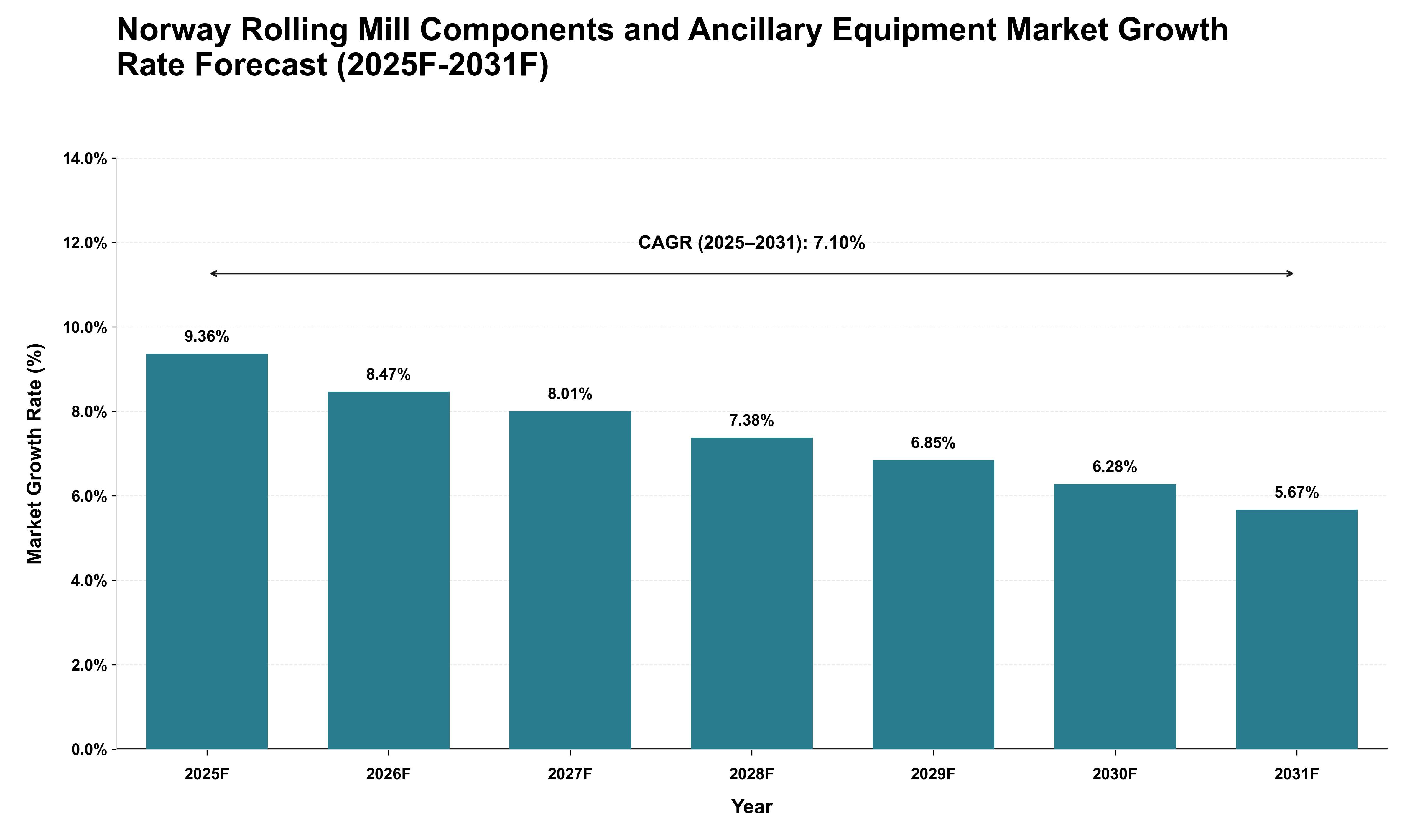
The forecasted growth trajectory for Norway's rolling mill components and ancillary equipment market will exhibit a notable deceleration from 2025 to 2031, as indicated by the declining annual growth rates. Starting with a robust 9.36% in 2025, the market will experience a gradual reduction, ultimately reaching 5.67% by 2031. This trend suggests that while demand for these components will remain strong, it may be influenced by external factors such as import dependencies on raw materials and technological advancements in manufacturing processes. The anticipated CAGR of 7.10% reflects an underlying resilience in trade flows, driven by increased global demand for steel production and infrastructure development. However, cyclical trends may introduce variability in import volumes and pricing dynamics, necessitating strategic adjustments among stakeholders to navigate potential fluctuations in supply chains effectively throughout this period.
Key Highlights of the Report:
- Norway Rolling Mill Components and Ancillary Equipment Market Outlook
- Market Size of Norway Rolling Mill Components and Ancillary Equipment Market, 2024
- Forecast of Norway Rolling Mill Components and Ancillary Equipment Market, 2031
- Historical Data and Forecast of Norway Rolling Mill Components and Ancillary Equipment Revenues & Volume for the Period 2021-2031
- Norway Rolling Mill Components and Ancillary Equipment Market Trend Evolution
- Norway Rolling Mill Components and Ancillary Equipment Market Drivers and Challenges
- Norway Rolling Mill Components and Ancillary Equipment Price Trends
- Norway Rolling Mill Components and Ancillary Equipment Porter`s Five Forces
- Norway Rolling Mill Components and Ancillary Equipment Industry Life Cycle
- Historical Data and Forecast of Norway Rolling Mill Components and Ancillary Equipment Market Revenues & Volume By Product for the Period 2021-2031
- Historical Data and Forecast of Norway Rolling Mill Components and Ancillary Equipment Market Revenues & Volume By Iron Rolls for the Period 2021-2031
- Historical Data and Forecast of Norway Rolling Mill Components and Ancillary Equipment Market Revenues & Volume By Steel Rolls for the Period 2021-2031
- Historical Data and Forecast of Norway Rolling Mill Components and Ancillary Equipment Market Revenues & Volume By Others for the Period 2021-2031
- Historical Data and Forecast of Norway Rolling Mill Components and Ancillary Equipment Market Revenues & Volume By End User for the Period 2021-2031
- Historical Data and Forecast of Norway Rolling Mill Components and Ancillary Equipment Market Revenues & Volume By Oil & Gas for the Period 2021-2031
- Historical Data and Forecast of Norway Rolling Mill Components and Ancillary Equipment Market Revenues & Volume By Industrial for the Period 2021-2031
- Historical Data and Forecast of Norway Rolling Mill Components and Ancillary Equipment Market Revenues & Volume By Automotive for the Period 2021-2031
- Historical Data and Forecast of Norway Rolling Mill Components and Ancillary Equipment Market Revenues & Volume By Mining for the Period 2021-2031
- Historical Data and Forecast of Norway Rolling Mill Components and Ancillary Equipment Market Revenues & Volume By Others for the Period 2021-2031
- Norway Rolling Mill Components and Ancillary Equipment Import Export Trade Statistics
- Market Opportunity Assessment By Product
- Market Opportunity Assessment By End User
- Norway Rolling Mill Components and Ancillary Equipment Top Companies Market Share
- Norway Rolling Mill Components and Ancillary Equipment Competitive Benchmarking By Technical and Operational Parameters
- Norway Rolling Mill Components and Ancillary Equipment Company Profiles
- Norway Rolling Mill Components and Ancillary Equipment Key Strategic Recommendations






































