Oman Automotive Drive Shaft Market Size, Share & Growth Rate
The Oman Automotive Drive Shaft Market was estimated at USD 411 Million in 2025 and is projected to reach USD 553 Million by 2032, growing at a CAGR of 4.3% from 2026 to 2032. This upward trajectory is primarily fueled by the burgeoning demand for vehicles, especially larger SUVs and trucks, driven by increasing disposable income and changing consumer preferences. Furthermore, the ongoing government infrastructure initiatives are enhancing commercial vehicle adoption, further bolstering demand for automotive drive shafts.
Oman Automotive Drive Shaft Market Year-wise Growth Rate and Key Drivers
This graph highlights how the Oman Automotive Drive Shaft Market has steadily grown over the years, supported by major growth factors.
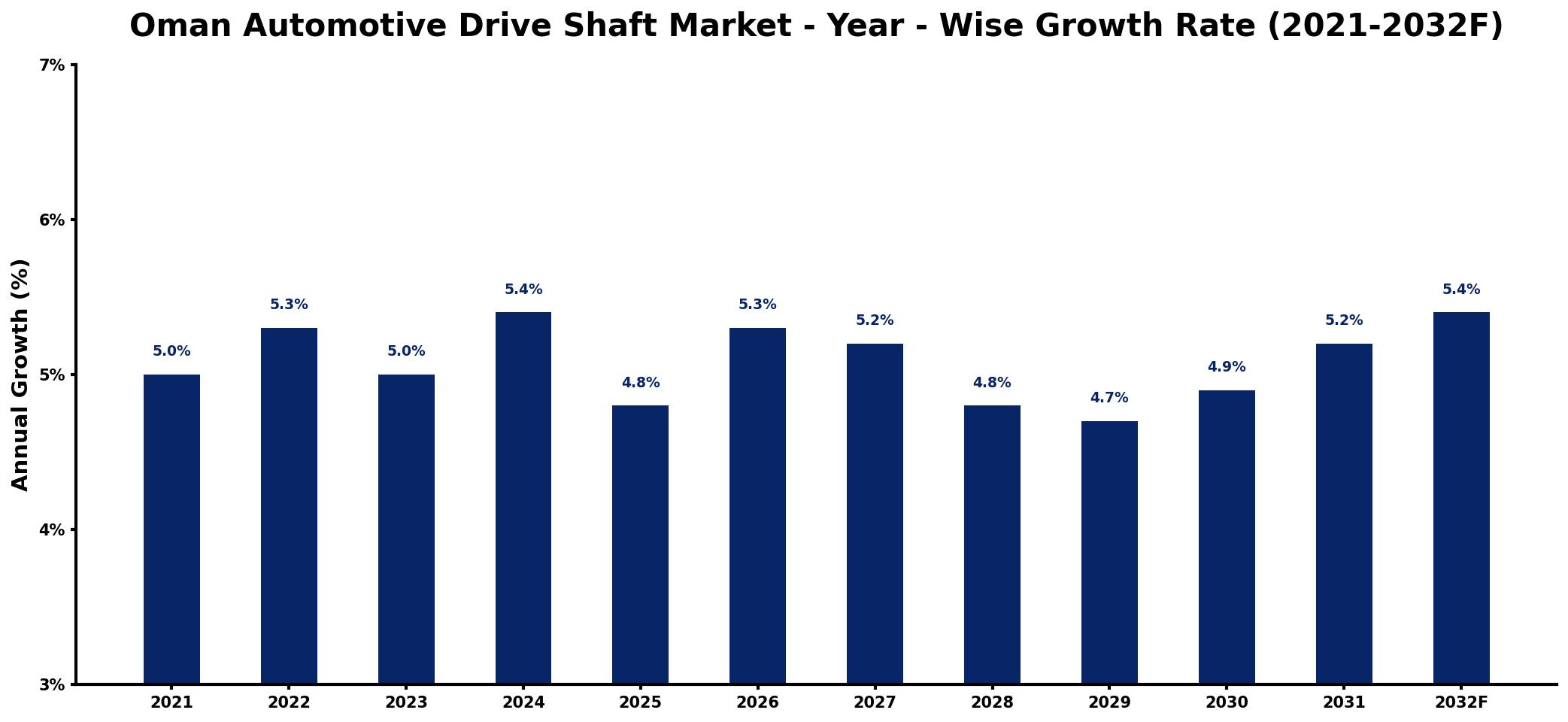
The table below presents the year‑wise growth rates along with the key drivers influencing the market
| Year | Growth Rate | Major Drivers |
| 2021 | 5.0% | Rising vehicle production rates |
| 2022 | 5.3% | Increasing demand for exports |
| 2023 | 5.0% | Growth in renewable energy vehicles |
| 2024 | 5.4% | Expansion of local manufacturing facilities |
| 2025 | 4.8% | Boost in infrastructure investments |
| 2026 | 5.3% | Higher consumer spending on mobility |
| 2027 | 5.2% | Surge in electric vehicle adoption |
| 2028 | 4.8% | Development of smart transportation solutions |
| 2029 | 4.7% | Increased focus on sustainability initiatives |
| 2030 | 4.9% | increased production capacity utilization |
| 2031 | 5.2% | Advancements in vehicle technology |
| 2032 | 5.4% | Rising demand for connected vehicles |
Note: Market size estimations and growth projections presented in this report are based on 6Wresearch's proprietary forecasting methodology, utilizing the latest available industry data, government publications, and primary research inputs.
Oman Automotive Drive Shaft Market Synopsis
The Oman Automotive Drive Shaft Market is currently in a phase of steady growth, influenced by the country's rising automotive manufacturing sector. OEMs play a crucial role in this market, providing vital components that support vehicle functionality and performance.
Amidst the overall economic diversification efforts, the demand for innovative and efficient drive shaft technologies is increasing. This is especially true as the market shifts towards accommodating electric and hybrid vehicles, reflecting broader global trends in the automotive industry.
Oman Automotive Drive Shaft Market Key Takeaways
- The market is poised for growth with a projected size increase from USD 411 Million to USD 553 Million by 2032.
- Technological advancements are leading to a rise in demand for lightweight materials in drive shafts.
- The shift towards electric vehicles is creating new demands and requirements for drive shaft configurations.
- Collaborations between local manufacturers and international suppliers are enhancing market competitiveness.
- Government policies aimed at promoting local production are creating a favorable environment for investment.
Evaluation of Restraints in Oman Automotive Drive Shaft Market
Despite the promising growth, the Oman Automotive Drive Shaft Market faces several significant restraints. Increasing competition from established international brands puts pressure on local manufacturers to innovate while also managing production costs. The fluctuating prices of raw materials can adversely affect profit margins, necessitating efficient supply chain strategies. Additionally, the ongoing shift towards electric vehicles may impact traditional drive shaft demand, requiring existing players to adapt rapidly to new market dynamics.
Oman Automotive Drive Shaft Market Trends
Current trends indicate a marked shift towards lightweight drive shafts made from advanced materials like carbon fiber and aluminum. This is largely driven by the automotive sector's commitment to improving fuel efficiency and reducing emissions. Moreover, the rise of electric and hybrid vehicles necessitates specialized designs for drive shafts that can effectively handle unique powertrains. Technological innovations, such as adaptive damping systems and torque vectoring, are enhancing overall vehicle performance, making these features increasingly desirable in the market.
Oman Automotive Drive Shaft Market Opportunities
Investment opportunities in the Oman Automotive Drive Shaft Market are burgeoning, particularly as the automotive sector expands due to government infrastructure projects and economic diversification initiatives. The continuous need for vehicle maintenance and replacement parts offers a stable demand for drive shafts. Additionally, as technological advancements pave the way for more durable and efficient products, investors have a unique chance to capitalize on R&D initiatives focused on enhancing drive shaft performance and sustainability.
Government Initiatives in the Oman Automotive Drive Shaft Market
The Omani government has instituted several policies aimed at fostering growth in the automotive sector, which directly benefits the drive shaft market. Initiatives include incentives for foreign direct investment and support for local manufacturing to enhance self-sufficiency. Furthermore, the establishment of quality and safety standards ensures that products meet rigorous environmental and regulatory requirements, thus promoting sustainability in automotive manufacturing. Such a conducive policy environment is expected to attract further investments and spur innovation in the drive shaft sector.
Future Insights of the Oman Automotive Drive Shaft Market
Looking ahead to 2026-2032, the Oman Automotive Drive Shaft Market is anticipated to experience moderate yet consistent growth. Key drivers will include sustained demand for commercial vehicles and advancements in vehicle technology that prioritize fuel efficiency. However, stakeholders must remain vigilant regarding raw material price volatility and adapt to the evolving landscape of electric vehicles, which may alter traditional demand patterns. Overall, the market is likely to thrive, underpinned by ongoing government support and industry innovation.
Oman Automotive Drive Shaft Market Latest Developments (2025 - 2026)
Recent developments in the Oman Automotive Drive Shaft Market indicate a shift towards collaborations between local firms and international players to enhance product offerings. There has been a notable increase in investments directed towards R&D for advanced materials and technologies. Additionally, regional infrastructure projects continue to stimulate demand for commercial vehicles, subsequently influencing drive shaft production and innovation in the automotive supply chain.
Oman Automotive Drive Shaft Market - Key Attractiveness of the Report
- 10 Years of Market Numbers
- Historical Data Starting from 2022 to 2025
- Base Year: 2025
- Forecast Data until 2032
- Key Performance Indicators Impacting the Market
- Major Upcoming Developments and Projects
Key Highlights of the Report:
- Oman Automotive Drive Shaft Market Outlook
- Market Size of Oman Automotive Drive Shaft Market, 2025
- Forecast of Oman Automotive Drive Shaft Market, 2032
- Historical Data and Forecast of Oman Automotive Drive Shaft Revenues & Volume for the Period 2022-2032F
- Oman Automotive Drive Shaft Market Trend Evolution
- Oman Automotive Drive Shaft Market Drivers and Challenges
- Oman Automotive Drive Shaft Price Trends
- Oman Automotive Drive Shaft Porter's Five Forces
- Oman Automotive Drive Shaft Industry Life Cycle
- Historical Data and Forecast of Oman Automotive Drive Shaft Market Revenues & Volume By Design Type for the Period 2022-2032F
- Historical Data and Forecast of Oman Automotive Drive Shaft Market Revenues & Volume By Hollow Shaft for the Period 2022-2032F
- Historical Data and Forecast of Oman Automotive Drive Shaft Market Revenues & Volume By Solid Shaft for the Period 2022-2032F
- Historical Data and Forecast of Oman Automotive Drive Shaft Market Revenues & Volume By Position Type for the Period 2022-2032F
- Historical Data and Forecast of Oman Automotive Drive Shaft Market Revenues & Volume By Rear Axle for the Period 2022-2032F
- Historical Data and Forecast of Oman Automotive Drive Shaft Market Revenues & Volume By Front Axle for the Period 2022-2032F
- Historical Data and Forecast of Oman Automotive Drive Shaft Market Revenues & Volume By Vehicle Type for the Period 2022-2032F
- Historical Data and Forecast of Oman Automotive Drive Shaft Market Revenues & Volume By Passenger Cars for the Period 2022-2032F
- Historical Data and Forecast of Oman Automotive Drive Shaft Market Revenues & Volume By Commercial Vehicles for the Period 2022-2032F
- Oman Automotive Drive Shaft Import Export Trade Statistics
- Market Opportunity Assessment By Design Type
- Market Opportunity Assessment By Position Type
- Market Opportunity Assessment By Vehicle Type
- Oman Automotive Drive Shaft Top Companies Market Share
- Oman Automotive Drive Shaft Competitive Benchmarking By Technical and Operational Parameters
- Oman Automotive Drive Shaft Company Profiles
- Oman Automotive Drive Shaft Key Strategic Recommendations






































